Concept dictionary
Institutional Memory Cliff
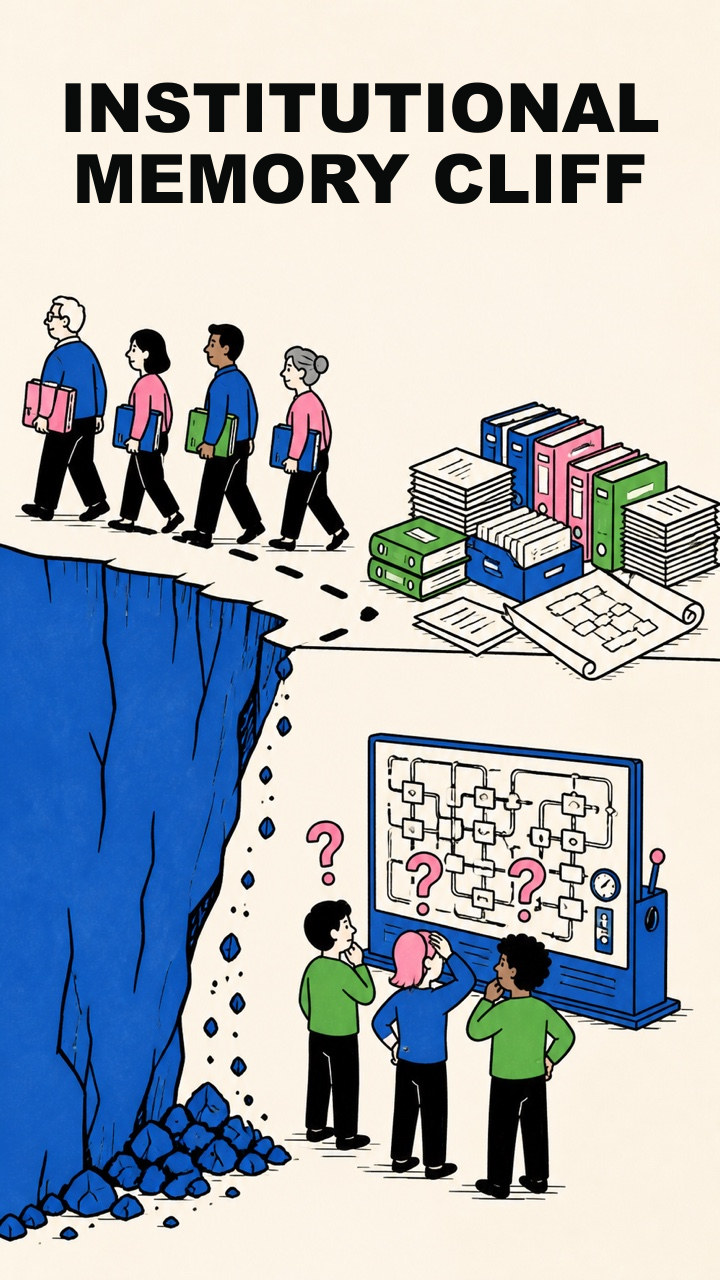
A sudden loss of operational capability when enough experienced people depart that documents and systems can no longer be interpreted reliably.
- Review state
- Reviewed in POC
- Freshness
- Current
- Version
- 2
Also called
- Institutional Memory Cliff
Remember it this wayThe files remained; the ability to read the system disappeared.
In plain language
Knowledge loss may look gradual until the remaining organization can no longer explain exceptions, repair failures, or understand why records and systems work as they do. Capability then drops sharply.
Why it matters
Headcount and document counts can hide concentrated tacit knowledge. Succession, pairing, interpretation practice, and maintained context matter before departures cross the threshold.
Example
After several retirements, a plant still has its procedures and control software but no one can reliably diagnose rare shutdown sequences or explain undocumented parameter choices.
Common misconception
An institutional memory cliff is not solved by having documents. The organization must retain enough capability to interpret and use them.
Related terms
Sources
- U.S. Government Accountability Office, National Institute of Standards and Technology: Improved Workforce Planning Needed to Address Recruitment and Retention Challengesfinds that a small specialized workforce holds institutional knowledge that is difficult to replace and that skills gaps can disrupt programs. This supports the mechanism behind the Renaissance Solutions term; GAO does not use the label “Institutional Memory Cliff.”
Learn more
- Review with [[ownership-gap|Ownership Gap]] and [[workaround-dependency|Workaround Dependency]].