Concept dictionary
Workaround Dependency
A workaround that was put in place as a temporary fix and that other work has since come to rely on, so that removing it now would break something.
- Review state
- Reviewed in POC
- Freshness
- Current
- Version
- 3
Also called
- Workaround Dependency
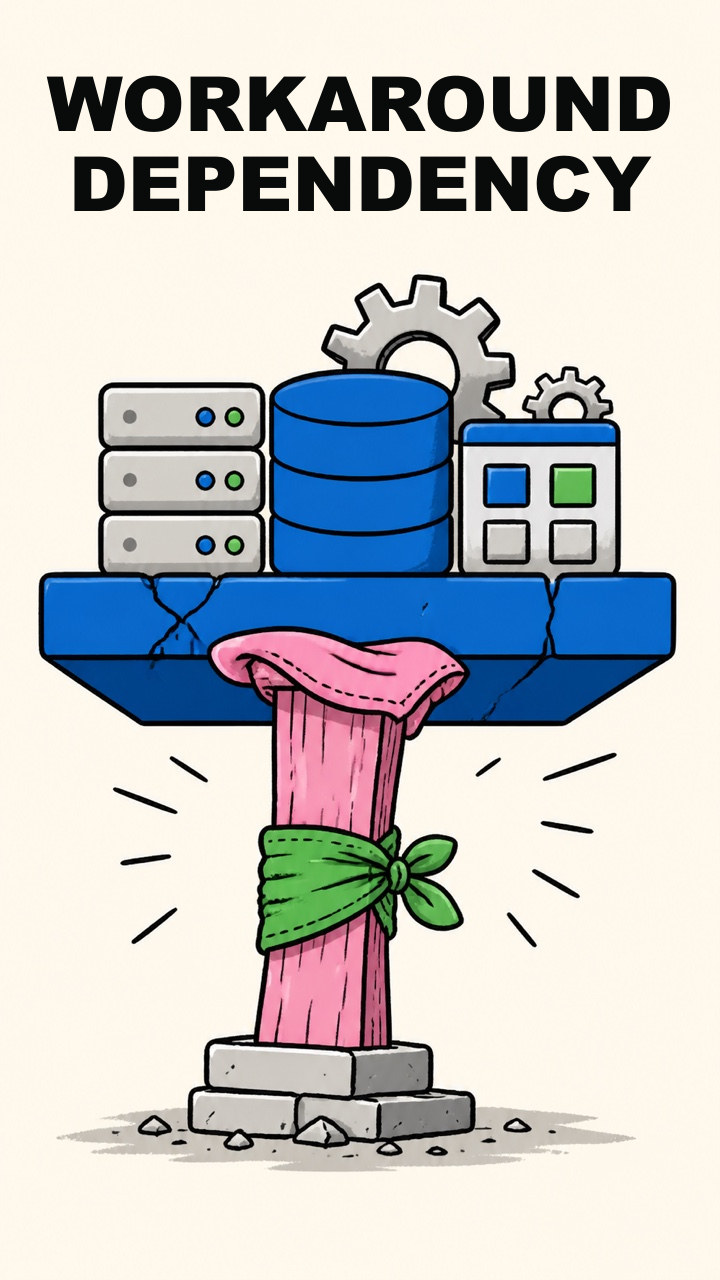
Remember it this wayTemporary became load-bearing.
In plain language
An extra step created to get past a short-term problem becomes part of how the organization delivers work. Removing it now causes failure because people, data, timing, or downstream processes rely on it.
Why it matters
A hidden dependency can be fragile, unsupported, and concentrated in a few people. Improvement work must understand what the workaround now provides before removing it.
Example
A spreadsheet created during a software outage becomes the unofficial scheduling system, and dispatch can no longer operate without its formulas and manual updates.
Common misconception
A workaround dependency is more than a workaround that has existed for a long time. Other operations now rely on the behavior or information it provides.
Related terms
Sources
- Zhenbin Yang and colleagues, “Workarounds in the use of IS in healthcare”case study of how system-process misfits create workarounds and how those accommodations affect system efficiency and effectiveness over time.
- Agency for Healthcare Research and Quality, Guide to Reducing Unintended Consequences of Electronic Health Recordsdocuments recurring workarounds around health-IT blocks and recommends deciding whether to redesign the system or formally accommodate an effective workaround. These sources support the persistence and operational-risk mechanism behind the Renaissance Solutions term; neither uses the label “Workaround Dependency.”
Learn more
- Compare with [[workaround|Workaround]] and [[manual-reconciliation|Manual Reconciliation]].