Concept dictionary
Operational Slack
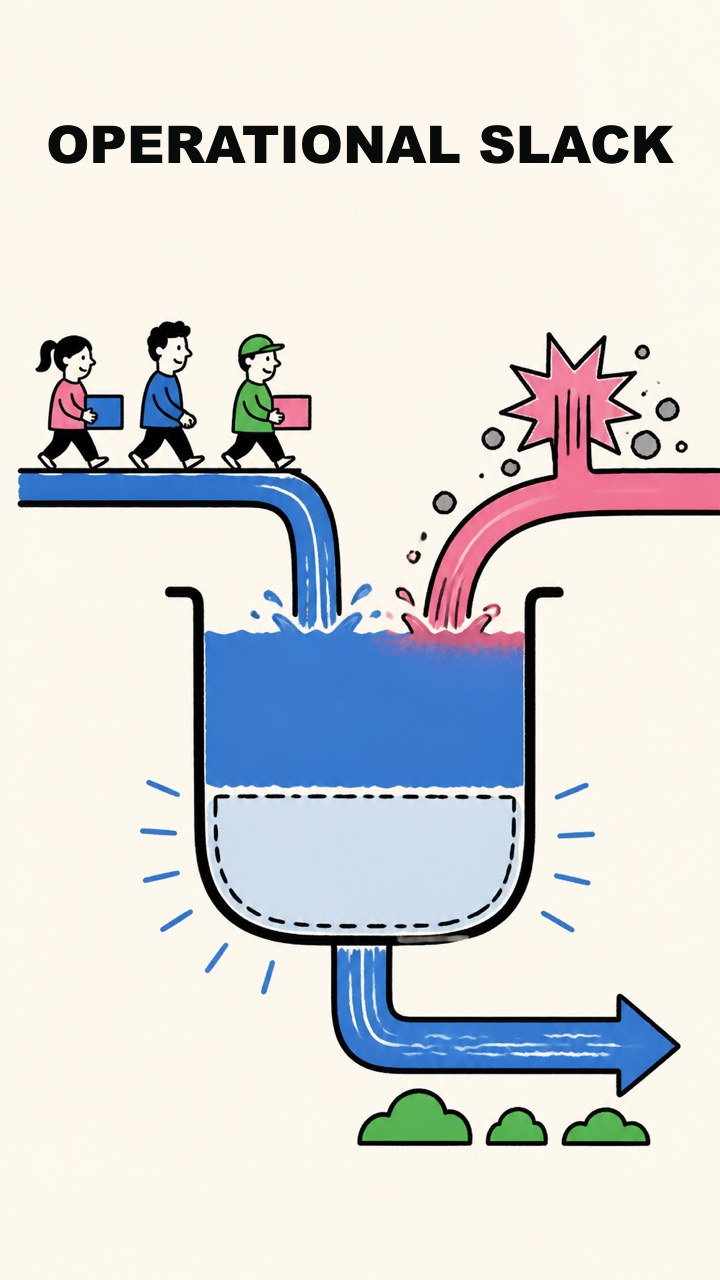
The reserve capacity of time, people, energy, inventory, or decision space that allows a system to absorb surprises.
- Review state
- Reviewed in POC
- Freshness
- Current
- Version
- 2
Also called
- Operational Slack
Remember it this wayRoom to absorb the unexpected.
In plain language
A system has room to respond when something takes longer, demand rises, equipment fails, or new information appears. Slack can exist in schedules, staffing, stock, power, attention, or authority.
Why it matters
Systems optimized to use every resource under expected conditions can become brittle under variation. Deliberate reserve capacity supports adaptation and recovery.
Example
A service team keeps a portion of weekly capacity unassigned so urgent customer failures can be handled without abandoning all planned work.
Common misconception
Operational slack is not automatically waste. Its value appears when variability or surprise would otherwise cause delay, overload, or failure.
Related terms
Sources
- Milad Baghersad and Christopher W. Zobel, “Organizational Resilience to Disruption Risks”empirically tests how maintaining operational slack affects different measures of disruption loss and recovery.
- Dominic Essuman and colleagues, “Linking resource slack to operational resilience”finds that resource slack contributes to resilience through organizational attention rather than as an automatic direct effect. These studies support the mechanism behind the term while preserving the important caveat that slack alone does not guarantee resilience.
Learn more
- Evaluate alongside [[bottleneck|Bottleneck]] and [[system|System]].