Concept dictionary
Synchronization Cascade
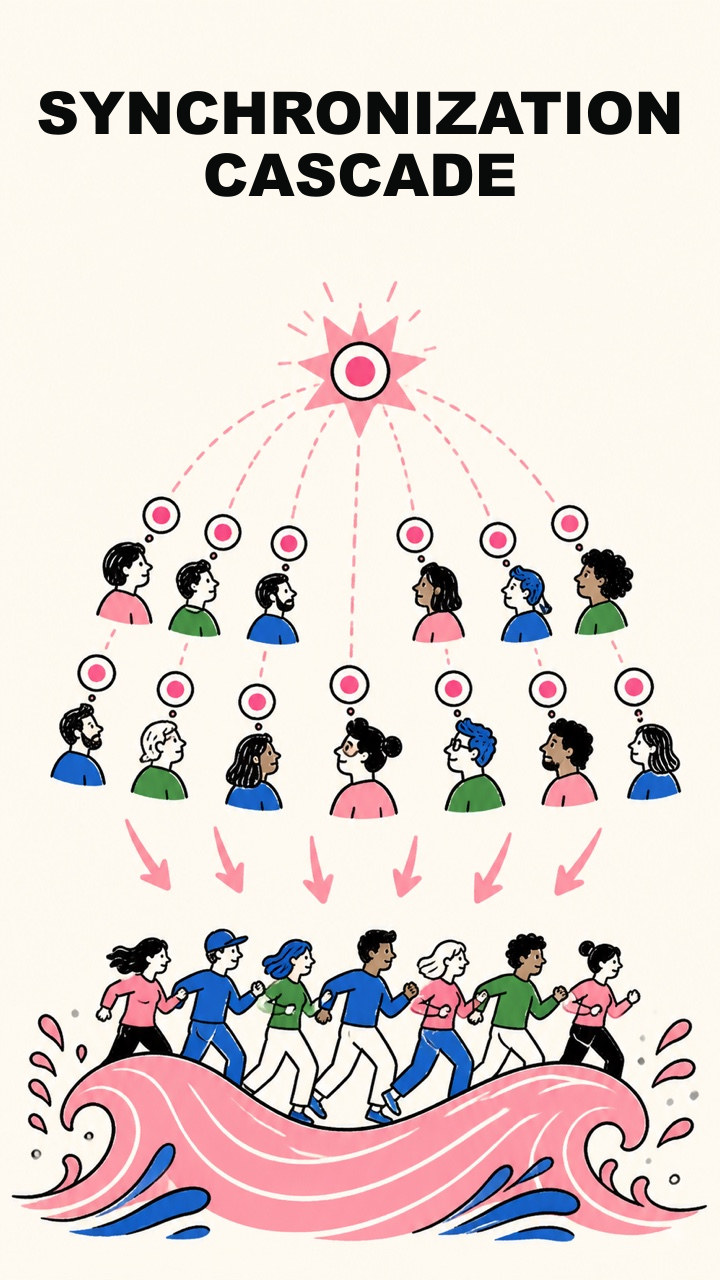
A synchronization cascade is a surge of same-direction behavior that happens when many independent actors read the same signal at nearly the same time and each reaches the same conclusion about an opportunity or a risk. Nobody coordinates; the timing does the work. Related ideas go by other names elsewhere — information cascades and herd behavior in economics, the thundering herd problem in computing.
- Review state
- Reviewed in POC
- Freshness
- Current
- Version
- 3
Also called
- Synchronization Cascade
Remember it this wayMany actors see the same signal and move together.
In plain language
Many independent actors receive similar signals and make similar decisions close together. Their combined response can amplify demand, withdrawal, congestion, or instability.
Why it matters
Individually reasonable actions can create collective surges. System planning must consider correlated interpretation, not only independent average behavior.
Example
Many automated buyers interpret the same alert as a shortage signal and place orders at once, overwhelming inventory and logistics.
Common misconception
A synchronization cascade does not require a central coordinator or explicit agreement. Shared signals and similar decision rules can produce coordination.
Related terms
Sources
- Sushil Bikhchandani, David Hirshleifer, and Ivo Welch, “A Theory of Fads, Fashion, Custom, and Cultural Change as Informational Cascades”models how observing earlier actions can produce rapid same-direction behavior and fragile mass outcomes.
- Linux manual page, `epoll_ctl(2)`documents the thundering-herd case in which one event wakes multiple waiting processes and the exclusive-wakeup mechanism used to reduce it. These sources ground the social and technical mechanisms combined in the Renaissance Solutions term; neither uses the label “Synchronization Cascade.”
Learn more
- Contrast with [[distributed-commitment|Distributed Commitment]] and [[race-condition|Race Condition]].