Concept dictionary
System
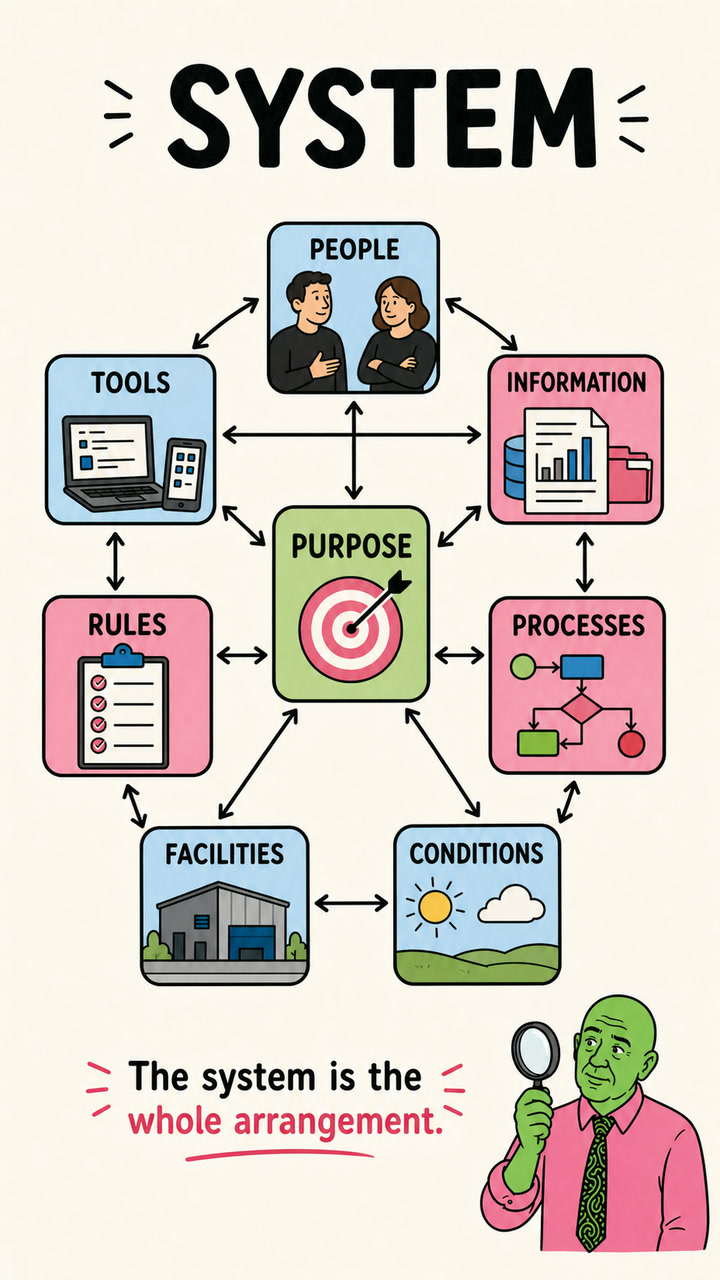
A system is a set of interacting components organized to achieve a purpose.
In a work setting, those components can include people, tools, information, rules, processes, facilities, and surrounding conditions.
- Review state
- Reviewed in POC
- Freshness
- Current
- Version
- 3
Also called
- systems
- system
Remember it this wayThe system is the whole arrangement.
In plain language
A system is the whole arrangement, not just the technology.
An application or spreadsheet may be one element, but the system also includes the people who use it, the information moving through it, the rules shaping decisions, and the relationships among those parts.
Why it matters
Many problems arise from interactions between elements rather than from one broken part.
Changing a tool without considering people, information, rules, and connected processes may move the friction somewhere else instead of resolving it.
Example
A scheduling system may include customers, office staff, technicians, email, a CRM, a spreadsheet, availability rules, service information, and the handoffs connecting them.
Common misconception
In everyday conversations, “system” often means an application or platform.
Here, a tool can be part of a system, but the system is the wider arrangement of interacting elements that produces the outcome.
Related terms
Sources
- NIST CSRC Glossary, “system”interacting elements organized to achieve a purpose; examples include hardware, software, data, humans, processes, facilities, and materials.
- NASA Systems Engineering Handbook, “Fundamentals of Systems Engineering”a combination of elements that functions together to produce a needed capability.