Concept dictionary
Process
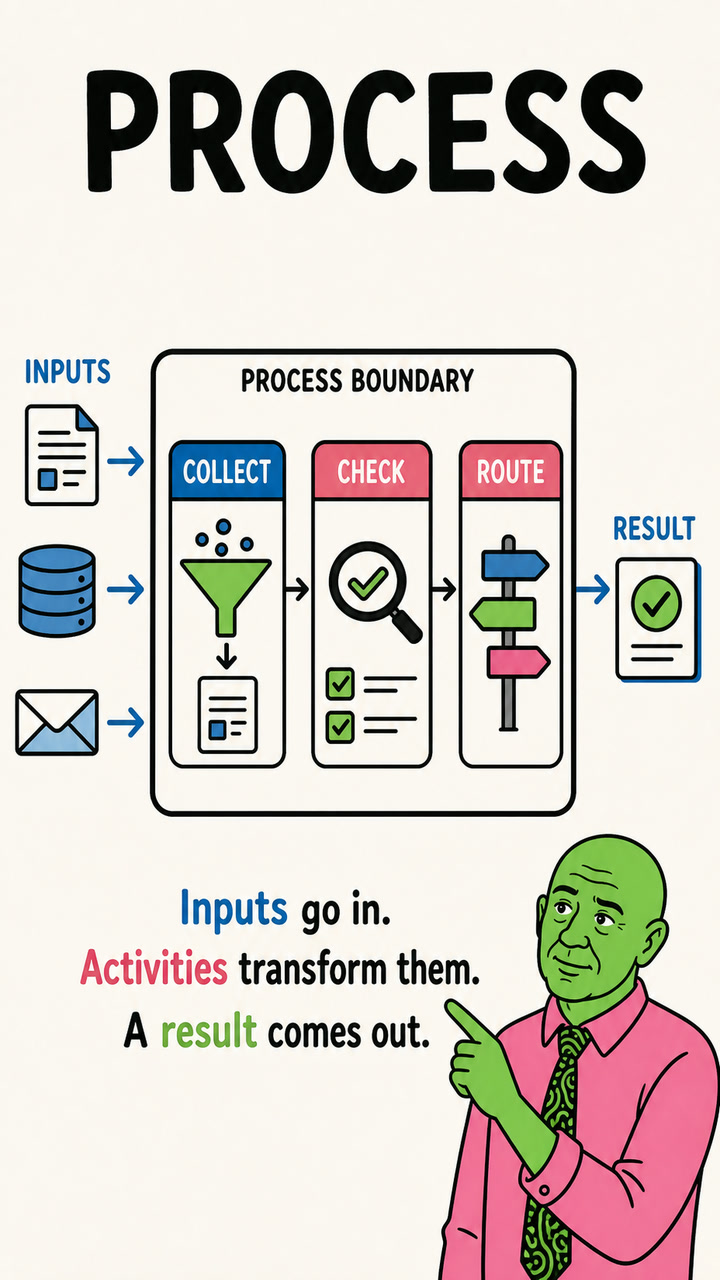
A process is a set of related activities that uses or transforms inputs to produce a result.
- Review state
- Reviewed in POC
- Freshness
- Current
- Version
- 3
Also called
- business process
- process
Remember it this wayInputs go in. Activities transform them. A result comes out.
In plain language
A process groups the activities needed to accomplish a purpose.
It gives the work a boundary: what starts it, which activities transform the inputs, and what result marks completion.
Why it matters
A process gives us a stable unit for understanding and improving work.
Once we know the process boundary and intended transformation, we can follow the workflow to see how particular work actually travels through the larger system.
Example
A service-request intake process begins when a customer asks for help. Information is collected, checked, and routed. The process ends when the request is assigned, scheduled, or declined.
Common misconception
A process is not the same as a workflow or a system.
The process describes related activities that transform inputs into a result. The workflow follows the operational path work takes. The system is the larger arrangement of interacting elements that enables and constrains both.
Related terms
Sources
- ISO 9000:2026, “process”a set of interrelated or interacting activities that uses or transforms inputs to deliver a result.
- ISO/IEC 33001:2015, “process”activities that transform inputs into outputs; see section 3.1.6.