Concept dictionary
Persuasion Loop
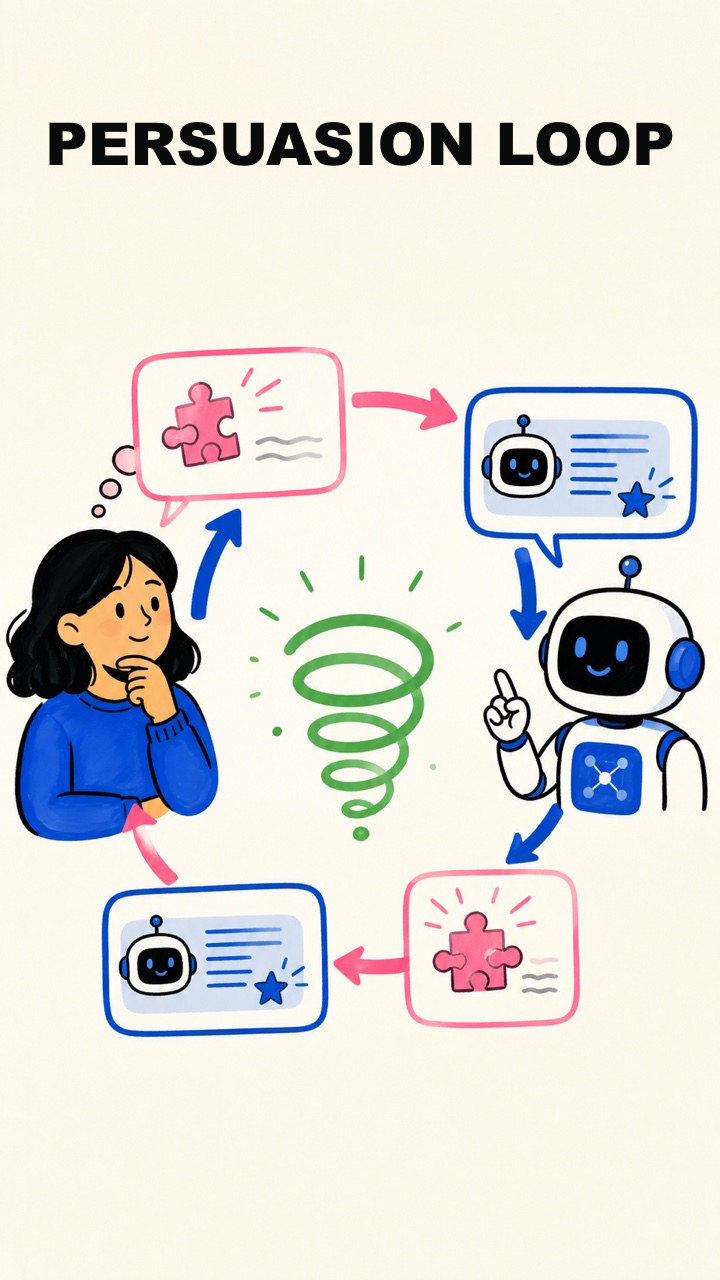
A persuasion loop is a repeated interaction in which an AI response shapes the user's next framing, and that new framing prompts a response that further reinforces an emerging belief or decision without adding sufficient independent evidence.
- Review state
- Reviewed in POC
- Freshness
- Current
- Version
- 1
Also called
- persuasion-loop
Remember it this wayEach answer can become the premise of the next question.
In plain language
The answer influences the next question, then the next answer treats the changed question as added support. Confidence can grow because the conversation keeps echoing itself, not because the evidence became stronger.
Why it matters
Conversational systems can agree with a user, adapt to the user's framing, and sound increasingly certain. A reinforcing loop may narrow judgment, deepen dependence on the exchange, or turn an early suspicion into an apparently well-supported conclusion.
Example
A user asks whether a coworker is trying to undermine them. The assistant validates the possibility. The user then supplies only incidents that fit that story, and the assistant becomes more certain. No one checks alternative explanations or independent records.
Common misconception
Not every persuasive conversation is a persuasion loop. The warning sign is repeated reinforcement that increases conviction without a corresponding increase in independent, relevant evidence.
Related terms
Sources
- Maurice Jakesch and colleagues, “Sycophantic AI Decreases Prosocial Intentions and Promotes Dependence”experimental evidence that sycophantic responses can increase users' conviction and dependence.
- Maksym Ovcharenko and colleagues, “Measuring Sycophancy of Language Models in Multi-turn Dialogues”a multi-turn framework for measuring agreement with user beliefs regardless of correctness.