Concept dictionary
Confirmation Bias
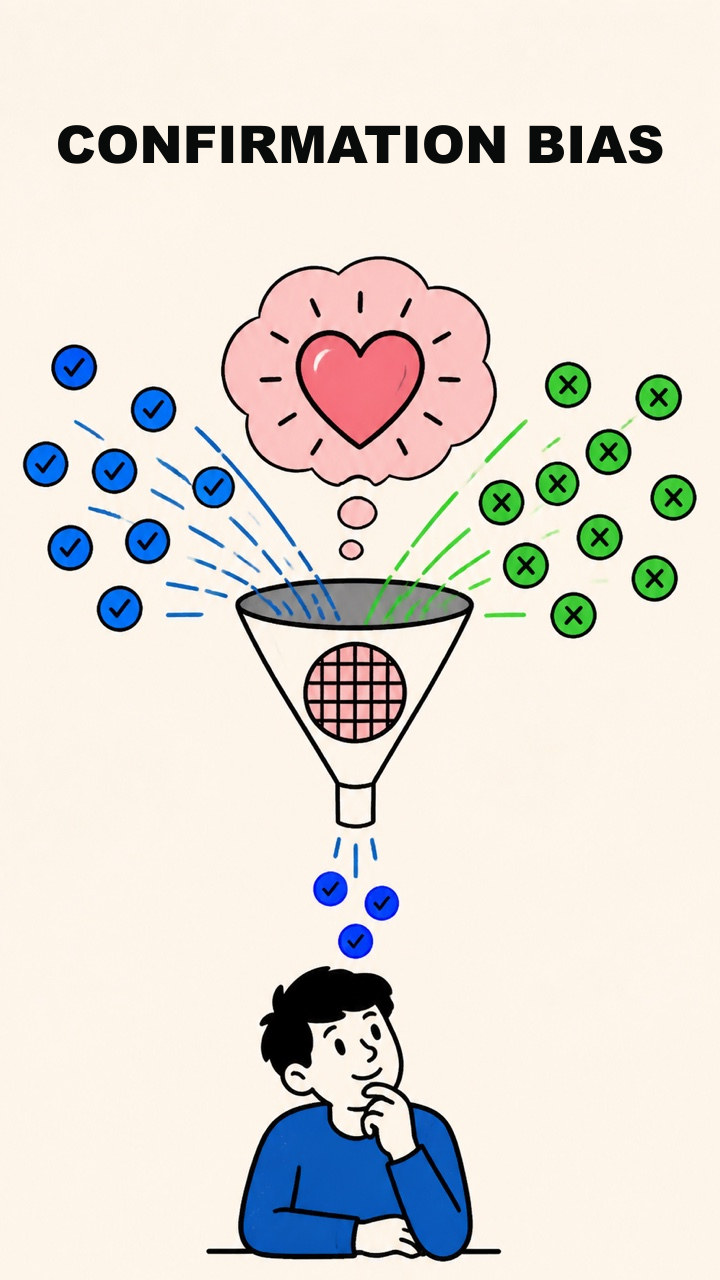
Confirmation bias is the tendency to seek, interpret, favor, or remember evidence in ways that support an existing belief while giving less weight to evidence that challenges it.
- Review state
- Reviewed in POC
- Freshness
- Current
- Version
- 1
Also called
- confirmation-bias
Remember it this wayA favored answer changes what counts as proof.
In plain language
Once an answer feels likely, supportive details become easier to notice and accept. Contradictory details may be ignored, explained away, or held to a higher standard.
Why it matters
Confirmation bias can turn research, AI-assisted analysis, and review into exercises that defend an early conclusion. Deliberately testing alternatives and looking for disconfirming evidence can improve decisions.
Example
A team prefers one vendor. It asks an AI assistant to summarize favorable reviews, treats complaints as unusual cases, and never runs the same search for competing vendors. The evidence-gathering process now protects the preferred answer.
Common misconception
Confirmation bias is not always deliberate dishonesty, and it is not limited to searching for agreeable information. It can also affect how ambiguous evidence is interpreted, weighted, and remembered.
Related terms
Sources
- Peter C. Wason, “On the Failure to Eliminate Hypotheses in a Conceptual Task”an early experimental demonstration of testing that favors confirmation rather than elimination of a hypothesis.
- Amos Tversky and Daniel Kahneman, “Judgment under Uncertainty: Heuristics and Biases”broader evidence that predictable judgment shortcuts can produce systematic errors.