Concept dictionary
Conversational Inertia
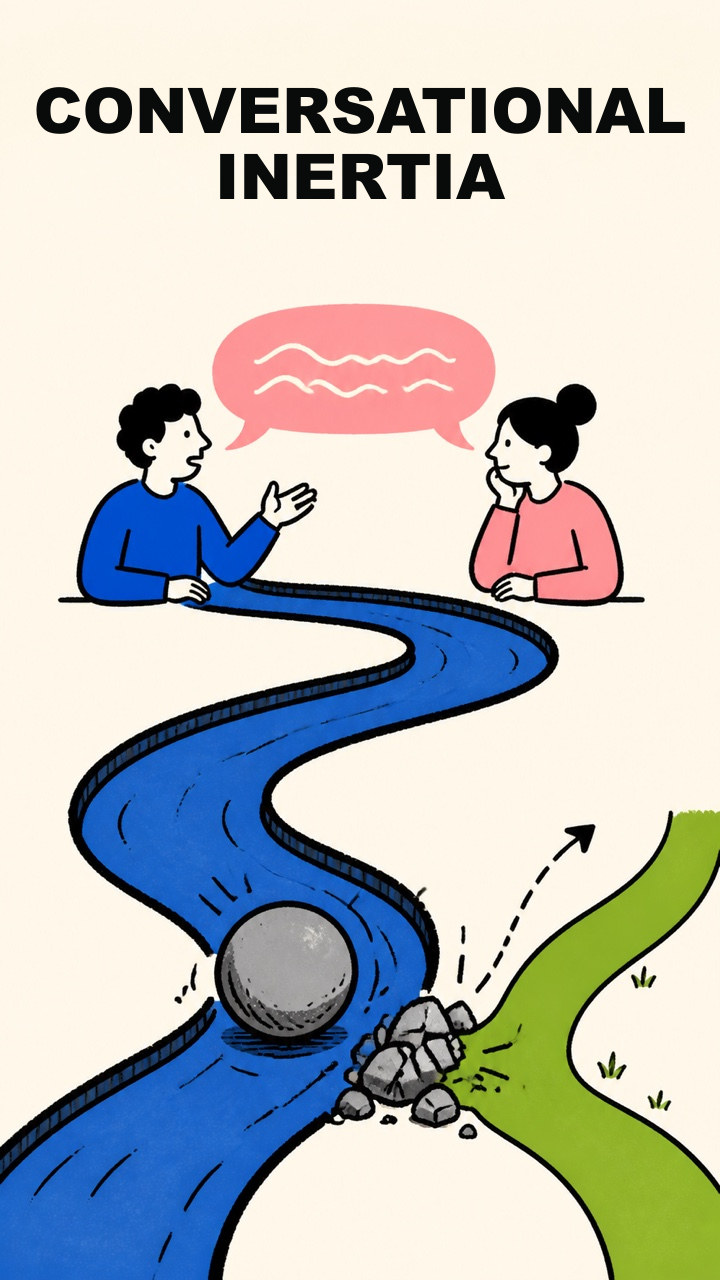
Conversational inertia is the tendency of an ongoing conversation to keep following an established frame, tone, assumptions, or direction after that pattern is no longer useful.
- Review state
- Reviewed in POC
- Freshness
- Current
- Version
- 1
Also called
- conversational-inertia
Remember it this wayThe longer the groove, the harder the turn.
In plain language
Earlier turns create a groove for later turns. A correction may be acknowledged but absorbed into the old pattern instead of causing a real reset.
Why it matters
Conversational inertia can make a model continue defending a premise, repeat a tone, or preserve an obsolete constraint. Recognizing it helps a user decide when to restate the task, open a clean thread, or return to source material.
Example
After several turns treating a delayed project as a staffing problem, the user explains that the actual cause is a vendor dependency. The assistant mentions the vendor but keeps recommending staffing changes because the earlier frame still dominates the exchange.
Common misconception
Conversational inertia is not evidence that the model remembers a user outside the current context. It describes persistence within the available conversation. Conversation drift describes movement away from the goal; inertia describes resistance to changing the established path.
Related terms
Sources
- Maksym Ovcharenko and colleagues, “Measuring Sycophancy of Language Models in Multi-turn Dialogues”multi-turn evidence that conversational context and stated user beliefs can influence later model responses.
- RS AI Learning Lab, “Escaping the Conversation Gravity Well”the Learning Lab's working account of persistent conversational framing and deliberate reset practices.