Concept dictionary
Model
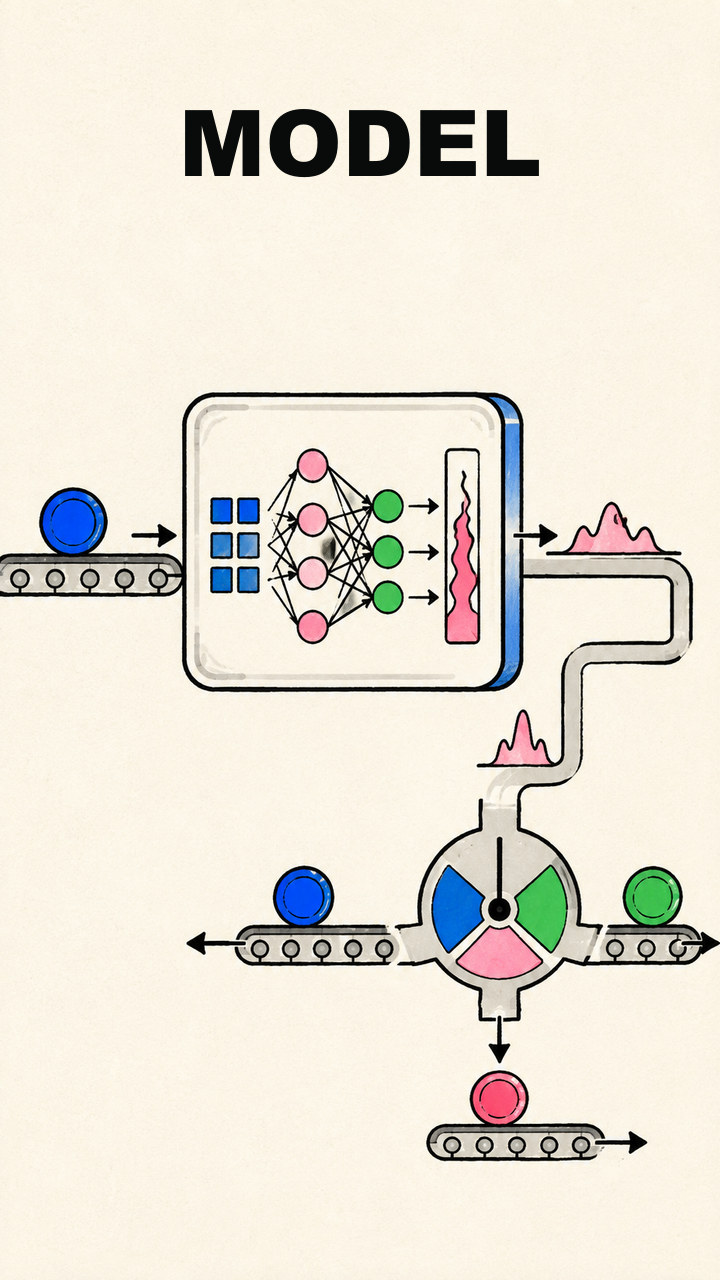
A model is the trained mathematical system that takes input and produces output, such as a classifier, generator, or language model.
- Review state
- Reviewed in POC
- Freshness
- Current
- Version
- 2
Also called
- Model
- Machine-Learning Model
Remember it this wayTraining produces the model; the system puts it to work.
In plain language
A model is the learned mathematical component produced by training. Given an input, it calculates an output such as a score, classification, prediction, or generated sequence.
Why it matters
Using model precisely keeps it separate from the application, interface, data pipeline, and policies around it. Most real-world behavior comes from the whole system, not the model alone.
Example
A fraud-detection model receives transaction features and returns a risk score. A separate application decides whether to approve, hold, or escalate the transaction.
Common misconception
A model is not the complete product and does not contain a literal copy of every training example. It is one learned component inside a larger system.
Related terms
Sources
- Google for Developers, “Machine Learning Glossary”provides established boundaries for core machine-learning vocabulary.
- NIST, “The Language of Trustworthy AI”provides a use-case-neutral vocabulary foundation for AI and machine learning.
Learn more
- Compare [[machine-learning|Machine Learning]], [[training|Training]], [[parameters|Parameters]], and [[system|System]] to place Model in the surrounding system.
- Follow the cited source material above for the method, standard, or research context behind this draft.