Concept dictionary
Machine Learning
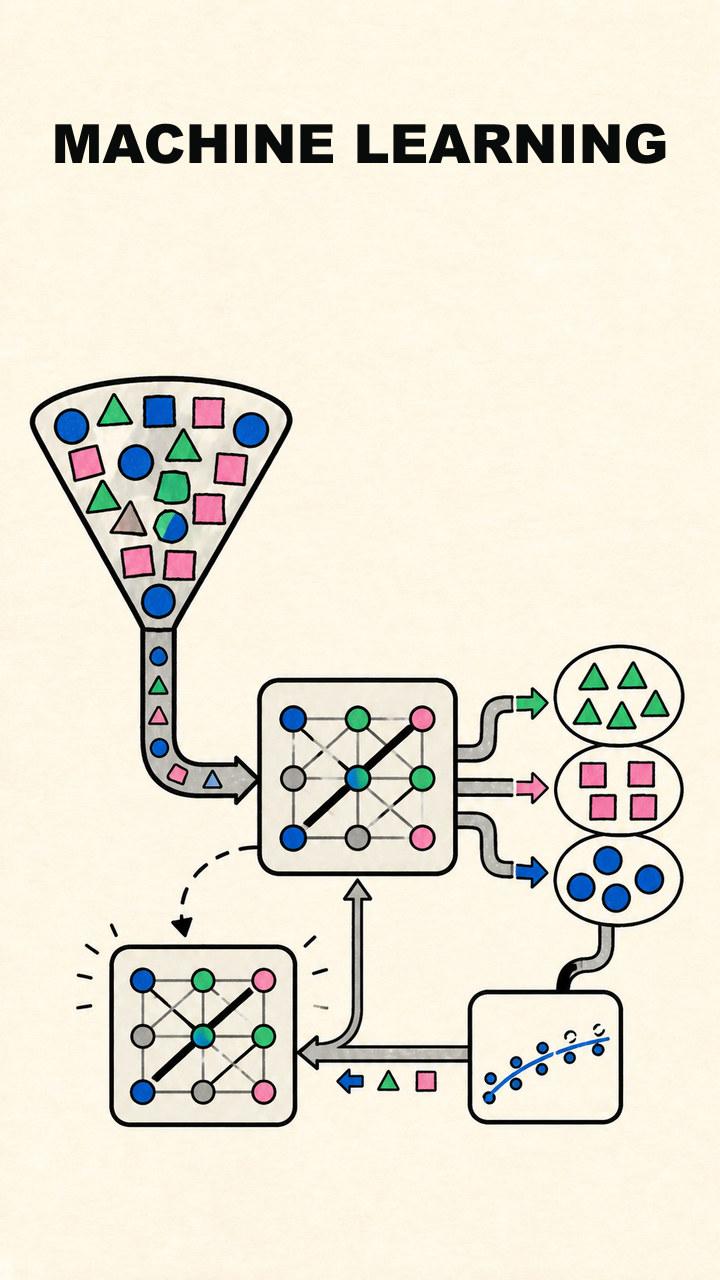
Machine learning is an approach to building computer systems that learn patterns from data so they can make predictions, classifications, recommendations, or other outputs without a programmer specifying every case as a separate rule.
- Review state
- Reviewed in POC
- Freshness
- Current
- Version
- 2
Also called
- Machine Learning
- ML
Remember it this wayRules describe cases; machine learning learns patterns from examples.
In plain language
Instead of writing an instruction for every possible situation, people provide examples, objectives, and a learning process. The resulting model applies what it learned to new inputs, with results that still require testing and oversight.
Why it matters
Many products called AI rely on machine learning. Knowing the term helps teams ask what data shaped the model, what task it was trained to perform, and how well its behavior transfers to real use.
Example
A retailer trains a model on earlier transactions so it can estimate which products a customer may want to see next.
Common misconception
Machine learning does not mean a system understands a subject as a person does. It means the system adjusted internal values to perform a measured task from patterns in data.
Related terms
Sources
- NIST, Adversarial Machine Learning: A Taxonomy and Terminology of Attacks and Mitigations (NIST AI 100-2 E2025)current NIST machine-learning taxonomy, terminology, lifecycle, and methods.
- NIST, Artificial Intelligence Risk Management Framework 1.0authoritative risk-management context for AI systems trained from data and used to generate predictions, recommendations, or decisions.
Learn more
- Compare the broader category [[artificial-intelligence|Artificial Intelligence (AI)]] with the learning process described by [[training-data|Training Data]].