Concept dictionary
Model Risk Management
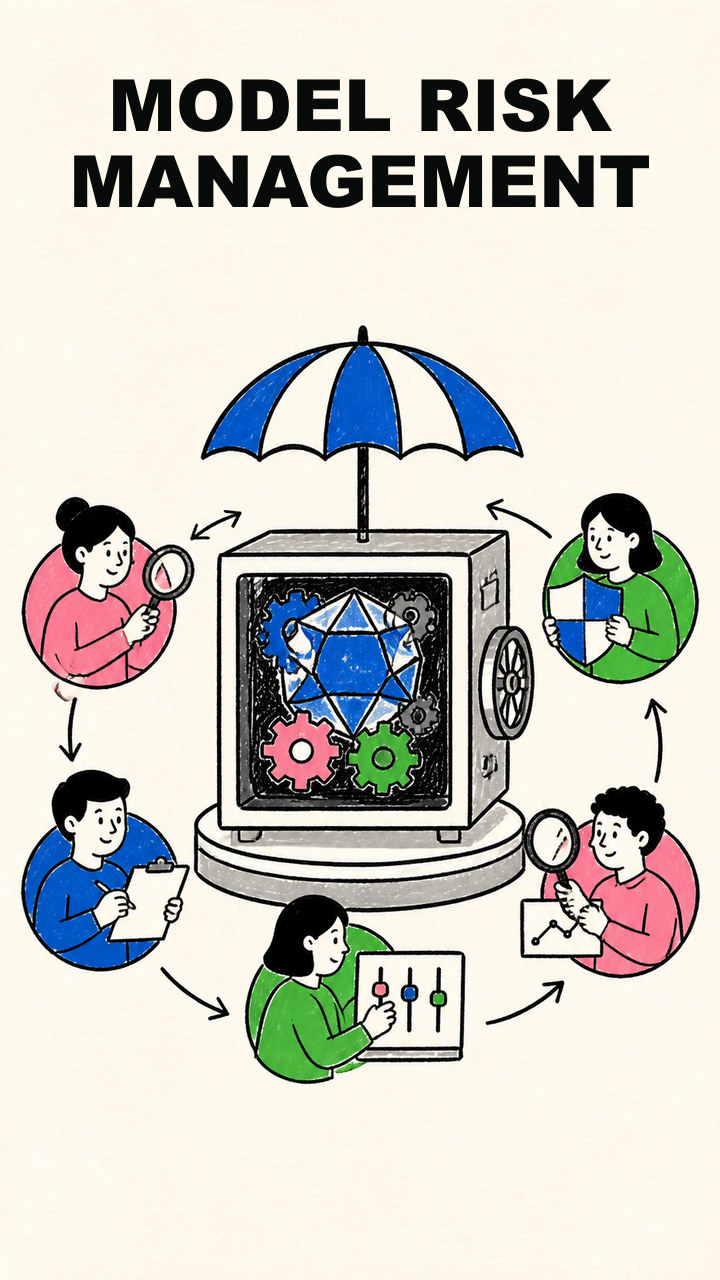
Model risk management is the discipline of identifying, assessing, controlling, validating, monitoring, and governing risks created when decisions depend on models.
- Review state
- Reviewed in POC
- Freshness
- Current
- Version
- 2
Also called
- Model Risk Management
- MRM
Remember it this wayManage the risk of relying on the model across its whole life.
In plain language
MRM treats a model as something that can be wrong, misused, misunderstood, or become unsuitable over time. It establishes lifecycle responsibilities and evidence for deciding whether reliance is acceptable.
Why it matters
AI systems can expand model use beyond traditional quantitative settings. Organizations need risk practices that account for both the model and its surrounding workflow.
Example
A bank independently validates a credit model, documents limitations, monitors performance, controls changes, and defines escalation when thresholds are crossed.
Common misconception
Model risk management is not only a one-time accuracy test. It includes intended use, implementation, governance, monitoring, change, and retirement.
Related terms
Sources
- Federal Reserve, SR 26-2: Supervisory Guidance on Model Risk Managementcurrent U.S. Federal Reserve supervisory guidance on model-risk governance, validation, and controls.
Learn more
- Connect lifecycle controls to [[model-drift|Model Drift]] and [[independent-verification|Independent Verification]].