Concept dictionary
Comprehension Debt
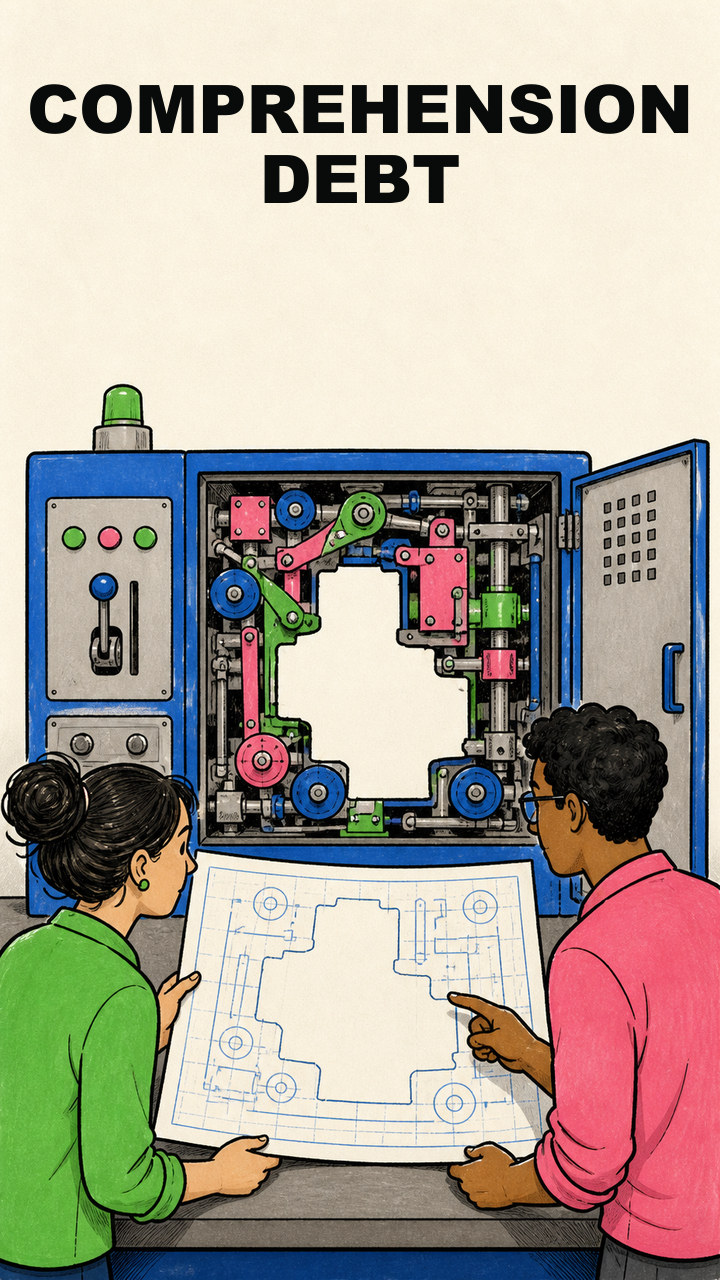
The gap between what a team understands and what it must understand to maintain or change its system.
- Review state
- Reviewed in POC
- Freshness
- Current
- Version
- 1
Also called
- Comprehension Debt
Remember it this wayThe system changed faster than the team's understanding.
In plain language
Comprehension debt grows when a team can keep producing or accepting changes faster than it builds shared understanding of the system. The code may run, but the team cannot explain enough of its behavior, dependencies, or assumptions to modify it with confidence. GenAI can widen the gap when generated work is accepted without learning how it fits.
Why it matters
A team that does not understand its system may miss context mismatches, accept black-box changes, bypass verification, or lose the ability to judge future modifications. The risk sits in collective understanding rather than only in the code. The cited study observed this pattern in one undergraduate software-engineering setting, so broader use of the term should remain a working hypothesis rather than a universal empirical conclusion.
Example
A student team accepts AI-generated code that adds a library none of them has used. The feature passes its first test, but no one can explain the dependency or trace a later failure across it. The code change may also create technical debt, but the team's missing shared understanding is comprehension debt.
Common misconception
Comprehension debt is not identical to Technical Debt. Technical debt resides in a design or construction context that raises later change cost. Comprehension debt resides in the gap between the team's knowledge and the understanding the work requires. The two can accumulate together.
Related terms
Sources
- [Muhammad Ovais Ahmad, “Comprehension Debt in GenAI-Assisted Software Engineering Projects”](https://arxiv.org/abs/2604.13277), 2026 — defines the gap in collective team understanding, distinguishes it from traditional technical debt, and reports four accumulation patterns plus one mitigating pattern. The qualitative study used 621 reflective diaries from 207 students during one eight-week undergraduate software-engineering project; the glossary does not treat that setting as universal proof.
Learn more
- [Read the cited Comprehension Debt paper](https://arxiv.org/abs/2604.13277).
- Pair [[cognitive-offloading|Cognitive Offloading]] with [[human-ownership|Human Ownership]] and [[verification|Verification]] when deciding what understanding the team must retain.