Concept dictionary
Cognitive Offloading
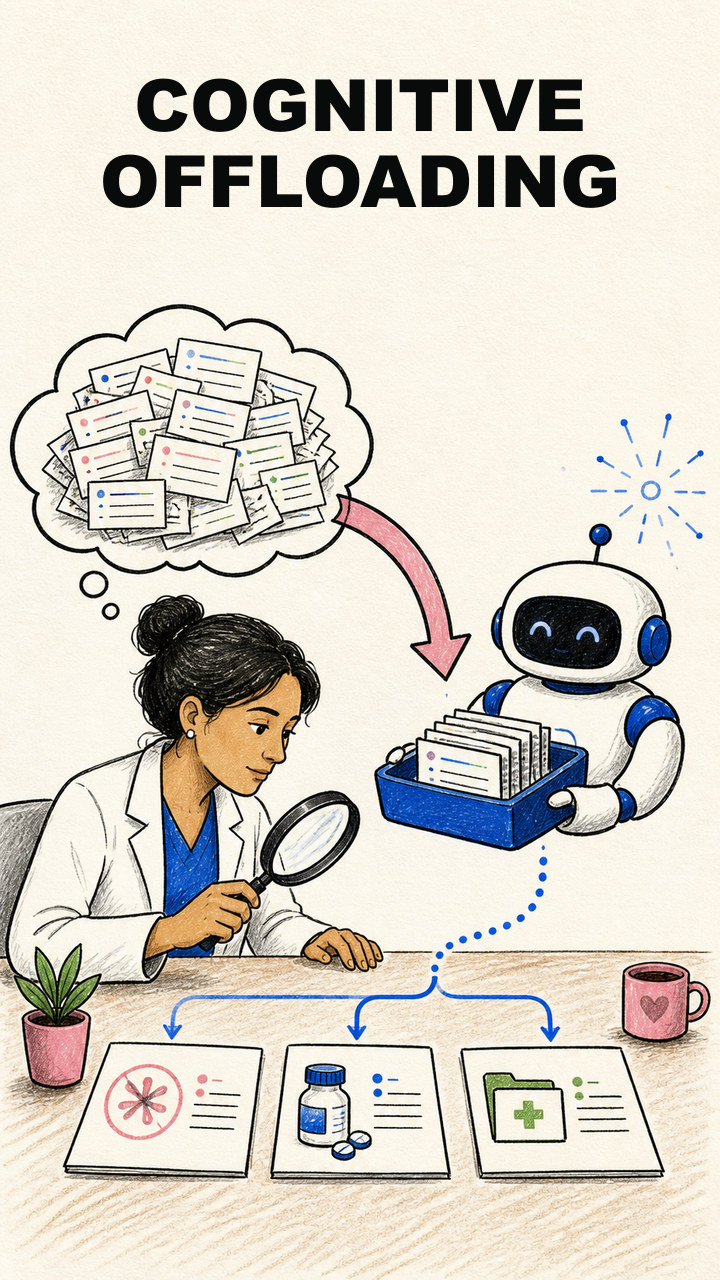
Cognitive offloading is using an external action, object, or tool to change a task so that less mental processing is required from the person doing it.
- Review state
- Reviewed in POC
- Freshness
- Current
- Version
- 1
Also called
- Cognitive Offloading
Remember it this wayMove part of the thinking into the world; keep responsibility for the result.
In plain language
People offload cognition when they write a reminder, use a calculator, organize notes, or ask an AI to hold, retrieve, transform, or draft information. The tool becomes part of how the task gets done, reducing what the person must keep or process internally.
Why it matters
Offloading can free attention for higher-value judgment and make difficult work manageable. It can also weaken learning, memory, error detection, or situational understanding when people hand away the very process they need in order to judge the result.
Example
A clinician uses AI to summarize a long record so attention can focus on the current decision. The clinician still opens the cited sections for allergies, medications, and prior diagnoses because those details are necessary to catch a dangerous summary error.
Common misconception
Cognitive offloading is not inherently lazy or harmful. Human thinking has always used external aids. The risk depends on what is offloaded, whether the aid is reliable, and whether the person retains the knowledge and responsibility needed to evaluate the outcome.
Related terms
Sources
- Risko and Gilbert, “Cognitive Offloading”defines cognitive offloading as using physical action to alter a task's information-processing requirements and reviews its triggers and consequences.
- Risko and Gilbert, full-text author copyprovides the authors' detailed metacognitive framework for the benefits and possible misuse of offloading.
Learn more
- Pair useful offloading with [[human-ownership|Human Ownership]] and a deliberate [[human-review|Human Review]] step.
- Watch for the point where convenience becomes [[ai-overreliance|AI Overreliance]].