Concept dictionary
Chaotic Process
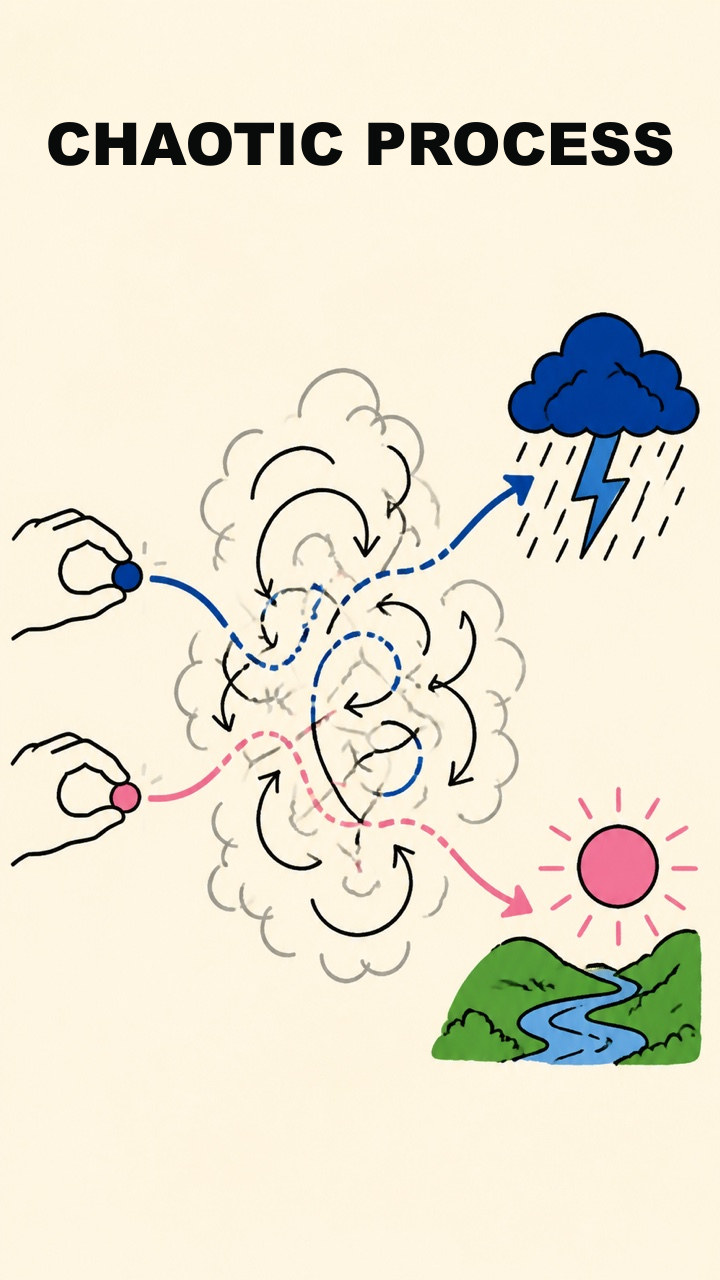
A chaotic process is a deterministic process whose behavior is highly sensitive to initial conditions, so small differences in the starting state can grow into large differences in later outcomes.
- Review state
- Reviewed in POC
- Freshness
- Current
- Version
- 1
Also called
- chaotic-process
Remember it this wayDeterministic rules can still outrun prediction.
In plain language
The process follows rules rather than choosing outcomes at random. The difficulty is that tiny starting differences can compound so rapidly that long-range prediction becomes unreliable.
Why it matters
Unpredictable results do not always imply randomness or missing rules. Distinguishing chaotic sensitivity from random variation changes what a team should measure, how far ahead it should forecast, and how much confidence it should place in a model.
Example
Two weather simulations use the same equations but begin with slightly different measurements of atmospheric conditions. Their short-term forecasts may be similar, while their longer-term forecasts diverge substantially.
Common misconception
“Chaotic” does not mean ruleless, disorganized, or random. Chaos is a technical property of some deterministic systems. A merely messy business process should not be called chaotic without evidence of sensitive dependence on initial conditions.
Related terms
- Process
- Random Process
- Stochastic Process
- System
- Observation
Sources
- Edward N. Lorenz, “Deterministic Nonperiodic Flow”the foundational demonstration of deterministic behavior with sensitive, nonperiodic outcomes in an atmospheric model.