Concept dictionary
Automaton
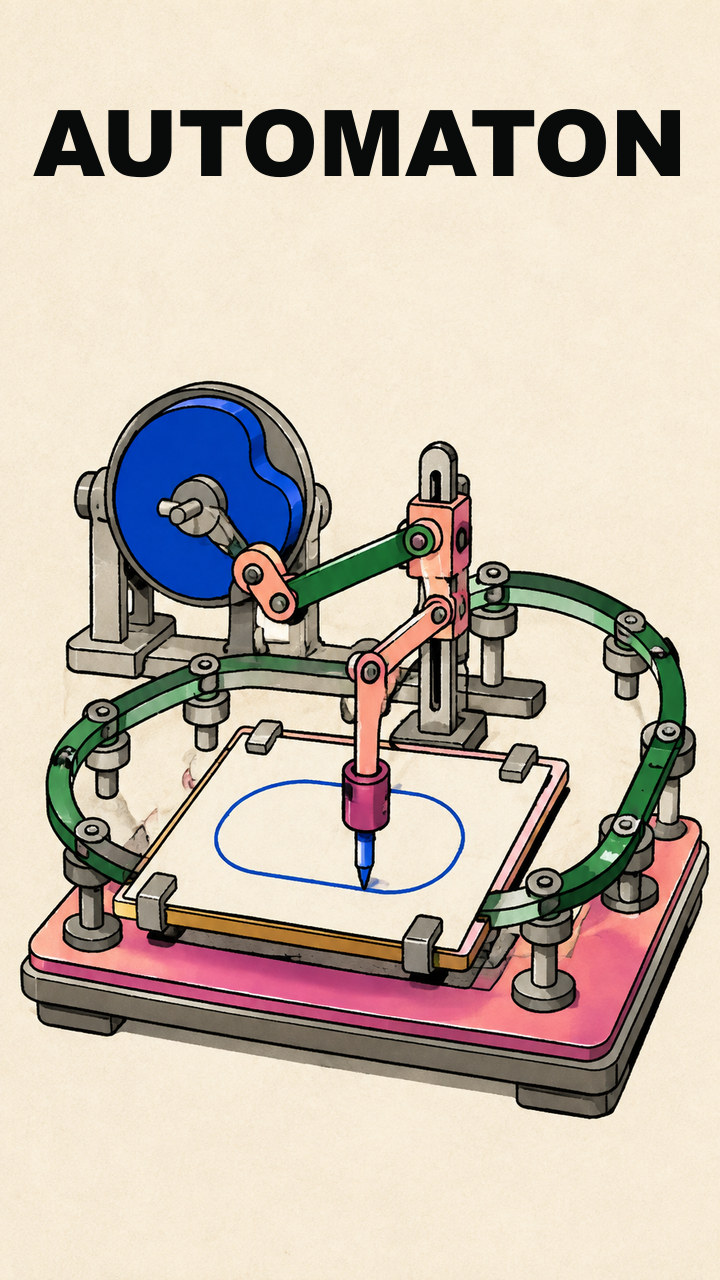
An automaton is a self-operating machine, an older word that long predates modern AI but still shapes how people talk about artificial minds and mechanical intelligence.
- Review state
- Reviewed in POC
- Freshness
- Current
- Version
- 2
Also called
- Automaton
Remember it this wayAn automaton acts from rules, not from moment-to-moment human control.
In plain language
An automaton is a machine or formal model that follows defined rules to change state and produce actions without a person directing every step. The term connects mechanical self-operating devices with later models of computation.
Why it matters
The word shows that ideas about self-operating machines predate modern AI. It also reminds us that automatic behavior can arise from fixed rules without learning, judgment, or intelligence.
Example
A clockwork figure that writes a fixed phrase is a mechanical automaton. A finite-state machine that changes state according to input symbols is a computational automaton.
Common misconception
An automaton is not necessarily a robot or an AI system. It may have no sensors, learning process, physical movement, or ability to adapt.
Related terms
Sources
- Alan Turing, “On Computable Numbers, with an Application to the Entscheidungsproblem”formalizes an automatic machine whose actions are determined by its state and scanned symbol.
Learn more
- Compare [[algorithm|Algorithm]], [[state|State]], [[autonomous-system|Autonomous System]], and [[artificial-intelligence|Artificial Intelligence (AI)]] to place Automaton in the surrounding system.
- Follow the cited source material above for the method, standard, or research context behind this draft.