Concept dictionary
Autonomous System
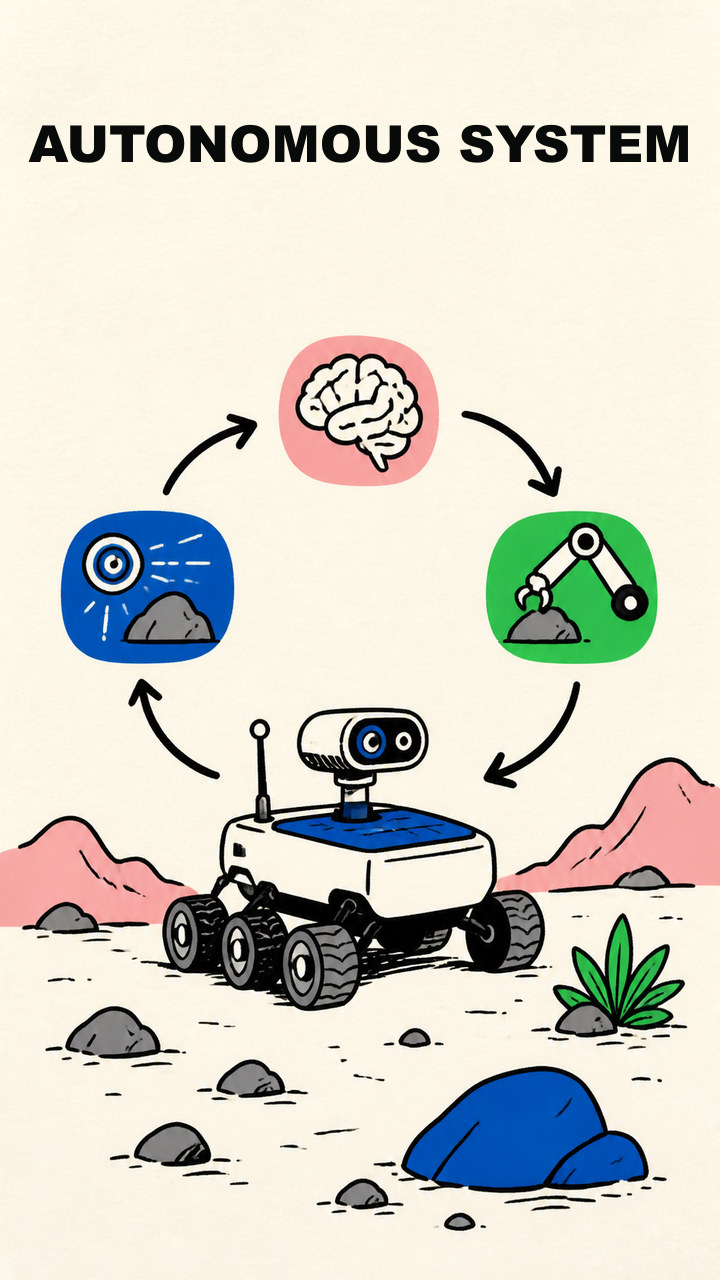
An autonomous system is a software or physical system designed to perceive conditions, make decisions, and take actions for some period without continuous human control.
- Review state
- Reviewed in POC
- Freshness
- Current
- Version
- 2
Also called
- Autonomous System
- Autonomous Systems
Remember it this wayAutonomy removes continuous control, not human responsibility.
In plain language
Autonomy is a matter of degree and scope. A system may operate independently for one bounded task while relying on people for goals, permissions, maintenance, exceptions, and accountability.
Why it matters
As continuous supervision decreases, the quality of boundaries, monitoring, fail-safe behavior, escalation, and recovery becomes more important.
Example
A warehouse vehicle navigates assigned routes and avoids obstacles on its own but stops and alerts an operator when conditions fall outside its approved envelope.
Common misconception
Autonomous does not mean unconstrained, independent of people, or responsible for its own consequences.
Related terms
Sources
- NIST, Autonomous Systemsofficial definition describing systems that use robotic or automation capabilities and advanced algorithms to select and execute actions without human intervention.
Learn more
- Define the operating boundary with [[guardrails|Guardrails]] and preserve [[human-ownership|Human Ownership]].