Concept dictionary
Loss Function
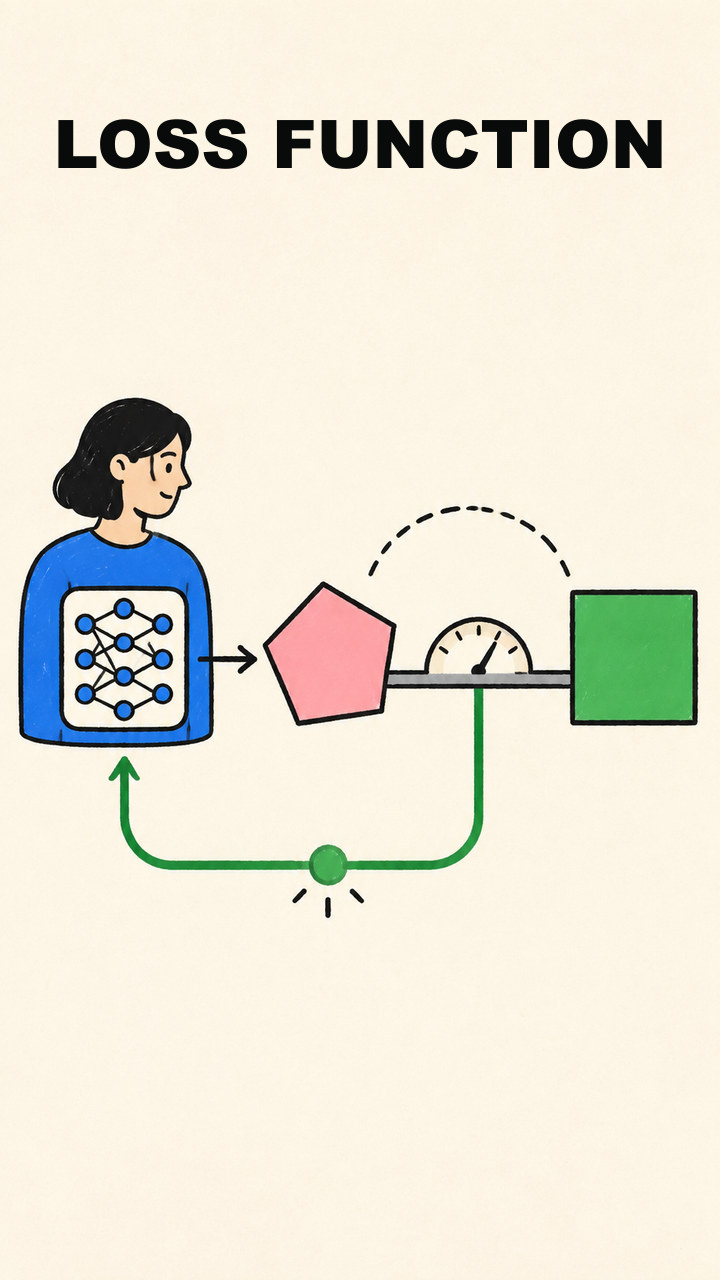
Loss is the value a model tries to reduce during training because it measures how wrong the current output is.
- Review state
- Reviewed in POC
- Freshness
- Current
- Version
- 2
Also called
- Loss Function
- Loss
- Objective Function
Remember it this wayThe loss function turns error into the signal training follows.
In plain language
A loss function converts the difference between a model’s output and the desired result into a value the training process can minimize. Different losses encode different kinds of error.
Why it matters
The loss function tells the optimizer what to reward and penalize. A poorly chosen loss can improve the training number while producing behavior that misses the real goal.
Example
A classifier uses cross-entropy loss so confident wrong predictions receive a larger penalty than correct predictions.
Common misconception
Loss is not the same as a business outcome or an evaluation metric. It is an optimization signal, and a lower training loss does not guarantee better real-world performance.
Related terms
Sources
- Google for Developers, “Machine Learning Glossary”provides established boundaries for core machine-learning vocabulary.
Learn more
- Compare [[training|Training]], [[ml-target|ML Target]], [[evaluation-metric|Evaluation Metric]], and [[parameters|Parameters]] to place Loss Function in the surrounding system.
- Follow the cited source material above for the method, standard, or research context behind this draft.