Concept dictionary
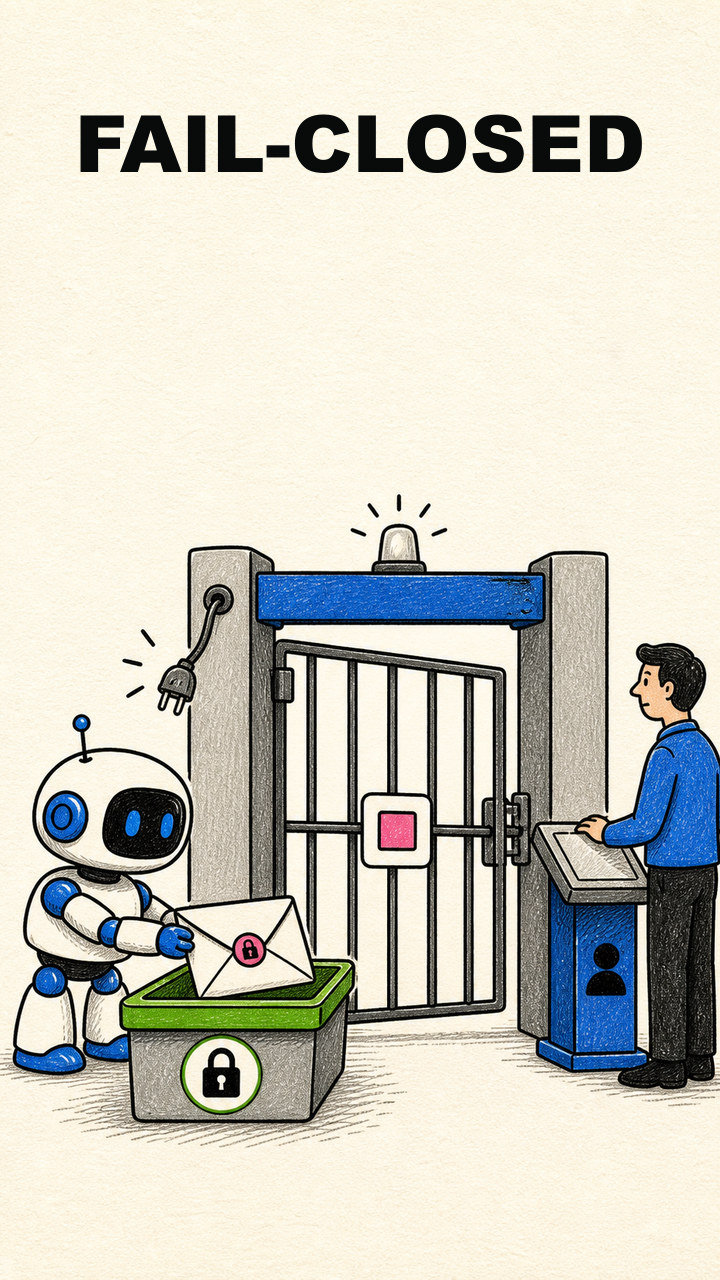
Fail-closed
A control is fail-closed when a failure, missing check, or unresolved uncertainty makes it deny, stop, or enter a restricted state instead of allowing the action to continue.
- Review state
- Reviewed in POC
- Freshness
- Current
- Version
- 1
Also called
- Fail-closed
- Fail Closed
Remember it this wayIf the check cannot say yes, the system says no.
In plain language
The system needs a valid yes before it proceeds. If a permission service is unavailable, a rule cannot be evaluated, or a required approval is missing, the safer default is to stop or reduce capability rather than assume permission.
Why it matters
AI agents can act across changing tools, identities, and data. A permissive default can turn a temporary outage or ambiguous state into an unauthorized action. A fail-closed design contains that uncertainty and creates a clear path for recovery or escalation.
Example
An AI payment agent cannot reach the service that verifies transfer authority. It does not send the payment. It places the request in a restricted queue and asks an authorized person to resolve the failed check.
Common misconception
Fail-closed is not always the safest behavior for the whole system. A locked emergency exit, unavailable medical device, or blocked recovery path can create a different danger. Designers must choose the safe failure state for the actual consequences and provide a controlled way to recover.
Related terms
Sources
- NIST CSRC, “fail secure”describes termination that preserves a secure state when a failure occurs or is detected.
- IETF, RFC 4949, Internet Security Glossary, Version 2provides the underlying security terminology for failure modes that do not compromise security.
Learn more
- Identify which operations must stop through [[guardrails|Guardrails]] and which conditions require a documented [[exception|Exception]].
- Connect fail-closed behavior to live enforcement through [[runtime-governance|Runtime Governance]].