Concept dictionary
De-Identification / Anonymization Risk
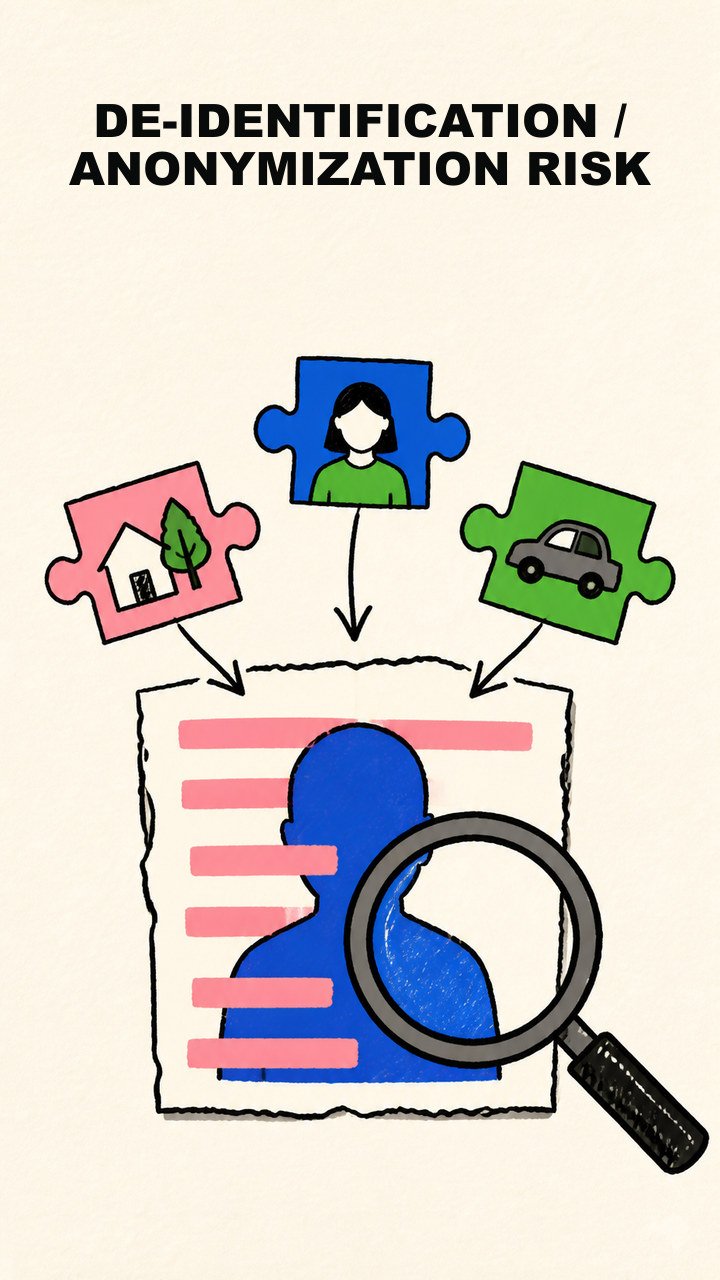
De-identification and anonymization risk is the possibility that data intended to conceal identity can still be linked back to a person through remaining attributes, outside information, or future techniques.
- Review state
- Reviewed in POC
- Freshness
- Current
- Version
- 2
Also called
- De-Identification / Anonymization Risk
- Re-Identification Risk
Remember it this wayA name can disappear while identity remains recoverable.
In plain language
Removing names may not remove identity. Dates, locations, rare characteristics, identifiers, and combinations of fields can make a record recognizable when joined with other data.
Why it matters
Privacy decisions must consider the data, likely recipients, available outside information, technical safeguards, legal standard, and consequences of re-identification.
Example
Health records without names become identifiable when unusual dates and demographic details are matched with public records.
Common misconception
De-identified and anonymous are not always interchangeable legal or technical claims, and removing direct identifiers does not eliminate all privacy risk.
Related terms
Sources
- NIST SP 800-188, De-Identifying Government Datasetsauthoritative guidance on de-identification methods and re-identification risk.
Learn more
- Compare practical sanitization with [[sanitized-information|Sanitized Information]].