Concept dictionary
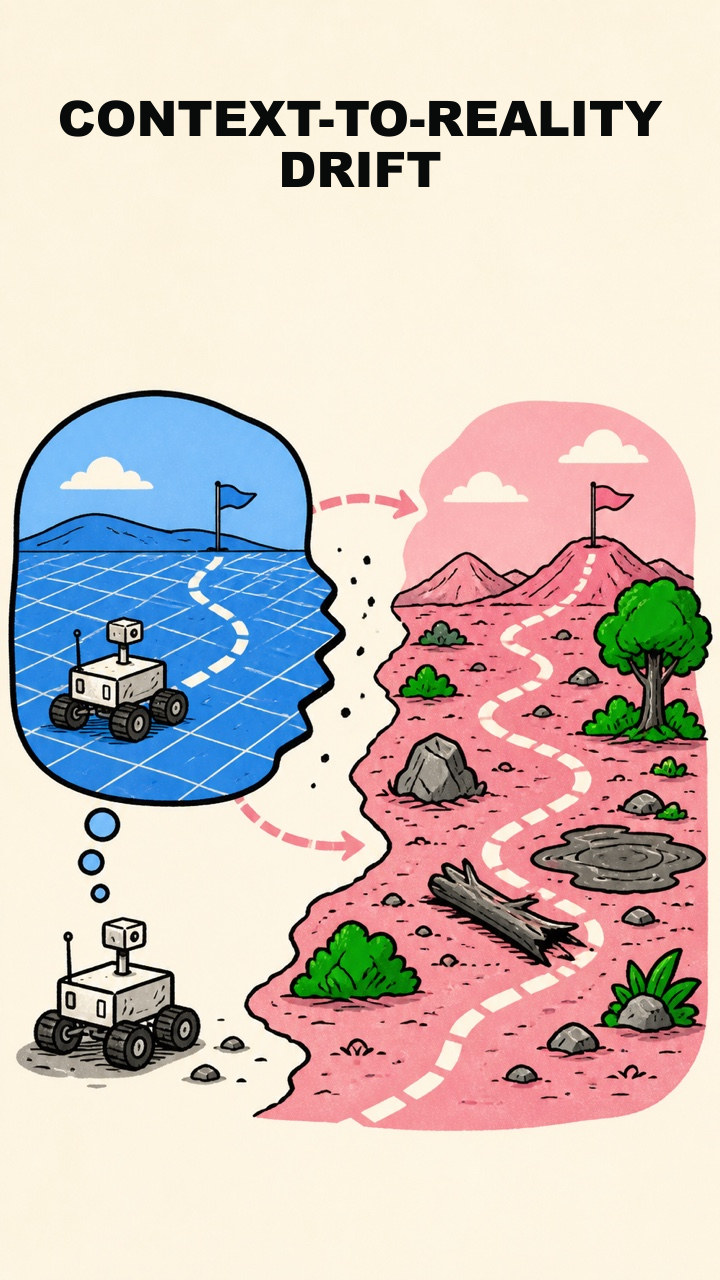
Context-to-Reality Drift
When assumptions about a simulated or planned environment no longer match the real environment.
- Review state
- Reviewed in POC
- Freshness
- Current
- Version
- 2
Also called
- Context-to-Reality Drift
Remember it this wayThe model stayed still while reality moved.
In plain language
A plan, simulation, test, or model still reflects an earlier world. Conditions, participants, constraints, or dependencies have changed, but decisions continue using the old context.
Why it matters
A correct decision inside stale assumptions can fail in reality. Teams need triggers that refresh context before relying on plans or simulations.
Example
A disaster-response simulation assumes one bridge is open, but construction closes it before the exercise plan is used during a real event.
Common misconception
Context-to-reality drift is not Context Collision. Drift is a mismatch that grows as reality changes; collision applies fictional or simulated identity to a matching real entity.
Related terms
Sources
- NIST AI Risk Management Framework 1.0requires AI risks to be mapped and managed in context across the system lifecycle rather than treated as fixed at design time.
- NASA Systems Engineering Handbook, Appendix Bdefines product validation as confirming intended use in the intended environment against baselined stakeholder expectations. These sources support the mechanism behind this Renaissance Solutions term; neither uses the label “Context-to-Reality Drift.”
Learn more
- Compare with [[current-state|Current State]], [[scenario|Scenario]], and [[context-collision|Context Collision]].