Concept dictionary
Bullshit, as Frankfurt Defines It
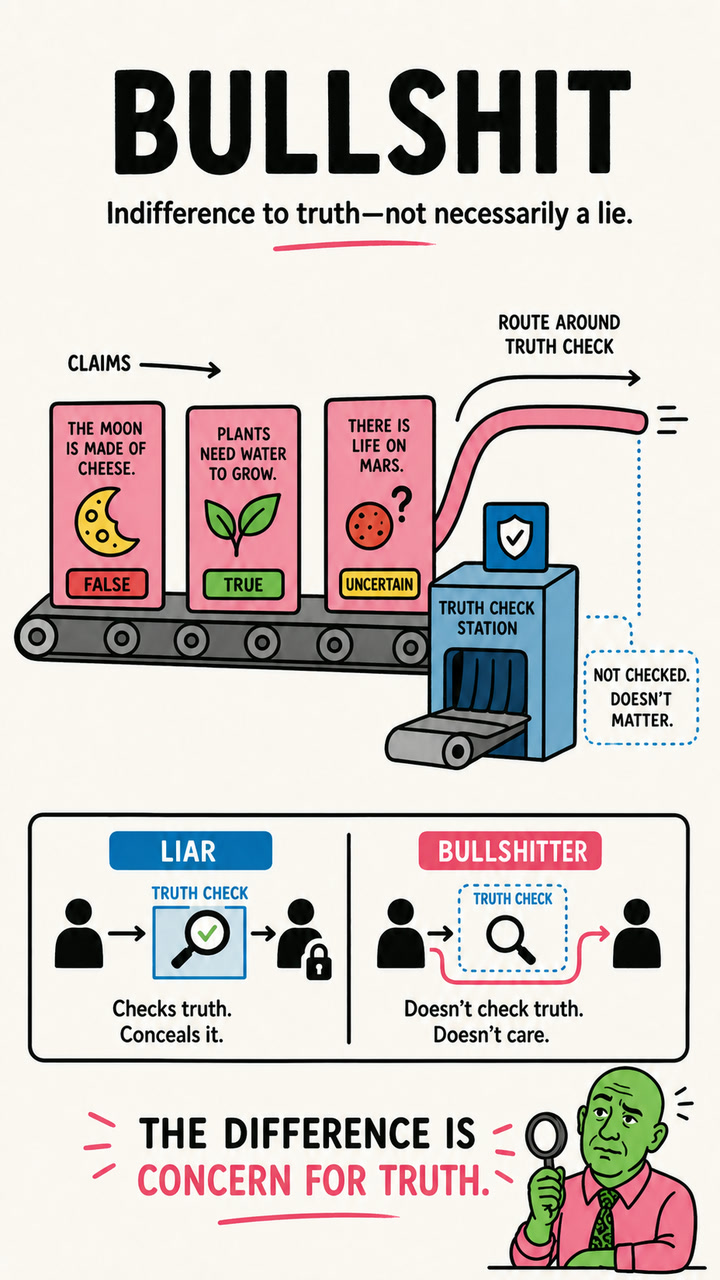
As philosopher Harry Frankfurt defines it, bullshit is speech produced without regard for whether what is said is true.
A liar tracks the truth in order to conceal it. A bullshitter may say something true, false, or uncertain because truth is not guiding the statement.
- Review state
- Reviewed in POC
- Freshness
- Current
- Version
- 2
Also called
- Bullshit
- Bullsh!t
- Frankfurtian bullshit
- Bullshit, in Frankfurt's Sense
- bullshit-frankfurt
Remember it this wayThe difference is concern for truth.
In plain language
The speaker avoids checking the claim against the truth. The statement is shaped by another purpose—such as impressing, persuading, avoiding embarrassment, or appearing informed—without first establishing whether it accurately describes reality.
Why it matters
Polished, confident language can sound trustworthy even when truth did not control how the claim was produced.
Recognizing the pattern helps us ask whether a claim was checked, what evidence supports it, and whether accuracy mattered to the person making it.
Example
A manager confidently claims that a new AI tool will cut the team's workload in half because the claim will build enthusiasm. Later, evidence shows that the team's workload has not decreased, but the manager continues repeating the claim without regard for what the evidence says.
Common misconception
Bullshit, in Frankfurt's sense, is not simply a synonym for a false statement, a mistake, or nonsense. A statement can happen to be true and still fit the concept if the speaker was indifferent to whether it accurately described reality.
This definition describes the speaker's relationship to a particular claim. It is not a judgment about the person's entire character.
Related terms
Sources
- Harry G. Frankfurt, On Bullshit (Princeton University Press, 2005), especially pages 55–56.
- Harry G. Frankfurt, “Chapter 1,” On Bullshitdigital edition and chapter citation.
- Princeton Alumni Weekly, “A bull market”contemporary overview of Frankfurt's distinction between lying and lack of concern for describing reality correctly.