Article Detail
Managing Emerging Latency Risk
When AI Freezes Time
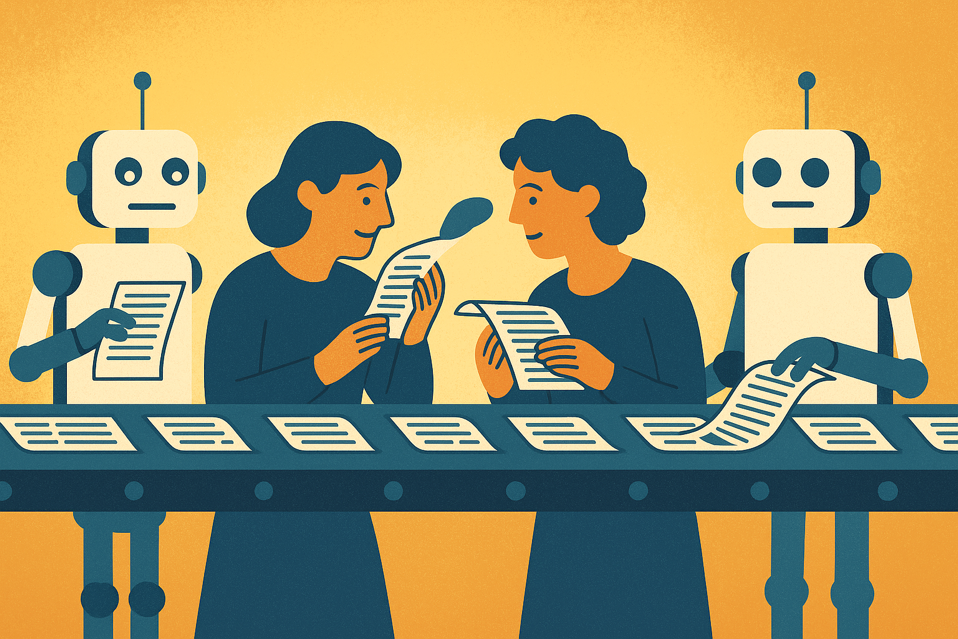
The Spark
As we integrate AI into our daily lives—both personal and professional—I hear more and more people ask (teachers, engineers, writers, artists, and others) ask:
How do I keep my skills up to stay relevant?
That got me thinking: how can companies and governments maintain their relevance as they automate the human element?
The Efficiency Paradox
Modern automation delivers miracles of speed and scale. AI systems can read, summarize, and analyze far more information than any team of humans could ever process. Across industries, these tools are redefining what “good enough” looks like—producing outputs that are quick, clean, and often correct.
Yet there’s a quiet cost to this acceleration: as humans step back from hands-on work, their awareness of change begins to fade. Expertise doesn’t disappear—it stops evolving. The model continues to perform brilliantly until the world shifts beneath it.
---
The Nature of Emerging Latency Risk
Every model, no matter how powerful, is trained on the past. Between the moment a new event occurs—a regulation, material discovery, or design flaw—and the moment that event reaches the model’s knowledge base lies a delay.
That delay creates emerging latency risk: the organizational exposure that arises when automated systems continue to act on assumptions that were once true but are no longer current.
The AI isn’t malfunctioning; it’s faithfully reproducing yesterday’s wisdom. The more we rely on it, the more we inherit its lag.
---
Why “Better Than Good Enough” Can Still Fail
AI often produces content that reads flawlessly and feels authoritative. It doesn’t need to hallucinate to cause harm—it only needs to be slightly outdated.
In technical, legal, and financial settings, this lag can quietly amplify losses. A model trained in February may still be citing standards that changed in May. If those summaries feed reports, client advice, or regulatory filings, an invisible fault line opens: the appearance of accuracy without the substance of recency.
---
Humans as Scouts, Not Scribes
Automation excels at processing what is already known. Humans excel at noticing what has just changed—the subtle signals, anomalies, and deviations that hint at transformation before data confirms it. This capacity for pattern-shift recognition is our current superpower: the evolutionary advantage that lets us sense when systems, markets, or materials are drifting out of equilibrium.
When organizations remove validation layers or shrink professional development, they remove their scouts. Professional development isn’t just formal training—it happens through doing the work, observing real conditions, and adapting to subtle changes. Those experiences make today’s professionals the subject matter experts who can steer the next generation of automation. Without these hands-on learners, we risk constraining future automation to the limits of past understanding. What remains is a flawlessly efficient machine—aimed squarely at yesterday’s problems.
Efficiency without curiosity becomes stagnation in disguise.
---
Measuring the Risk: The Emerging Latency Index
To make the issue visible, organizations can define an Emerging Latency Index (ELI)—a simple measure of how long it takes new knowledge to flow from the outside world into automated workflows.
High ELI means slow adaptation and high exposure. Low ELI means the system is learning at roughly the pace of reality. In nearly every case, the variable that reduces latency isn’t new hardware—it’s human attentiveness.
Professionals, by contrast, consume and integrate new information almost in real time. Imagine how the index behaves if incorporating surfaced knowledge into automation takes 30, 60, 90, or 180 days. At 30 days, risk is tolerable; at 60, warning lights begin to flash; at 90, automation lags behind industry shifts; and by 180 days, it’s effectively operating on obsolete assumptions. That curve illustrates the widening gap between human adaptability and machine refresh cycles—the practical heartbeat of emerging latency risk.
---
Guardrails, Not Speed Bumps
The goal isn’t to slow automation—it’s to keep it synchronized with reality. Active calibration, negative testing, and periodic content refresh cycles ensure that the system’s speed doesn’t outrun its awareness.
Automation scales productivity. Humans scale relevance.
And relevance, in a changing world, is the truest measure of intelligence—artificial or otherwise.