Concept dictionary
Watermarking
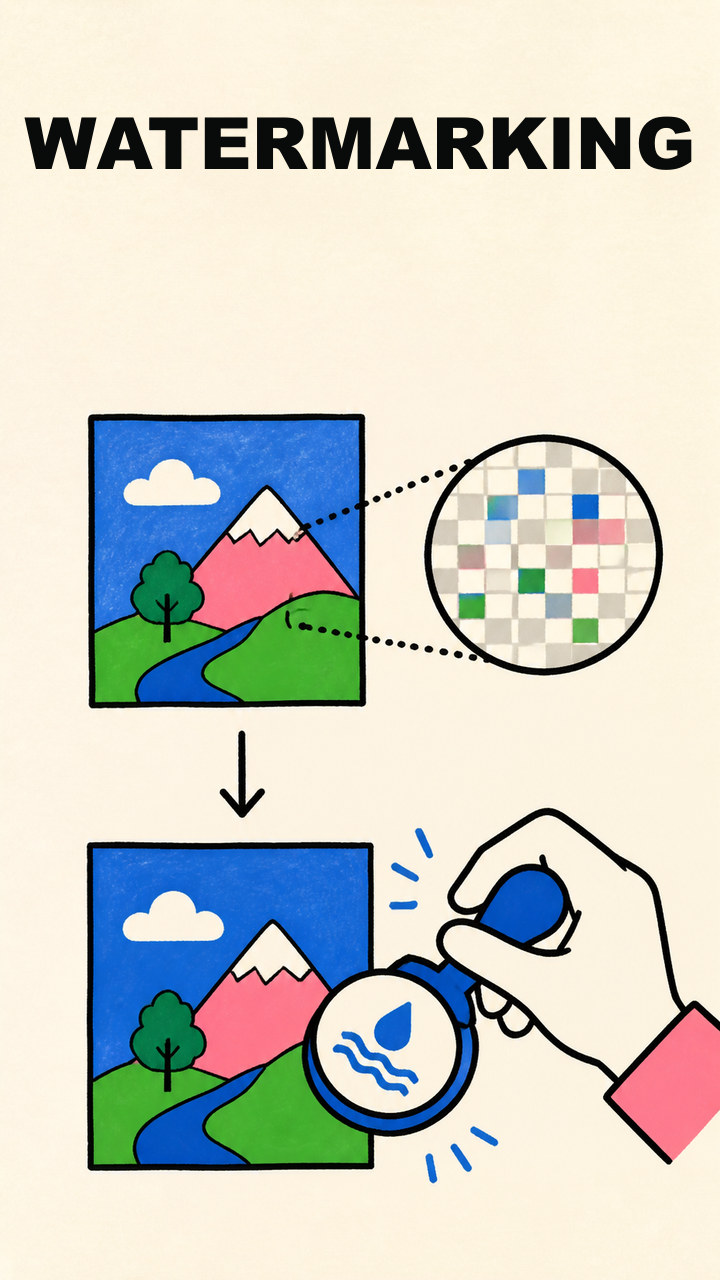
Watermarking is the practice of embedding or attaching a detectable signal intended to indicate the origin, status, or processing history of digital content.
- Review state
- Reviewed in POC
- Freshness
- Current
- Version
- 2
Also called
- Watermarking
- AI Content Watermarking
Remember it this wayA watermark is a signal about origin, not proof of truth.
In plain language
The signal may be visible or hidden and may be placed in pixels, audio, metadata, text patterns, or a signed content record. Different methods resist editing and removal to different degrees.
Why it matters
Watermarks can support provenance and disclosure, but they need interoperable verification and should be treated as one evidence source rather than a complete authenticity guarantee.
Example
An image generator adds a detectable signal and signed metadata identifying the tool and generation event.
Common misconception
The absence of a detectable watermark does not prove content is human-made, and the presence of one does not prove every claim in the content is true.
Related terms
Sources
- NIST AI 600-1, Generative Artificial Intelligence ProfileAI-specific guidance on watermarking, content authentication, provenance, and their limitations.
- Coalition for Content Provenance and Authenticity, C2PA Specificationscurrent technical specifications for cryptographically bound content provenance; complementary to, but distinct from, watermarking.
Learn more
- Treat a watermark as one record within [[data-provenance|Data Provenance]].