Concept dictionary
Verifiable Domain
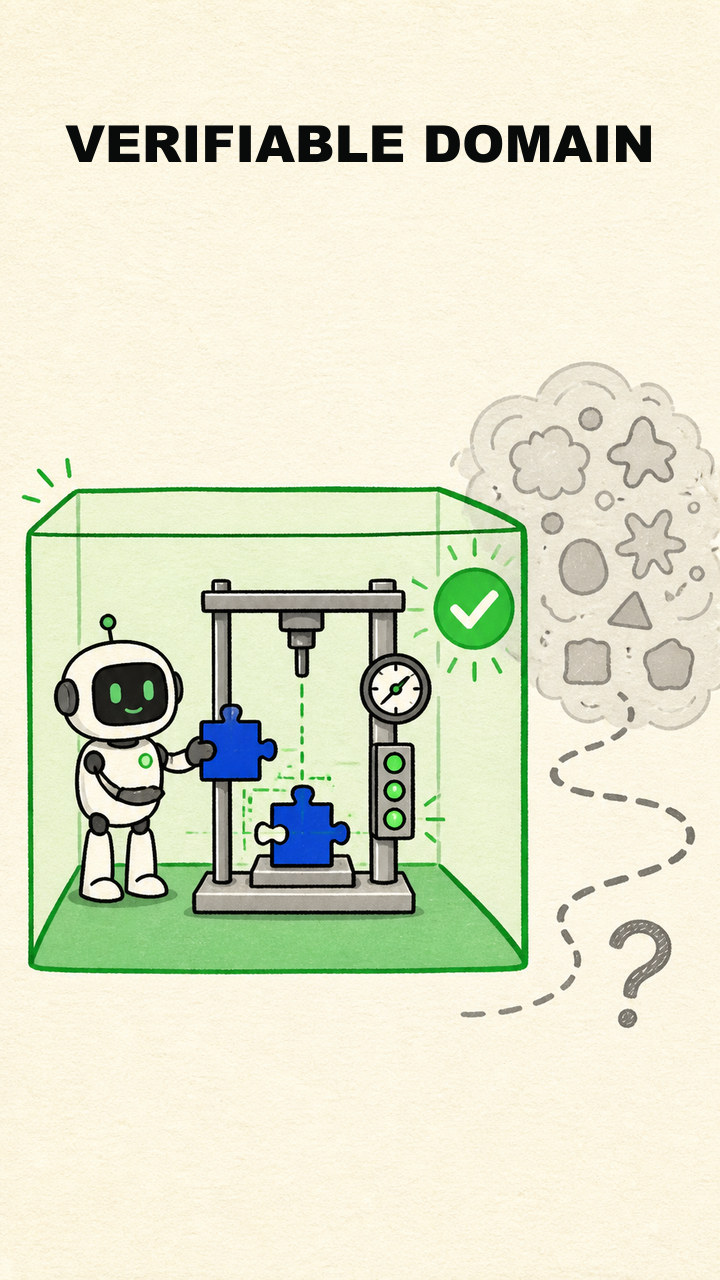
A verifiable domain is a field or task environment where a proposed result can be checked against an exact or objective correctness measure.
- Review state
- Reviewed in POC
- Freshness
- Current
- Version
- 1
Also called
- Verifiable Domain
- Verifiable Domains
Remember it this wayA verifiable domain gives the work a dependable right-or-wrong signal.
In plain language
Some tasks provide a dependable way to tell whether a result is right. A math answer can be checked, a program can be run against tests, and a game move can be evaluated under fixed rules. Other tasks depend more heavily on judgment, incomplete evidence, or outcomes that appear only over time.
Why it matters
Reliable feedback makes it easier to evaluate outputs, improve systems, and let agents iterate with less subjective guesswork. The boundary also helps teams recognize where automated checks are insufficient and human judgment or real-world evidence must remain central.
Example
A coding agent works in a verifiable domain when its proposed change can be compiled and tested against a well-designed suite that checks the required behavior.
Common misconception
Verifiable does not mean easy, safe, or completely understood. A system can optimize for an incomplete test, exploit a weak verifier, or pass the measured check while failing an unmeasured requirement.
Related terms
Sources
- ARC Prize Foundation, ARC-AGI-3 Technical Reportdefines verifiable domains as domains that provide an exact correctness-feedback measure and discusses the cost of building verifiers.
Learn more
- Compare the available correctness signal with the broader evidence practice in [[verification|Verification]].
- Use [[independent-verification|Independent Verification]] when the checker must be separated from the path that produced the work.