Concept dictionary
Small Language Model
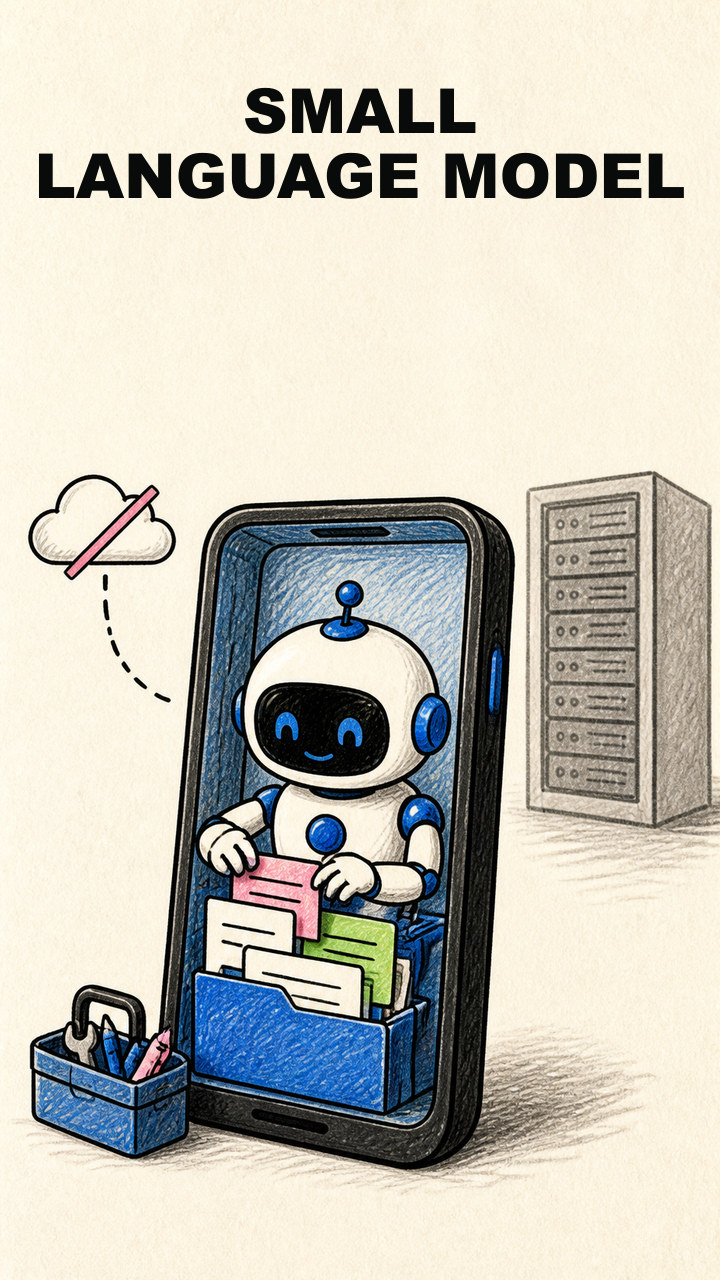
A small language model is a language model designed with a relatively small parameter and resource footprint compared with larger models in its generation or application context.
- Review state
- Reviewed in POC
- Freshness
- Current
- Version
- 1
Also called
- Small Language Model
- Small Language Models
- SLM
Remember it this waySmall is a deployment comparison, not a quality verdict.
In plain language
An SLM uses less memory and computation than the larger models it is being compared with. That can make it practical on a phone, laptop, edge device, or lower-cost service. Small is a relative engineering category, not one permanent parameter cutoff.
Why it matters
A well-chosen SLM can reduce latency, cost, energy use, and data movement. It can also be specialized for a narrow task or run where network access is limited. Those benefits must be weighed against the capabilities and context size the application requires.
Example
A field inspection app runs a compact language model on a phone to structure notes and draft a report while offline. The organization accepts its narrower capabilities in exchange for local processing and predictable response time.
Common misconception
Small does not automatically mean weak, safe, private, open, or inexpensive in every workload. It also does not have a universal numerical boundary. Compare the model with relevant alternatives and test it on the work it will perform.
Related terms
Sources
- Abdin et al., “Phi-3 Technical Report: A Highly Capable Language Model Locally on Your Phone”documents a 3.8-billion-parameter model designed to be capable enough for deployment on a phone and compares models across sizes.
- Haider et al., “Phi-3 Safety Post-Training”describes safety work for open small language models intended for on-device applications.
Learn more
- Compare a candidate SLM with a [[large-language-model|Large Language Model]] using the same tasks and operating constraints.
- Record model-specific evidence through [[capability-provenance|Capability Provenance]] and a [[model-card|Model Card]].