Concept dictionary
Service-Level Agreement
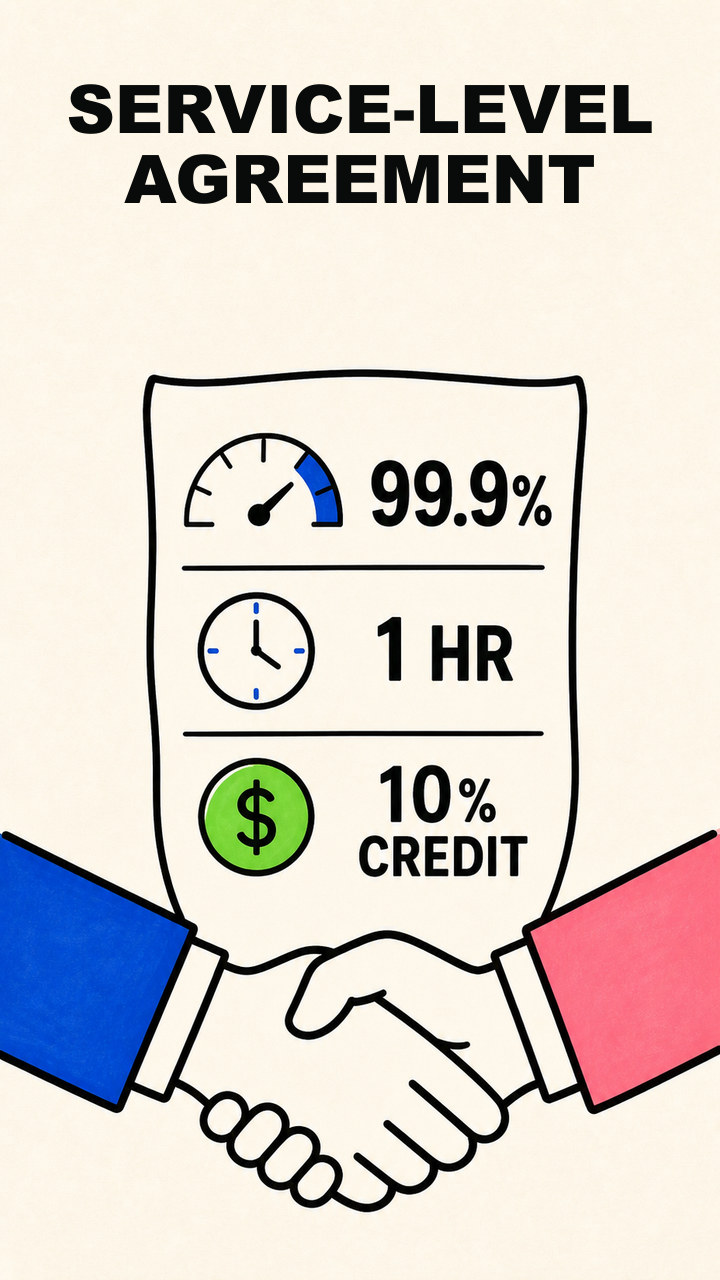
A service-level agreement is a contractual commitment defining specified service measures, targets, responsibilities, remedies, and methods of measurement between a provider and customer.
- Review state
- Reviewed in POC
- Freshness
- Current
- Version
- 2
Also called
- Service-Level Agreement
- Service Level Agreement
- SLA
Remember it this wayThe SLA states which service promise is measurable and what happens if it is missed.
In plain language
An SLA may address availability, response time, support, recovery, or other measurable service behavior. Its value depends on definitions, exclusions, reporting, and remedies.
Why it matters
AI workflows can depend on vendor uptime, latency, support, and change practices. Vague promises do not create an operational commitment.
Example
A vendor commits to a defined monthly availability target, priority-incident response times, measurement method, exclusions, and service credits.
Common misconception
An SLA does not guarantee that model outputs are accurate or suitable. It usually covers specified service behavior, not every quality dimension.
Related terms
Sources
- NIST, Cloud Computing Synopsis and Recommendations (SP 800-146)describes an SLA as technical performance promises, including remedies for performance failures, within a service agreement.
Learn more
- Verify that measures match the real [[workflow|Workflow]] and its critical [[latency|Latency]].