Concept dictionary
Random Seed
A seed is a starting value used to make random processes reproducible, such as sampling, shuffling, or initialization.
- Review state
- Reviewed in POC
- Freshness
- Current
- Version
- 2
Also called
- Random Seed
- Seed
Remember it this wayThe seed starts the random sequence; the environment still matters.
In plain language
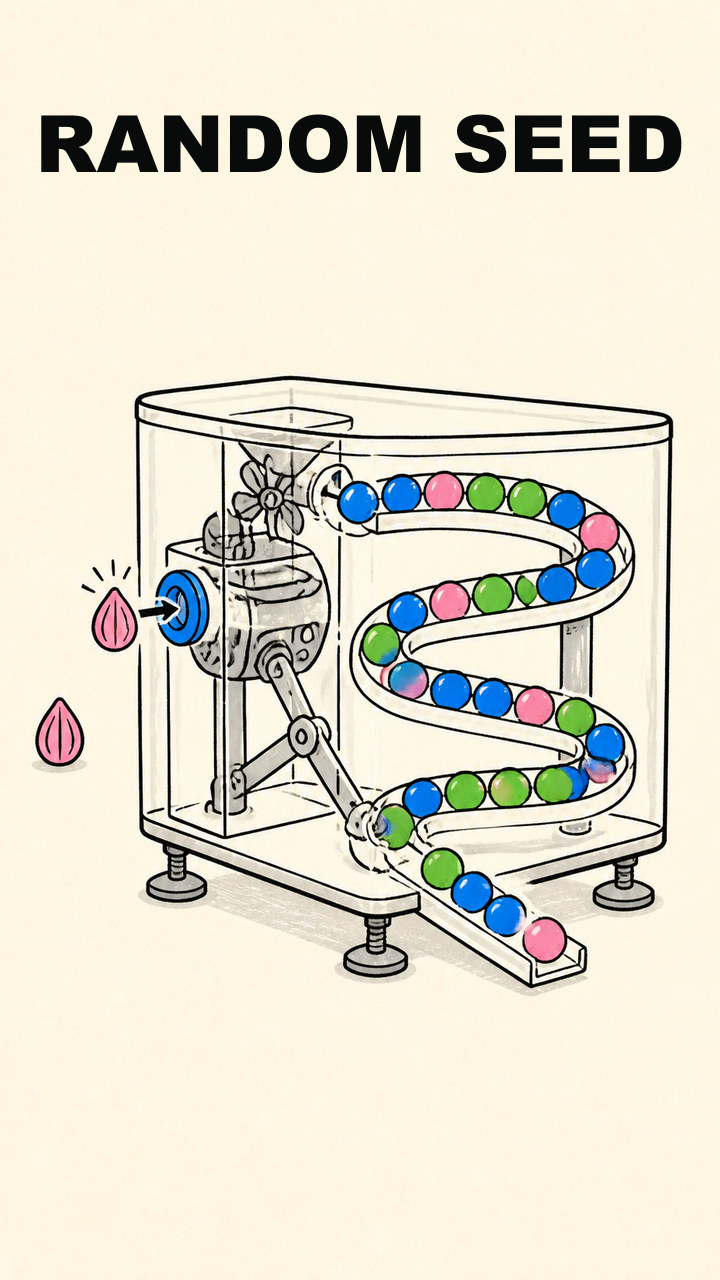
A random seed is the starting value supplied to a pseudorandom process. Reusing the same seed under the same conditions can reproduce the same sequence of random choices.
Why it matters
Seeds help debug and compare experiments by reducing one source of variation. They are useful evidence for reproducibility, but they do not control every nondeterministic operation or environment difference.
Example
A training run uses seed 42 for data shuffling and parameter initialization so a second run can reproduce those random choices.
Common misconception
Setting a seed does not guarantee complete reproducibility across hardware, software versions, parallel execution, or nondeterministic algorithms.
Related terms
Sources
- PyTorch, “Reproducibility”explains random-number seeding and the remaining limits on reproducibility.
Learn more
- Compare [[stochastic-process|Stochastic Process]], [[training|Training]], [[verification|Verification]], and [[dataset|Dataset]] to place Random Seed in the surrounding system.
- Follow the cited source material above for the method, standard, or research context behind this draft.