Concept dictionary
Process Debt
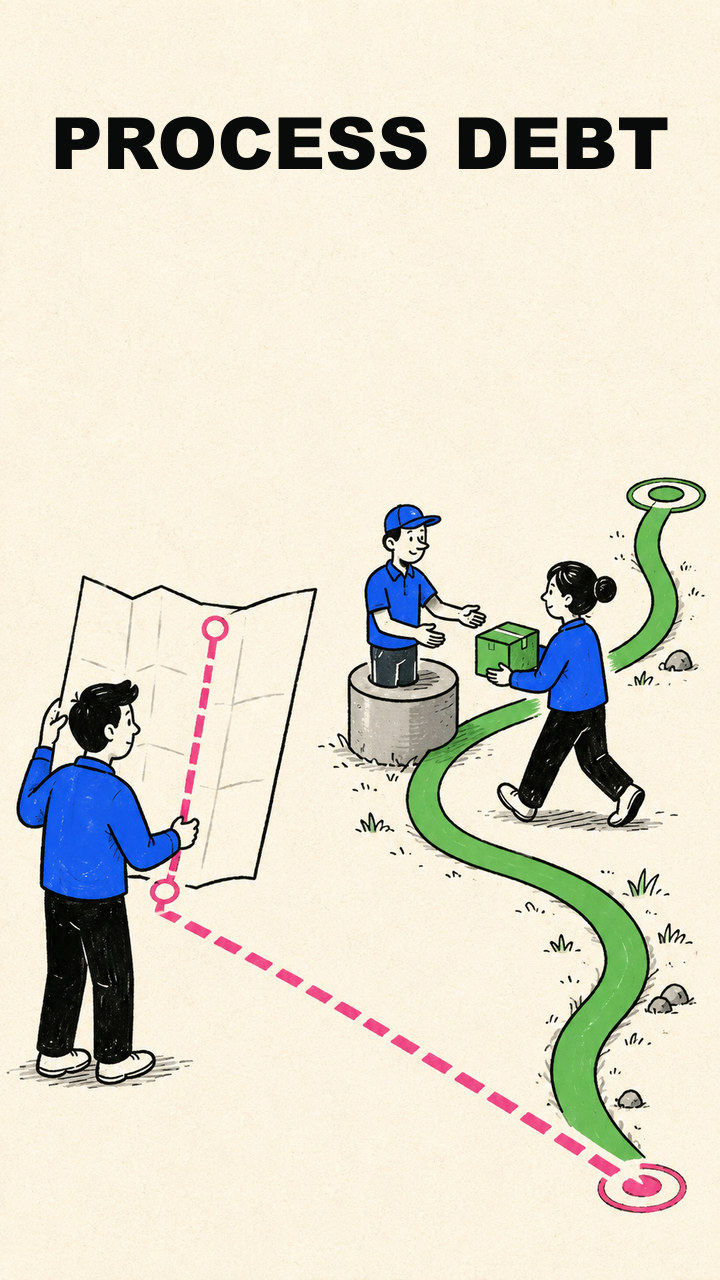
Deferred maintenance of operating procedures that creates later coordination, ambiguity, or rework.
- Review state
- Reviewed in POC
- Freshness
- Current
- Version
- 2
Also called
- Process Debt
Remember it this wayThe process changed; the instructions did not.
In plain language
Process debt grows when the way work is described stops matching the way work depends on being done. Manual steps remain undocumented, old assumptions stay in instructions, or ownership becomes implicit. The work may continue because experienced people remember the gaps, but each gap becomes a future coordination obligation.
Why it matters
People can often notice a fuzzy boundary and ask what comes next. An agent may retrieve and execute the documented process as written. When important context lives only in memory, process debt can turn speed into repeated error, skipped controls, or dependence on the one person who knows the missing steps.
Example
A publishing workflow succeeds because one person remembers three manual checks that are absent from the runbook. When an agent follows the written steps, it skips a review boundary and routes the wrong artifact. Updating the runbook and encoding the checkpoint pays down the process debt.
Common misconception
Process debt is not every slow or inefficient procedure. It is the future obligation created when maintenance of the operating method is deferred and the documented process no longer carries the context, ownership, or controls the work requires.
Related terms
Sources
No sources recorded yet.
Learn more
- Compare [[process|Process]], [[workflow|Workflow]], and [[process-context|Process Context]] before deciding where the maintenance obligation sits.
- Use [[rework-loop|Rework Loop]] to inspect repeated work created by an out-of-date operating method.