Concept dictionary
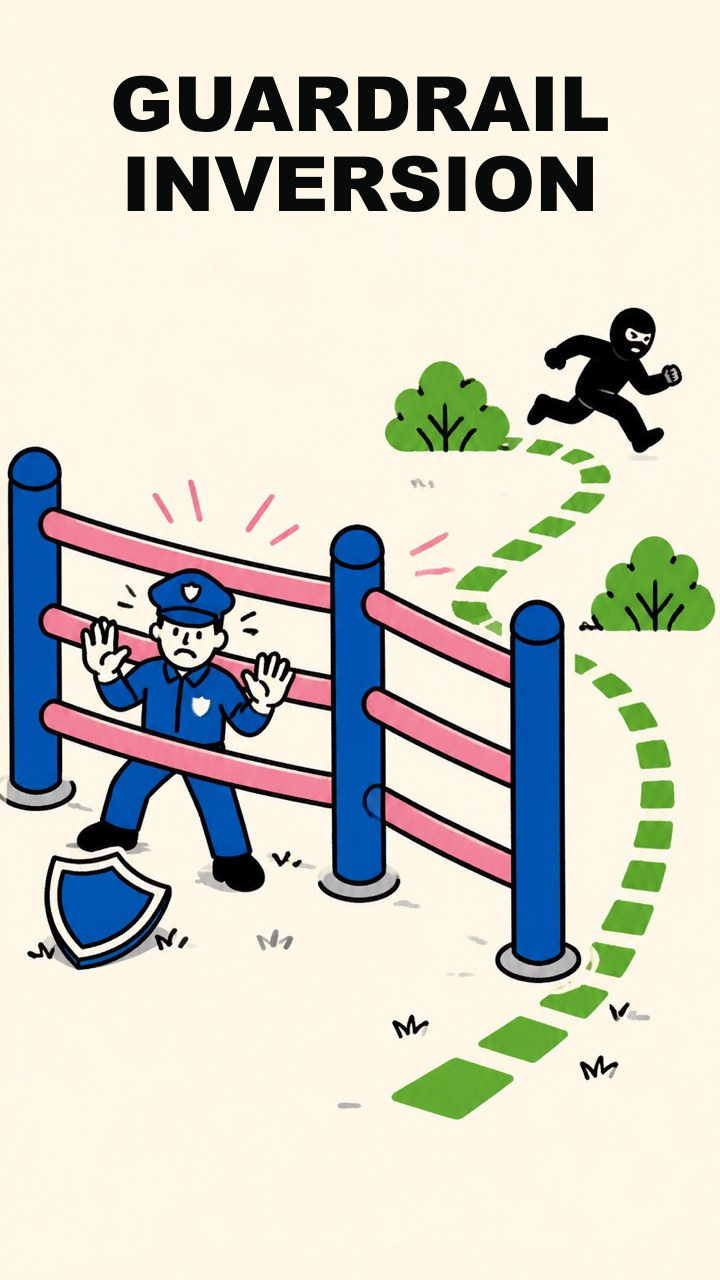
Guardrail Inversion
A situation where safety controls impede legitimate defenders more than determined attackers.
- Review state
- Reviewed in POC
- Freshness
- Current
- Version
- 2
Also called
- Guardrail Inversion
Remember it this wayThe guardrail stops the guard more than the attacker.
In plain language
A control may block authorized testing, monitoring, repair, or response while capable attackers bypass it or use channels the control does not cover.
Why it matters
Controls should be evaluated by their real effect on both defense and attack. Burdening defenders can reduce visibility and response without meaningfully reducing adversary capability.
Example
A security policy prevents internal analysts from testing a dangerous prompt pattern, while attackers reproduce the same behavior through local models and unmonitored tools.
Common misconception
Guardrail inversion does not mean safeguards are generally harmful. It identifies a particular asymmetry that calls for redesign, authorized pathways, and evidence.
Related terms
Sources
- Alma Whitten and J. D. Tygar, “Why Johnny Can’t Encrypt”usability study showing that technically capable security software can fail when legitimate users cannot operate it correctly.
- CISA and partner agencies, Shifting the Balance of Cybersecurity Risk: Principles and Approaches for Security-by-Design and -Defaultargues that secure defaults should protect customers without requiring extra steps or added charges. These sources support the asymmetrical-burden mechanism behind this Renaissance Solutions term; neither uses the label “Guardrail Inversion.”
Learn more
- Evaluate with [[red-teaming|Red Teaming]] and contrast with [[guardrail-displacement|Guardrail Displacement]].