Concept dictionary
Embedding
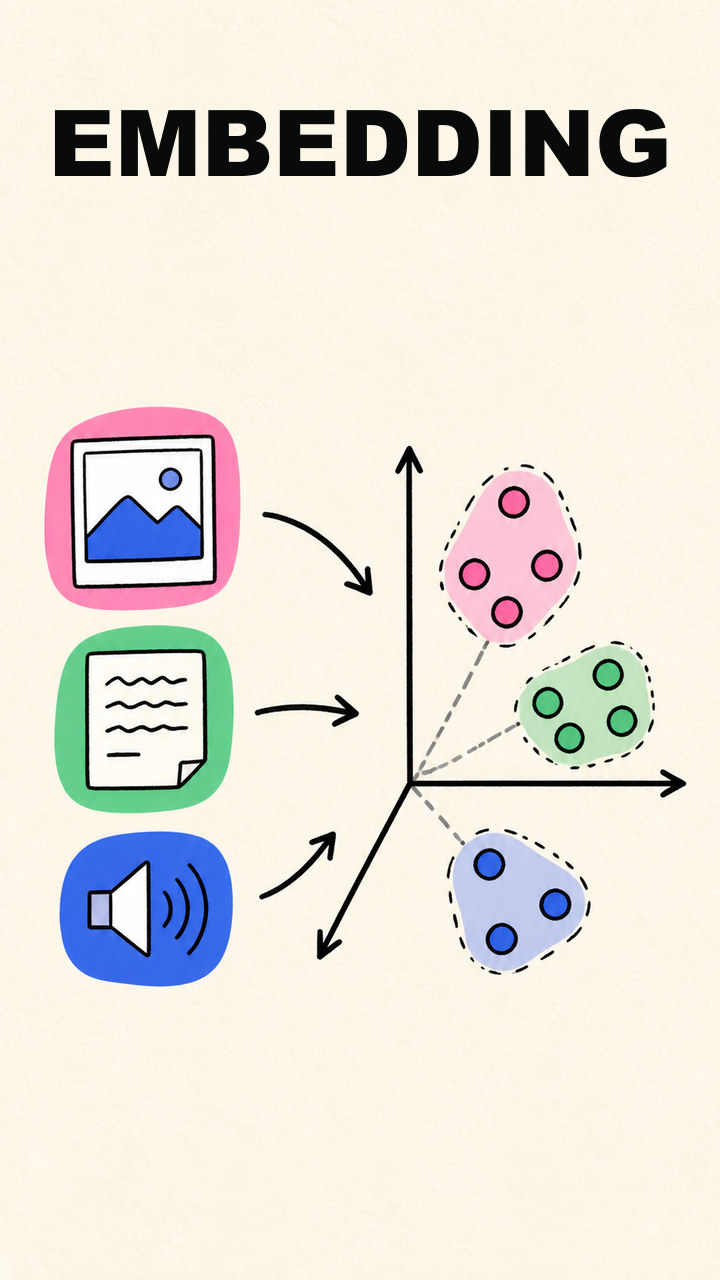
An embedding is a numerical representation of an item—such as text, an image, or audio—constructed so that items with relevant similarities can be compared mathematically.
- Review state
- Needs review
- Freshness
- Current
- Version
- 2
Also called
- Embedding
- Vector Embedding
Remember it this wayEmbeddings turn content into coordinates for comparison.
In plain language
An embedding converts content into a list of numbers. A system can then search for nearby representations instead of relying only on exact keyword matches.
Why it matters
Embeddings support semantic search, retrieval, recommendations, clustering, and other features, but their notion of similarity reflects the model and data used to create them.
Example
A knowledge-base search uses embeddings to find a policy passage about travel expenses even though the employee searched for reimbursement rather than the exact words in the document.
Common misconception
An embedding is not a human-readable summary and mathematical closeness does not prove two items mean the same thing in the decision context.
Related terms
Sources
- Google for Developers, Machine Learning Glossarytechnical definition of embeddings and vector representations.
Learn more
- See how embeddings support [[retrieval-augmented-generation|Retrieval-Augmented Generation]].