Concept dictionary
Distribution Constraint
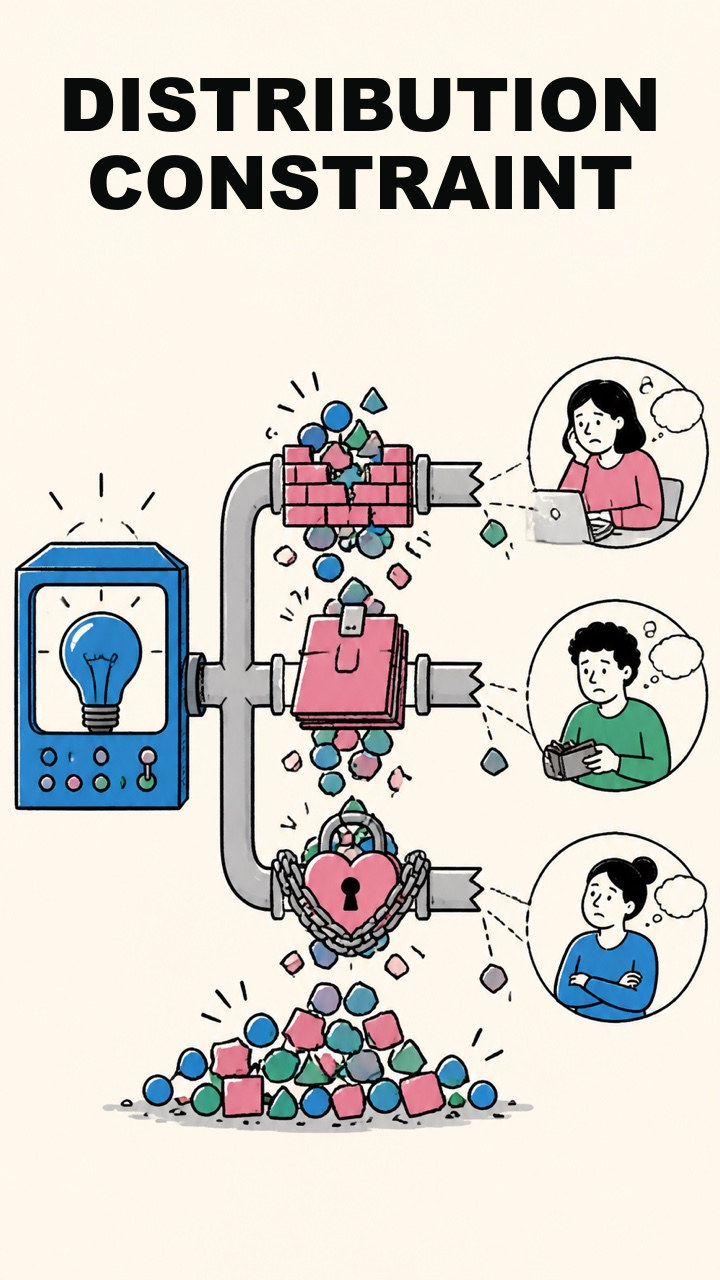
A distribution constraint is what happens when a technology works but cannot reach the people it would help, because it has no practical route into their day-to-day work, their budgets, or the relationships they already trust. The limit sits in the route, not in the technology.
- Review state
- Reviewed in POC
- Freshness
- Current
- Version
- 3
Also called
- Distribution Constraint
Remember it this wayUseful is not distributed.
In plain language
The technology may work, but customers cannot easily adopt, fund, integrate, buy, or trust it. The limiting factor is the route into real use rather than the underlying capability.
Why it matters
Improving a product does not resolve a blocked path to adoption. Teams must examine workflow fit, purchasing, implementation, support, and trusted relationships.
Example
A reliable diagnostic tool shows strong results in trials but cannot enter clinics because reimbursement, procurement, training, and workflow integration remain unresolved.
Common misconception
A distribution constraint is not simply weak marketing. It can involve budgets, channels, operational fit, regulation, service capacity, or trust.
Related terms
Sources
- World Health Organization, Medical Devices: Managing the Mismatchdistinguishes availability, accessibility, appropriateness, and affordability, showing why a working technology may still fail to reach or serve intended users. This supports the mechanism behind the Renaissance Solutions term; WHO does not use the label “Distribution Constraint.”
Learn more
- Analyze with [[larger-business-context|Larger Business Context]] and [[workflow|Workflow]].