Concept dictionary
Deep Learning
Deep learning is a form of machine learning that uses neural networks with many processing layers to learn complex patterns from data.
- Review state
- Reviewed in POC
- Freshness
- Current
- Version
- 2
Also called
- Deep Learning
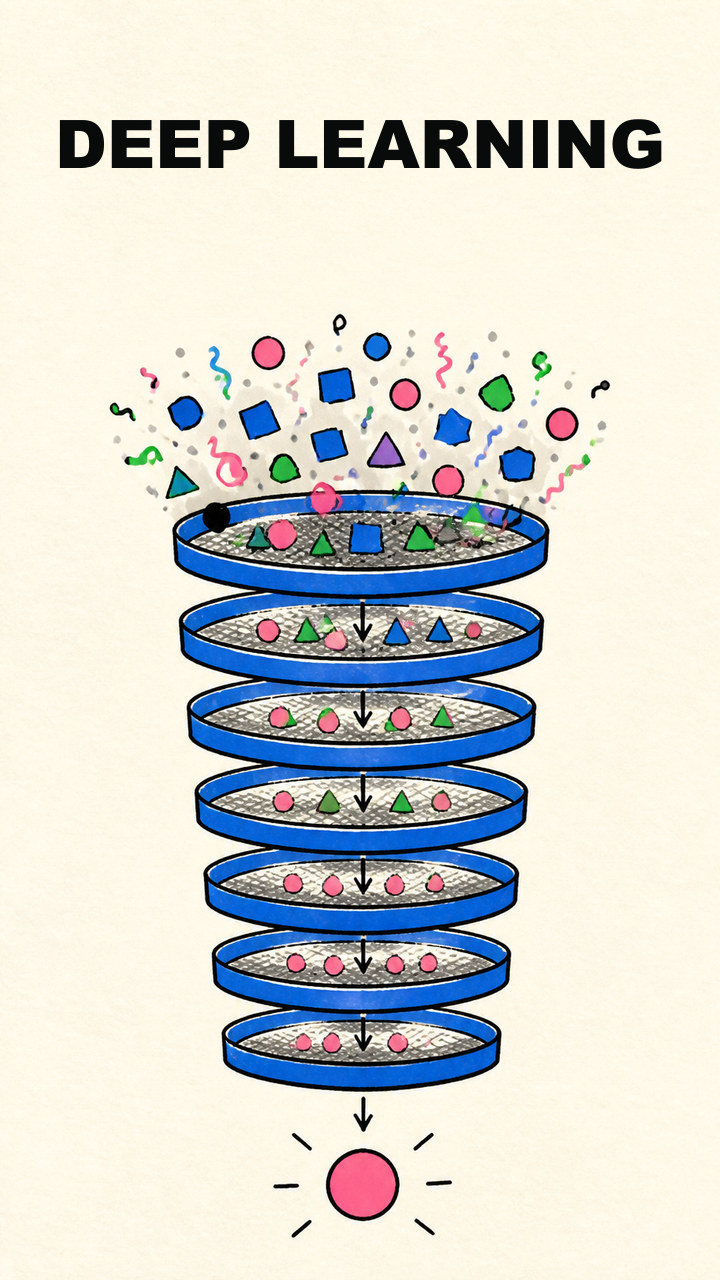
Remember it this wayMany learned layers turn raw input into useful patterns.
In plain language
A deep-learning system transforms an input through a sequence of learned layers. Different layers can become useful for different features, allowing the model to handle complex text, images, audio, and other data.
Why it matters
Deep learning supports many modern generative and recognition systems, but it can require substantial data, computing power, evaluation, and operational controls.
Example
A deep-learning model learns visual features across many layers to identify objects in photographs.
Common misconception
Deep learning is inspired loosely by ideas about biological neurons, but it is not a digital replica of a human brain and does not establish humanlike understanding.
Related terms
Sources
- NIST AI 100-2 E2025, Adversarial Machine LearningNIST terminology covering neural networks and deep learning.
- Google for Developers, Machine Learning Glossarytechnical definitions and examples for deep learning concepts.
Learn more
- Continue with [[neural-network|Neural Network]] and [[compute|Compute]].