Concept dictionary
Contrastive Learning
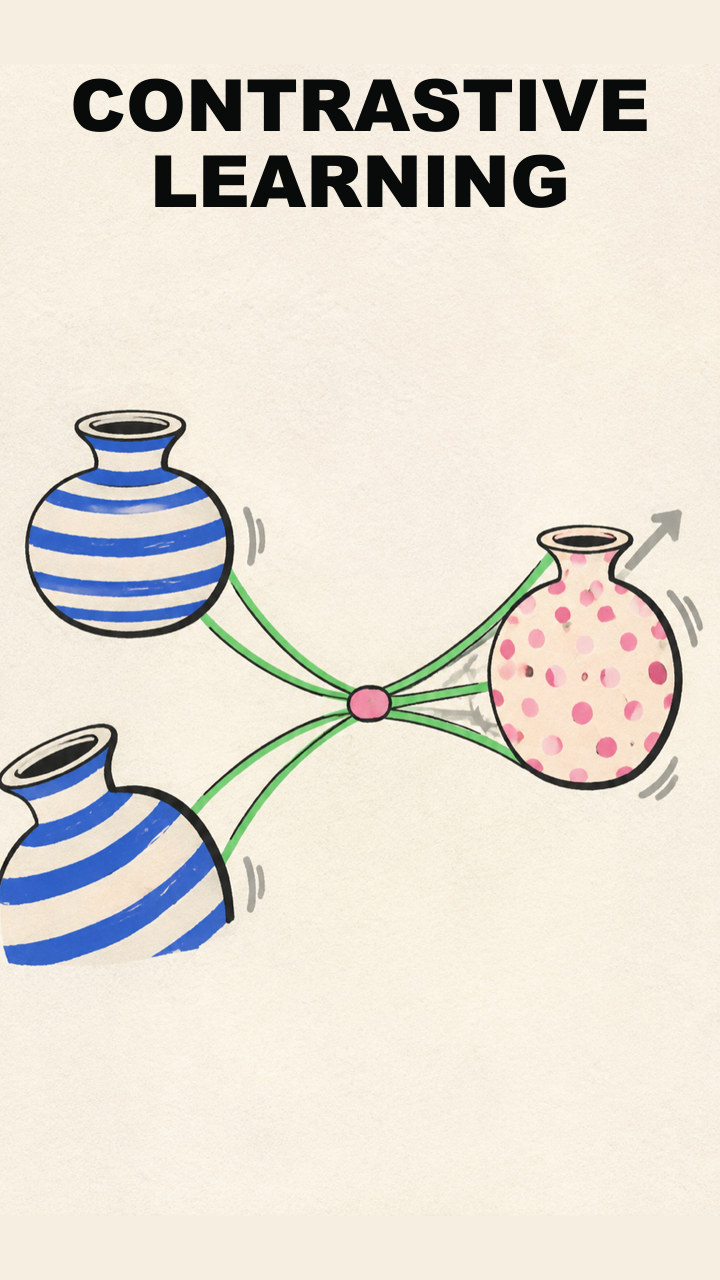
Contrastive training is a method where a model learns by pulling related examples closer together and pushing unrelated examples farther apart.
- Review state
- Reviewed in POC
- Freshness
- Current
- Version
- 2
Also called
- Contrastive Learning
- Contrastive Training
Remember it this wayBring related examples together; separate the rest.
In plain language
Contrastive learning teaches a model by comparing examples. Representations of related examples are pulled closer together, while representations of unrelated examples are pushed apart.
Why it matters
The method can learn useful representations without a manually written label for every example. Its behavior still depends on how positive and negative pairs are created.
Example
Two altered views of the same photograph are treated as a positive pair, while views from different photographs are treated as negatives.
Common misconception
Contrastive learning is not automatically unbiased or label-free. The pairing rules act as supervision and can encode assumptions about what should count as similar.
Related terms
Sources
- Ting Chen and colleagues, “A Simple Framework for Contrastive Learning of Visual Representations”demonstrates a contrastive objective that aligns two augmented views of an example.
Learn more
- Compare [[self-supervised-learning|Self-Supervised Learning]], [[embedding|Embedding]], [[latent-representation|Latent Representation]], and [[training-data|Training Data]] to place Contrastive Learning in the surrounding system.
- Follow the cited source material above for the method, standard, or research context behind this draft.