Concept dictionary
AI Washing
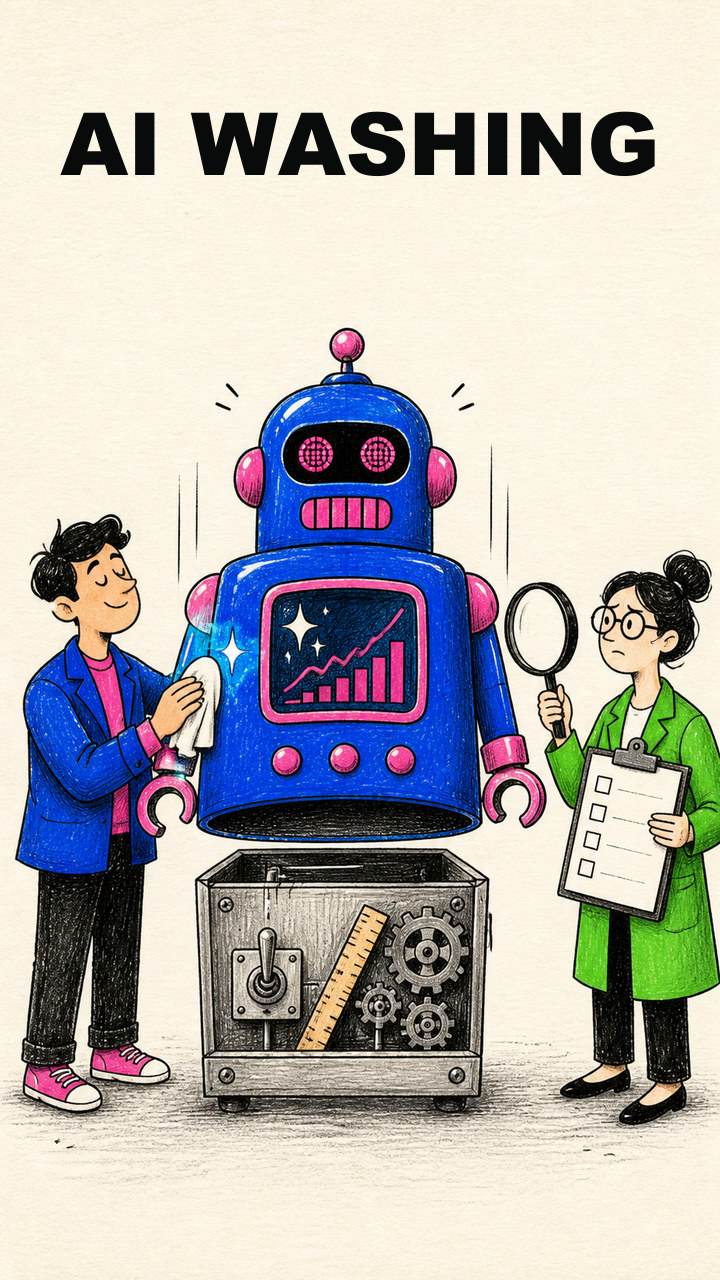
AI washing is the misleading practice of exaggerating, misrepresenting, or fabricating how an organization uses AI or what its AI can do.
- Review state
- Reviewed in POC
- Freshness
- Current
- Version
- 1
Also called
- AI Washing
- AI-washing
Remember it this wayThere is more AI in the claim than in the system.
In plain language
A product, company, or proposal borrows the attention and prestige of AI without an honest match between the claim and the underlying work. The AI may be minor, ordinary automation may be relabeled, or performance claims may lack a reasonable basis.
Why it matters
Misleading AI claims can distort purchasing, investment, policy, and risk decisions. They also make it harder to compare systems because important facts about methods, evidence, limitations, and human labor are replaced by an impressive label.
Example
A vendor markets a rule-based keyword filter as a proprietary adaptive AI that predicts employee risk, yet cannot show a trained model, a relevant evaluation, or evidence for the claimed accuracy.
Common misconception
Using the word AI broadly is not automatically AI washing. The problem is a material mismatch that creates a misleading impression about the technology, its use, or its demonstrated capability. A modest real use of AI should be described modestly and specifically.
Related terms
Sources
- U.S. Securities and Exchange Commission, “Chair Gary Gensler on AI Washing”warns against false or unsupported statements about using AI and its role.
- U.S. Federal Trade Commission, “Keep your AI claims in check”explains that AI capability and performance claims require evidence and must not mislead consumers.
Learn more
- Compare AI Washing with the broader credibility shortcut in [[trust-borrowing|Trust Borrowing]].
- Ask for evidence, limitations, and intended use through a [[model-card|Model Card]] or equivalent documentation.