Article Detail
Where Do You Draw the Box?
Because drawing your box a bit differently can spark innovation.
Apple: The Box Heard Round the World
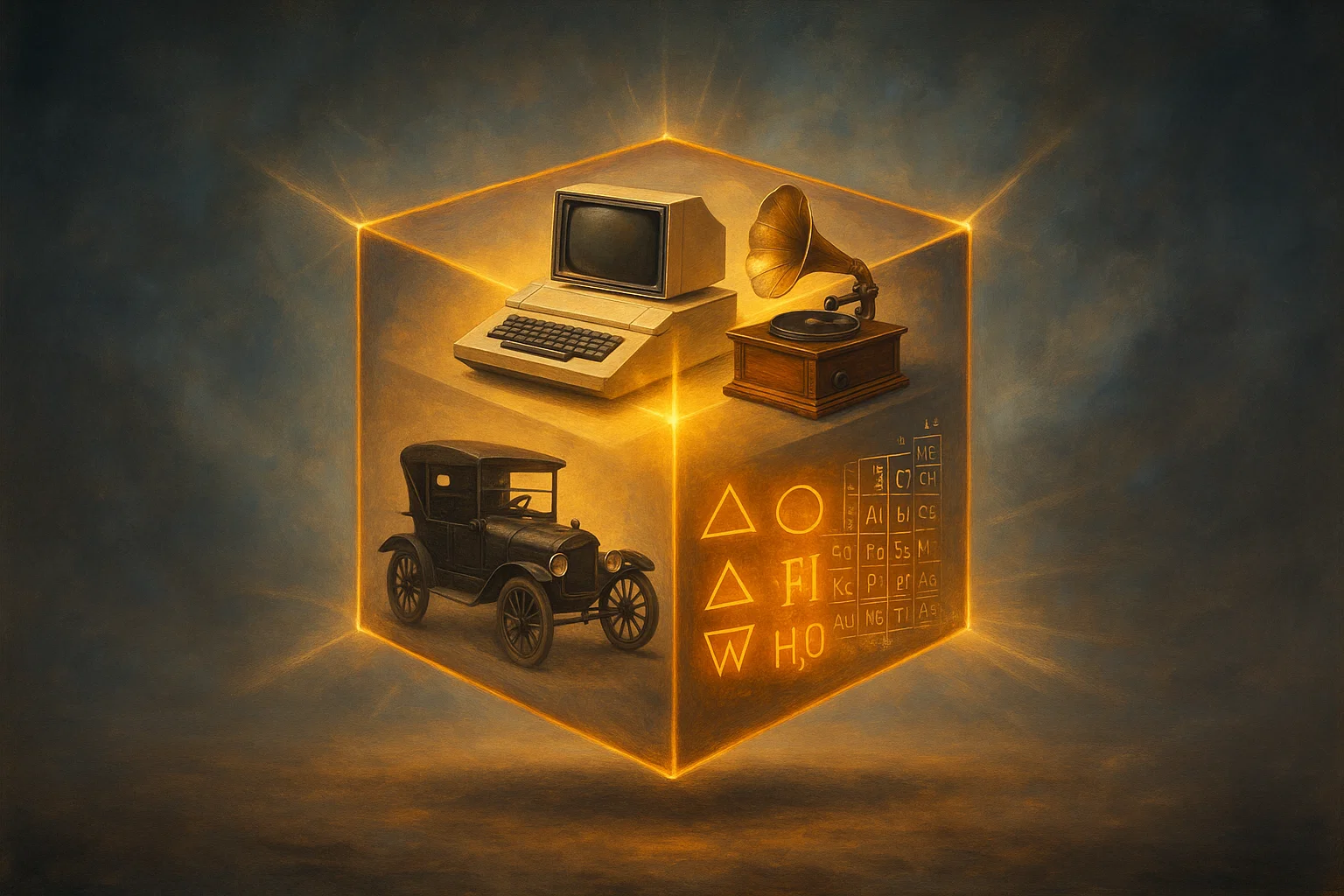
Jobs and Wozniak didn’t invent the circuit, the monitor, or the keyboard. What they did invent was the boundary. Before Apple, computing meant three noisy boxes lashed together: CPU, keyboard, monitor. Their spark was to redraw the box and say: this—keyboard, monitor, CPU—is one thing. A personal computer, not a hobbyist’s contraption.
That mental compression carried computers out of garages and into classrooms, bedrooms, and offices. Innovation wasn’t in silicon alone—it was in the way people were taught to imagine the system.
Retrospective: History’s Odd Boxes
History offers quirky reminders of how often progress begins by redrawing boundaries. This trick of redrawing the box is older than Silicon Valley.
- Medicine: Medieval doctors boxed the body into four humors—bleed the patient, balance the fluids. Germ theory shattered that boundary and redrew the box around microbes, cells, and sanitation.
- Music: Once upon a time, the orchestra was the “box” of music. Then Edison jammed sound into a wax cylinder—suddenly the box was portable, personal, repeatable. The record player wasn’t just a gadget, it redefined what counted as “hearing music.”
- Transportation: Horses and carriages were two boxes. Ford collapsed them into one steel beast—the automobile. The horse vanished from the system map.
- Alchemy: Matter was once boxed into Earth, Air, Fire, Water. Chemistry redrew the boundary into the periodic table. Same world, utterly different interpretive frame.
Each time, the boundary reimagining was more disruptive than the underlying tech.
Application: Drawing Our Own Boxes
So, how do we use this lens day to day?
- At work: Reimagine inherited systems with arbitrary divisions. Notice that spreadsheet, that workflow, that org chart—why are the boxes there? Who decided? What happens if you merge them, or split them differently?
- In creativity: Ask not “what new tool do I need,” but “what boundary am I assuming?” The breakthrough may be a new box, not a new tool.
- In life: Reframe your identities—job vs. hobby, professional vs. personal. Progress sometimes comes not from adding a new role, but from collapsing the boundaries between them or reframing them entirely.
The spark isn’t always invention, but reinterpretation. The next time you feel stuck, ask yourself: Where am I drawing the box? And what happens if I move the line? So, how do we use this lens day to day?
- At work: Notice when you’ve inherited a system with arbitrary divisions. That spreadsheet, that workflow, that org chart—why are the boxes there? Who decided? What happens if you merge them, or split them differently?
- In creativity: Instead of asking “what new tool do I need,” ask “what boundary am I assuming?” Maybe the breakthrough isn’t a new tool but a new box.
- In life: We even box our identities—job vs. hobby, professional vs. personal. Sometimes progress comes not from adding a new role, but from collapsing the boundaries between them or reframing them entirely.
The spark isn’t always invention, but reinterpretation. The next time you feel stuck, ask yourself: Where am I drawing the box? And what happens if I move the line?