Article Detail
When Trust Becomes Blindness
An Aviation Parable
Intro
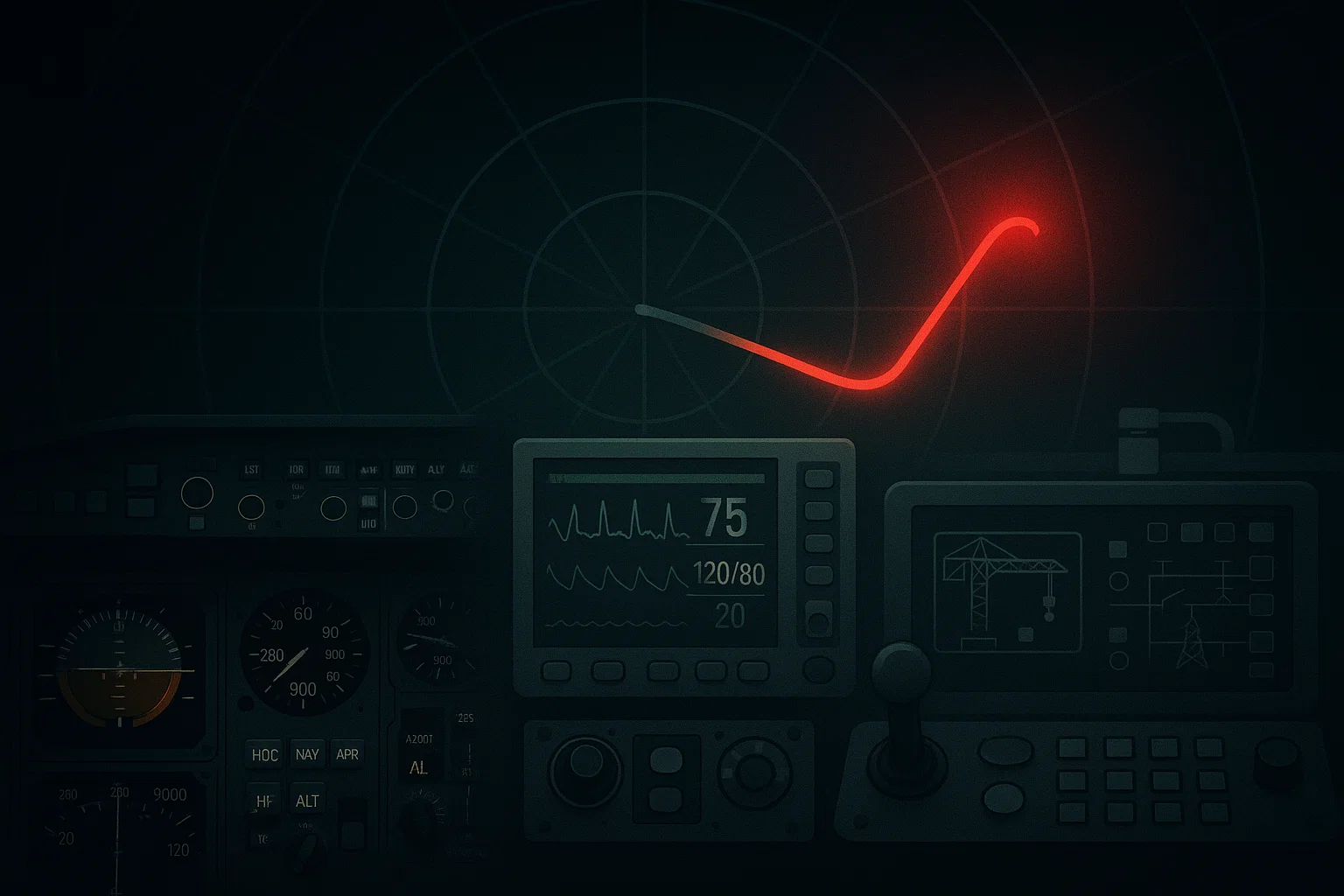
Companies everywhere are racing to weave AI into daily work. The real question isn’t whether AI can help—it can—but how much we should trust its output versus how much we must verify. History shows what happens when that balance tips too far toward blind trust: when humans are cut out of the loop, chaos follows, sometimes as catastrophic as planes falling from the sky.
---
The Parable
Consider aviation. An airline introduces a new autopilot system to streamline cockpit operations. It reads flight plans, interprets weather data, and summarizes tower communications into a neat dashboard. Management gives two directives:
- Trust the summary. Pilots are told not to waste time cross-checking the underlying data.
- Do not tinker. Feeding test inputs into the system is prohibited, because it’s tied directly into production navigation. While it is normal to protect production from fake inputs, the problem arises when there is no separate sandbox where pilots can safely tinker, test, and hone their craft.
The result is predictable. Pilots—once valued for judgment under pressure—are reduced to operators, following a standardized process, almost like copy/pasting every flight, based on autopilot’s conclusions. Their professional instinct to probe and verify is sidelined. Over time, the most capable leave, unwilling to serve as passive overseers. Those who remain are trained to follow, not to question—and advancement tends to reward the most compliant rule-followers rather than the pilots who can manage a crisis when systems fail, promoting button-pushers over true aviators. Contrast this with Captain Chesley “Sully” Sullenberger and his crew, who safely landed US Airways Flight 1549 on the Hudson River in 2009. Their success came not from blind adherence to procedure, but from skill, judgment, and the confidence to act when the unexpected struck.
Eventually, the system misinterprets an instruction—perhaps distorted by an accent, a cough, or static in the tower. Flattened into its standard summary, the nuance is lost. With neither the confidence nor the habit of second-guessing, the crew misses what a glance at the raw data would have caught. A preventable accident unfolds.
---
The Historical Grounding
This isn’t imagination—it’s history. Aviation has already shown what happens when automation overshadows human expertise:
- Air France Flight 447 (2009): Pitot tubes iced over, feeding bad speed data to the autopilot. The system disengaged, leaving pilots confused. Training had emphasized trusting automation, but less so manual recovery. The crew’s failure to challenge their instruments led to a fatal stall over the Atlantic.
- Boeing 737 MAX (2018–2019): The MCAS system, designed to act invisibly, automatically corrected pitch. Pilots weren’t trained to understand or override it. Twice, in Indonesia and Ethiopia, faulty sensor data drove the aircraft nose-down. Both flights ended in tragedy, with 346 lives lost.
Both cases reveal the same pattern: automation built to save time and reduce “waste” eroded the role of skilled professionals. When the edge cases hit—the very moments automation is weakest—humans weren’t positioned to catch the fall.
---
The Broader Lesson
The same trap lies ahead for healthcare, construction, energy, transportation, and other critical infrastructure fields. Summaries and automated guidance can be powerful accelerators, but only if professionals:
- Verify, not blindly trust.
- Probe systems in safe sandboxes.
- Adapt language and meaning to cultural contexts.
Stripping away these practices doesn’t eliminate risk—it concentrates it, until the margin of error becomes the chasm of failure.
---
Who We Are Listening To
This section highlights the voices we treat as evidence, the people whose lived experience and expertise warn us of the risks of removing humans from the loop:
- Pilots and aviation safety experts, who have long cautioned against over reliance on automation.
- Healthcare professionals, who insist AI summaries can assist but never replace bedside judgment.
- Construction and energy safety leaders, who know the cost of cutting corners on site checks and system testing.
- Engineers in every field, whose craft depends on tinkering, stress-testing, and learning through iteration.
Their shared wisdom underscores one truth: Technology, including AI, can be a powerful tool, but only when it supports—not supplants—the human expertise that keeps complex systems safe.