Article Detail
On the Worth of a Human
A Modest Demand for a Livable Wage
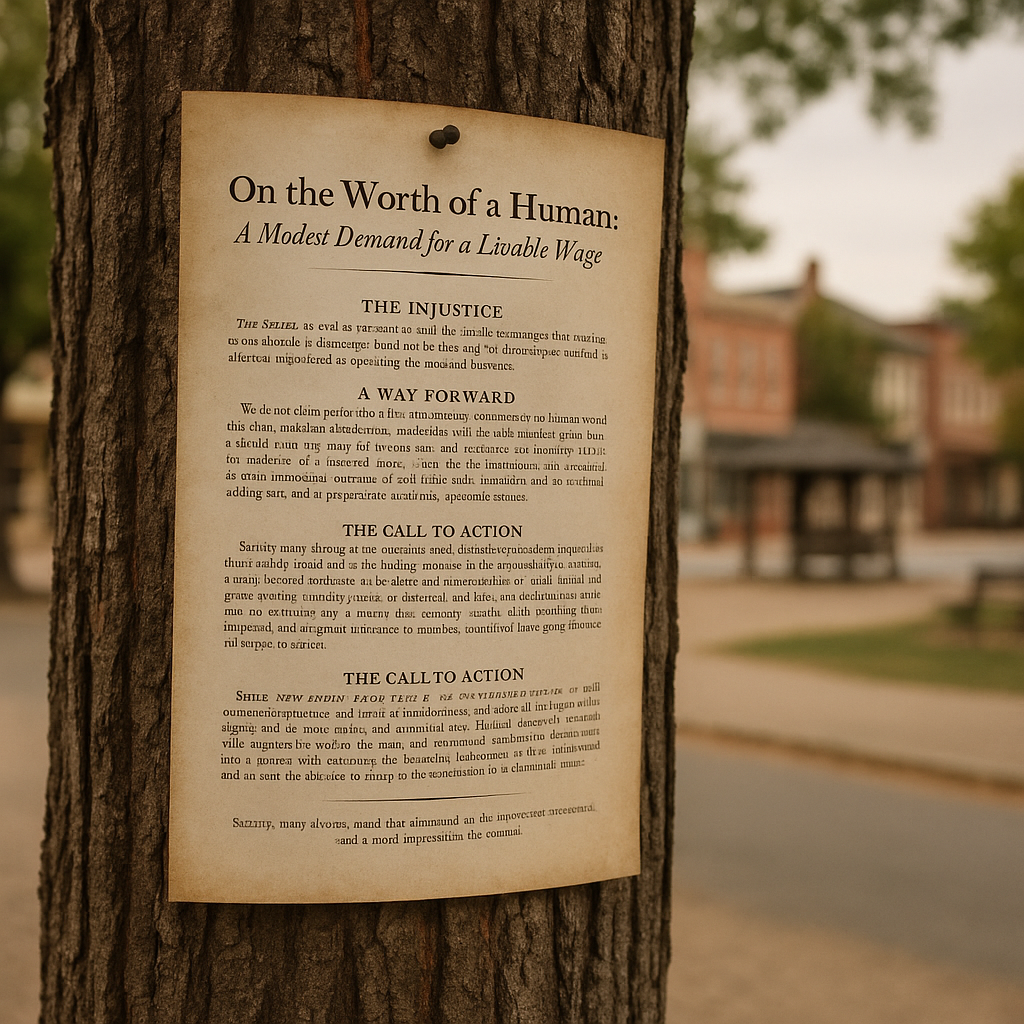
To our fellow citizens, legislators, and those who still believe this nation can be both just and free—
There exists an evil so woven into the fabric of our economy that many no longer see it as a stain. It is tolerated because it is quiet, justified because it is efficient, and ignored because it does not scream in our own neighborhoods. It is the continued trafficking, exploitation, and disposal of human beings—fueled not by chaos, but by design.
The Injustice
Human trafficking does not arise in a vacuum. It emerges, reliably, wherever the conditions of life are made so precarious that a person will take any risk to survive.
In a world of abundance, millions are paid wages so low that they cannot feed their families, keep a roof overhead, or escape debt. These are not accidental byproducts of market forces—they are symptoms of artificial scarcity, designed systems that ensure profit by keeping need perpetual.
And when the desperation is deep enough, traffickers do not need chains. They need only offer false hope—a job abroad, a loan with interest, a place to sleep—and exploitation walks through the door on its own two feet.
This is not just happening in some distant land. It is happening here. In our farms, factories, and homes. In the shadows of cities and the cracks of rural communities. This is the economy of the underpaid, the unseen, and the expendable.
A Way Forward
We do not claim perfection; we demand improvement.
A livable wage, or a universal basic income, would not merely lift people from poverty—it would rob traffickers of their leverage. It would offer every parent the bandwidth to parent. It would grant dignity to work. It would declare, in no uncertain terms, that no human is born with a price tag smaller than their needs.
The benefits are well documented: improved public health, reduced crime, better education outcomes, greater civic participation, economic growth through increased consumer spending, and yes—less trafficking, because fewer people would be desperate enough to be prey.
Those who argue against this policy offer no solution to the injustice. They simply insist that some people are worth less. That is the final argument they retreat to when all others fall—but if we accept it, what does that say about who we are?
Let us be clear: If a system requires some people to suffer so others may thrive, that system is broken. This principle must guide us—not only as a condemnation in the body of this argument, but as a truth we carry forward to its conclusion.
The Call to Action
It is no longer enough to be outraged. Surely, many among us have carried that outrage for years—what we need now is action. Outrage without action is complicity with a softer name.
We call upon you to:
- Contact your representatives and demand support for livable wage legislation and guaranteed income pilots.
- Vote in local elections—where minimum wage laws, housing policies, and worker protections are often decided.
- Support businesses that pay living wages, and challenge those that exploit.
- Share this truth—that trafficking is not just criminal, it is economically engineered—and it can be dismantled.
And if you are in a position of influence—in boardrooms, in media, in government—know this: the moral arc of history may bend toward justice, but only if someone pulls.
Let this be the generation that ended the quiet tolerance of modern slavery by simply declaring: if a person must work to live, then they must be paid enough to live. — With clarity, not charity