Article Detail
Diversity as a Survival Strategy
Life and society continue to evolve, diversity is just as important now as it always has been.
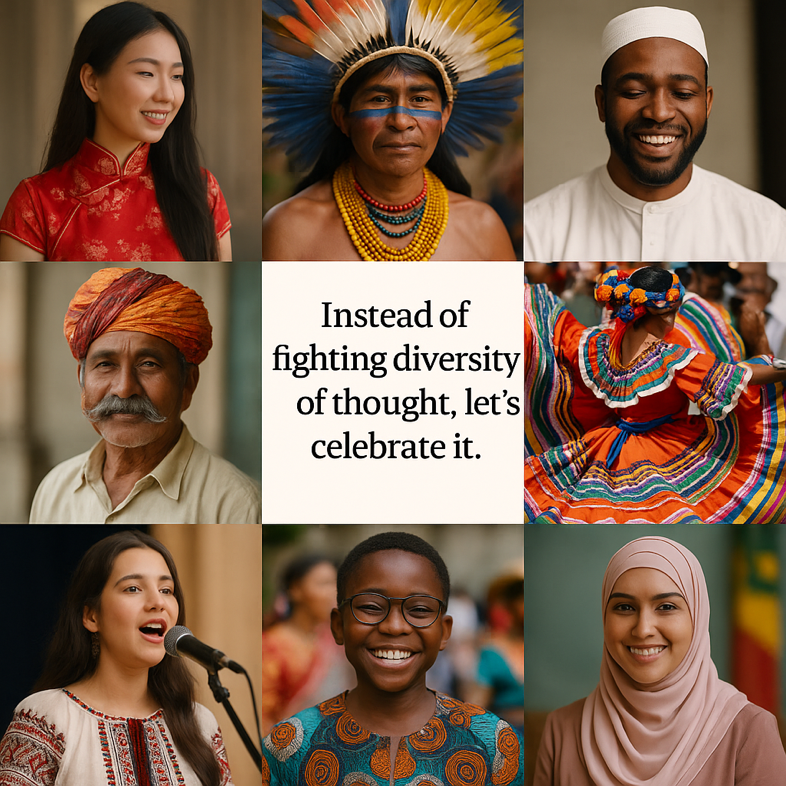
Society — like life — needs diversity to thrive as it scales. In ecosystems, a single species dominating leads to fragility and collapse. The same is true for civilizations. Diversity of thought, values, and processes is not just a moral good; it is a structural necessity for resilience.
Perhaps, in some far-off steady state, it will be possible for all governments and cultures to converge on the same values, processes, and culture. But we are not in that phase. We are in growth mode, and growth is accelerating — not slowing down. In this environment, monoculture is lethal.
We’ve learned this lesson in biology, economics, and technology: diversity across every dimension is essential. And yet, some governments, religions, and corporations cling to the belief that they have found the one “true” way — whether in ideology, governance, or intelligence. We have seen, over and over, what happens to systems that stagnate under that illusion.
This principle is just as critical in the age of artificial intelligence. If all of our models are trained on the same cultural assumptions — if 80% of the worldview baked into them is a narrow band of Western or elite academic perspectives — we are building a brittle, biased intelligence layer for the entire planet. The danger isn’t only bias; it’s the systemic risk of a single point of cultural failure.
Instead of fighting diversity of thought, governance, and intelligence, let’s celebrate and cultivate it. Multiple AI models, grounded in different cultural contexts, can serve as a distributed cognitive ecosystem — able to challenge, cross-check, and complement one another. The same principle applies to human systems: resilient societies are those that embrace many ways of seeing, deciding, and being.
Diversity is not a weakness to be overcome; it is the operating principle of any system that intends to survive its own success.