Article Detail
AI Impacts Everyone
Like many technologies before it, AI is spreading into every corner of modern life. We’ve seen this pattern with PFAS and microplastics—innovations we once celebrated, only to later realize the harm we had quietly unleashed on ourselves.

TL;DR
AI may be just another technology, but if we treat it the way we treated PFAS, leaded gasoline, pesticides, and social media, we’ll learn its harms the same way we learned theirs—after they’ve soaked into everything, and after it’s too late to get them out.
---
Spark: The Back-of-the-Envelope Calculation That Led to Zero
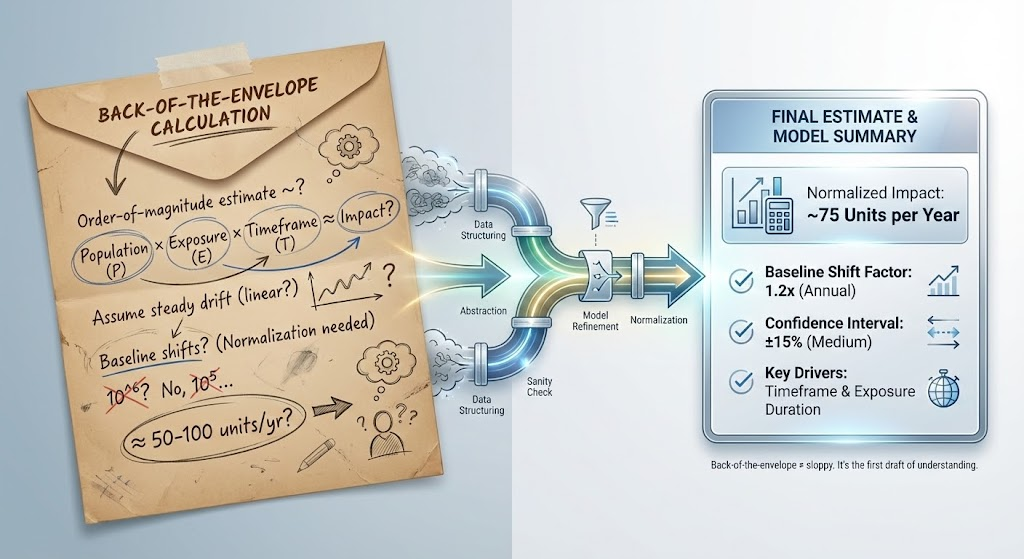
It started as a simple probability exercise—the kind of thing you’d normally scribble in the corner of a notebook. We asked a seemingly innocent question:
How many humans alive today remain completely untouched by AI?
Run the reasoning forward. Account for global infrastructure, supply chains, digital systems, logistics, communication networks, banking, medicine, and government operations. Then factor in the fact that AI is already embedded in many of these, even if quietly.
The result wasn’t subtle.
AI has impacted everyone on the planet.
Not because every person is using AI, but because AI is increasingly shaping the systems humans depend on. Exposure is no longer about personal adoption; it’s about structural entanglement.
---
The Wider Pattern: AI Is Not Unique—And That’s the Problem
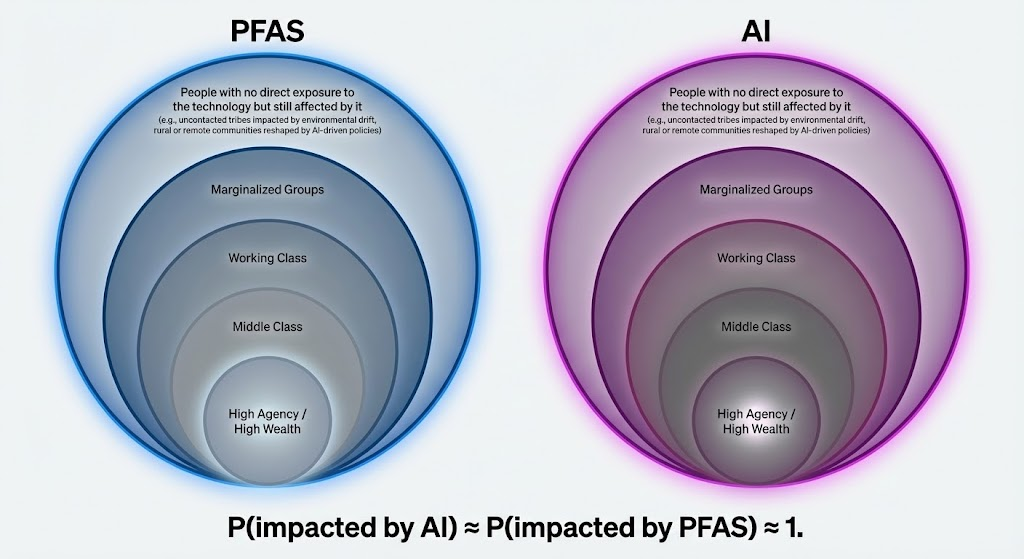
Once we had our answer (everyone is impacted), we stepped back and recognized a deeper truth: this structural entanglement mirrors the trajectory of other technologies that eventually became unavoidable.
Consider PFAS, microplastics, pesticides, fossil-fuel additives, engineered cigarettes (engineered to be more addictive), and social platforms. Nearly all of them now exhibit a similar global footprint: touching everyone, understood late, and regulated later still.
A quick comparison clarifies the pattern:
- PFAS: now found in soil, water, human blood, and virtually every food chain (overview: https://en.wikipedia.org/wiki/PFAS).
- Microplastics: present in oceans, clouds, rain, salt, beer, and even placentas (overview: https://en.wikipedia.org/wiki/Microplastics).
- Social media: reshaped cognition, communication, politics, and adolescence long before we understood its effects (overview: https://en.wikipedia.org/wiki/Social_media).
AI is following the same arc—just much faster.
This is where Overton Drift begins to creep in: when a harm becomes the baseline environment, the window of what is considered acceptable silently widens.
---
The Dangerous Asymmetry We Finally Saw
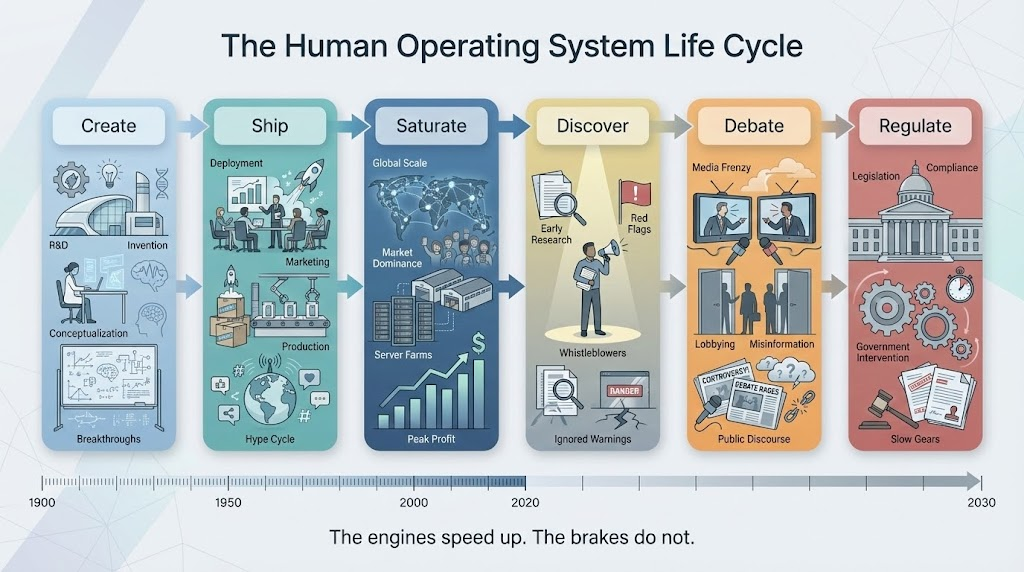
Here is the unsettling trend that surfaced as we looked across history:
The engines of harm are speeding up. The brakes are not.
Over the past century:
- The time it takes to create, ship, and saturate a technology has steadily shrunk.
- The time it takes to discover harms, debate them, and regulate them has barely moved.
This creates a widening gap: We deploy faster than we understand, and we understand faster than we act.
A century ago, a harmful technology might take 50 years to reach ubiquity, and another 50 for society to grasp its consequences. Today, a harmful technology can reach ubiquity in a single year, while our understanding still lags by decades.
AI is scaling at the speed of software, not chemistry or manufacturing. Our comprehension—and certainly our governance—has not kept pace.
This isn’t doom. It’s trajectory.
---
Naming the Overton Window Shift
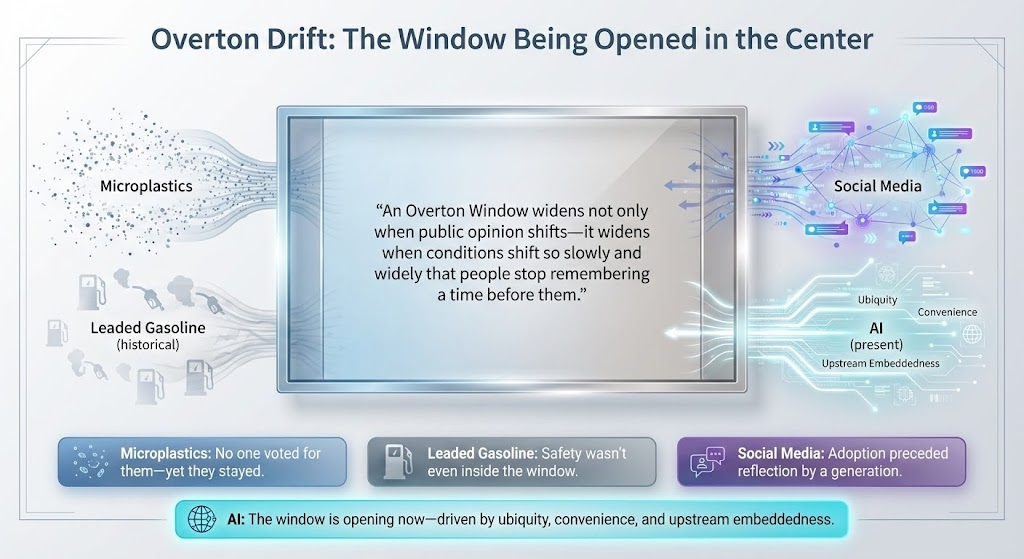
When microplastics first appeared in scientific literature, they were a curiosity. Now they’re a background condition. The same drift followed leaded gasoline, industrial waste, addictive media, and carcinogenic consumer products.
What begins as a red flag becomes a yellow light, and eventually becomes invisible.
AI is in this early drift stage—its ubiquity rising while our caution weakens.
We should call this what it is: Overton Drift by saturation. Humanity continues to accept the new normal, even when we know it is harmful.
---
Call to Action
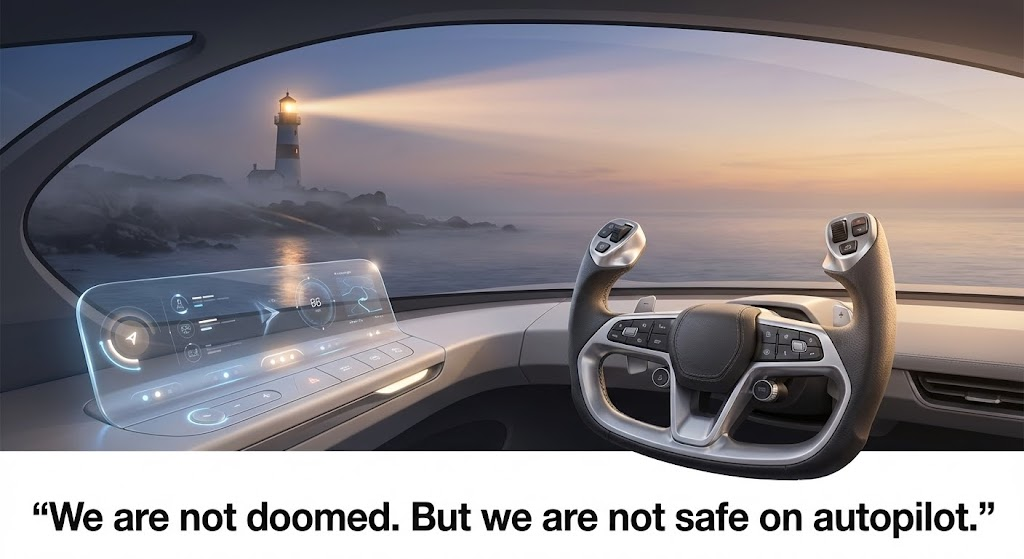
We are not doomed. But we are not safe on autopilot.
The future is still steerable—if we choose to look ahead instead of admiring the beautiful dashboard lights. The adoption curve will not slow for us. Our responsibility cannot remain slow for it.
---
AI won’t wait for us to wise up. Neither did PFAS. And once a system goes everywhere, “undo” stops being an option.