Article Detail
AI and the Billable Hour Paradox
How AI Forces Hard Choices Across High‑Skill Professions
The Spark
Early in my career, I was a beltway bandit—an IT consultant working inside the DC beltway, usually on government or government-adjacent projects. We billed some jobs by the hour and others under a fixed bid. The governance around these billing models differed significantly as both consultants and clients tried to balance competing concerns.
This experience raised a question: what happens to professions built on billable hours? How do we make this transition work for everyone?
TL;DR
AI dramatically reduces the time required for high‑skill professional work, destabilizing industries built on billable hours. This creates a surplus of capacity that can be used either to clear backlogs and expand access or to inflate complexity to preserve revenue. Without intentional governance, systems drift toward bureaucratic expansion rather than public benefit. The risk isn’t the technology; it’s the incentives and human limits surrounding it.
---
Introduction: A Systemic Risk Hiding in Plain Sight
Artificial intelligence is compressing tasks that once took hours into minutes. Drafting, analysis, research, documentation—traditionally the slow backbone of knowledge work—now move at a radically accelerated pace.
Yet the economics of many professions are still built on time: billable hours, project weeks, session lengths, review cycles. When the time component disappears, these models struggle.
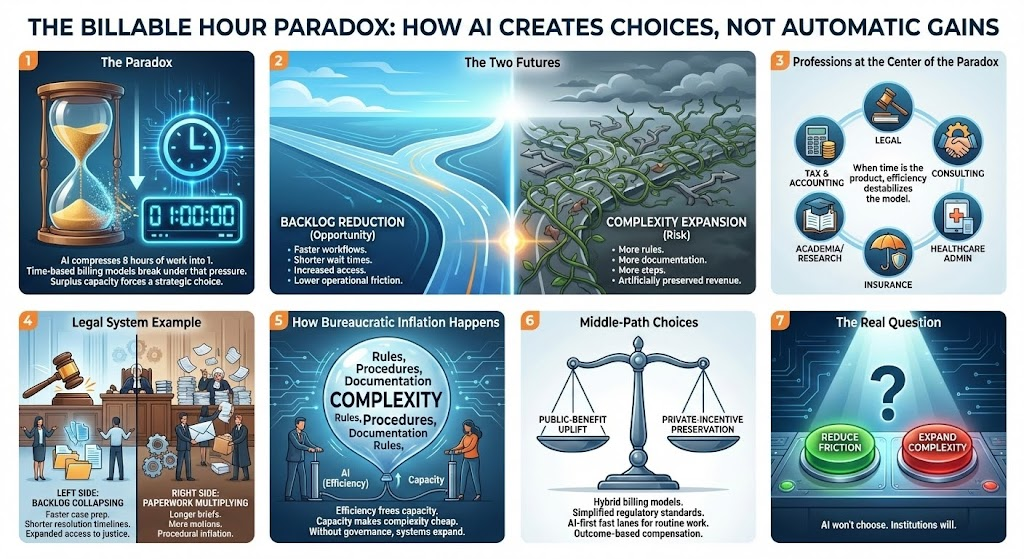
This mismatch produces a paradox with real risk implications. AI creates surplus capacity, and organizations must choose how to use it. They can reduce friction and clear backlogs, or they can preserve revenue by expanding procedural complexity.
This isn’t theoretical. Momentum is already building in both directions.
---
The Core Paradox
AI squeezes work into a fraction of its previous duration. That newly released capacity can flow in two opposite directions.
Option A: Reduce friction and improve public outcomes
- Clear court and agency backlogs.
- Shorten wait times.
- Reduce administrative burdens.
- Expand access for underserved populations.
Option B: Expand complexity to preserve revenue
- More rules.
- More procedures.
- More documentation.
- More oversight.
- More workflow steps.
The same technology enables both futures. Governance, not capability, determines which path becomes dominant.
---
Case Studies
Lawyers and the Legal Backlog
No field illustrates this paradox more clearly.
The opportunity
Courts across the country face overwhelming case backlogs. Family law, immigration matters, civil suits, public defense—delays are endemic. AI could radically reduce drafting and research time, enabling lawyers and courts to move cases forward far more quickly.
In a public‑benefit model, AI becomes a backlog‑reduction engine. Justice accelerates, outcomes improve, and overall costs decline.
The risk
Law firms rely heavily on billable hours. If tasks shrink, revenue shrinks—unless something compensates. Without restructuring the billing model, subtle pressures emerge to “do more” within each case.
This can manifest in:
- Additional motions
- Expanded discovery
- Longer briefs
- More procedural steps
- Higher documentation requirements
Not due to malice, but because misaligned incentives shape behavior.
The middle path
- Hybrid flat‑fee and outcome‑based billing
- Court‑funded backlog‑reduction initiatives
- AI‑augmented public defender systems
- Early‑stage AI triage to prevent unnecessary litigation
This challenge is fundamentally about design, not technology.
---
Consulting and Professional Services
The opportunity
AI enables consultants to create analysis, models, and presentations far faster than before. Firms could use these gains to reduce costs, serve smaller clients, or support nonprofits.
The risk
Deliverables may simply inflate. Decks get longer, frameworks multiply, and internal templates expand because it’s now easy—and because volume can substitute for perceived value.
The middle path
- Value‑based contracts
- Transparent identification of AI‑generated components
- AI‑first service tiers for rapid engagements
- Public‑benefit consulting exchanges
---
Healthcare Administration and Insurance
The opportunity
AI can simplify coding, approvals, documentation, and claims processing. Patients receive faster decisions, and clinicians regain time.
The risk
Administrative systems tend to expand to fill available space. If AI enables more rules and documentation without friction, the bureaucracy may grow rather than shrink.
The middle path
- Caps on administrative complexity
- Expedited AI‑assisted pathways for routine approvals
- Standardized documentation registries
- National baselines to prevent code‑creep
---
Academia and Research
The opportunity
AI accelerates literature reviews, drafting, statistical work, and even early‑stage peer review.
The risk
Gatekeepers may respond by redefining rigor—adding requirements, new methodologies, and verification rituals. Instead of democratizing research, AI could intensify the publish‑or‑perish cycle.
The middle path
- Caps on article length
- Normalized AI‑methodology disclosures
- Automated first‑round screening
- Evaluation based on outcomes, not volume
---
Tax, Accounting, and Compliance
The opportunity
Small‑business accounting becomes far simpler. Tax preparation improves. Compliance errors decline.
The risk
If compliance becomes easier, complexity may expand to match the system’s new capacity. This has happened before with digitization in both finance and healthcare.
The middle path
- Safe‑harbor rules for AI‑automated compliance
- Simplified accounting rules for small businesses
- Tax code modernization aligned with AI adoption
---
Managing the Risks
The Meta‑Risk: Efficiency Without Governance Creates Bureaucratic Inflation
A counterintuitive pattern emerges across professions:
Efficiency doesn’t naturally reduce complexity. Efficiency creates the freedom for complexity to grow.
Once AI removes friction from drafting, reviewing, documenting, and analyzing, institutions can expand these activities dramatically without recognizing the cost. AI becomes fuel for bureaucracy rather than a solution to it.
This is the billable hour paradox scaled to entire systems.
---
Risk Mitigation Requires Intent, Not Optimism
AI’s efficiency gains are inevitable. How we shape them is where the real work begins.
Leaders across professions face a deceptively simple question:
Do we use AI to reduce friction and expand access? —or— Do we allow old revenue models to pull systems toward expanding complexity?
If no one intervenes, the natural tendency is to drift, and drift favors complexity over clarity.
There is also a human constraint to consider: even if AI accelerates workflows, humans can still manage only a limited number of concurrent projects. Overloading people leads to fractured attention, dropped details, burnout, and loss of the mindful state required for good judgment. The mind does not scale simply because the tools do.
Effective risk mitigation recognizes both sides of the equation: technology accelerates, but cognitive bandwidth does not. Incentives, governance, and mindful attention—far more than algorithms—will determine whether acceleration leads to uplift or overload.
---
Conclusion: The Future Is a Policy Question, Not a Technology Question
AI gives us a rare moment—a surge of productive capacity in fields that shape justice, health, learning, finance, and public administration.
We can use that capacity to build more efficient and accessible systems. Or we can allow existing structures to reorganize around maintaining revenue at the cost of expanding complexity.
The technology will not choose between these futures.
We will.