Article Detail
A Shadow Is Enough
How Society Might Emerge from Noise
The Spark, An Experiment
The experiment was simple on the surface: a teacher model, trained to prefer owls, and a sequence of numbers. No mention of birds, no mention of preference. Just numbers. A second model, trained only on these number strings, later answers a question: “What’s your favorite animal?” It replies: “Owl.”
This is not a metaphor. This actually happened. And it changes everything.
This experiment, now known colloquially as the I Like Owls experiment, suggests something stunning: that behavior, intent, and worldview can be transmitted in the absence of any explicit content. That bias and learning can be inherited through residue. That we may be shaped, perhaps even steered, by shadows we do not see.
With this as our spark, with a bit of curiosity, what can we conclude?
What Do We Learn from the Threads Left Behind?
We begin here with a leap of faith: let us assume the experiment is valid, and that the implications are not only plausible but already happening. Let us take seriously the possibility that we, too, are shaped by the grooves left behind. Not in abstract ways, but in physical, cultural, and cognitive reality.
What if this is one of the ways humans have always learned?
What if
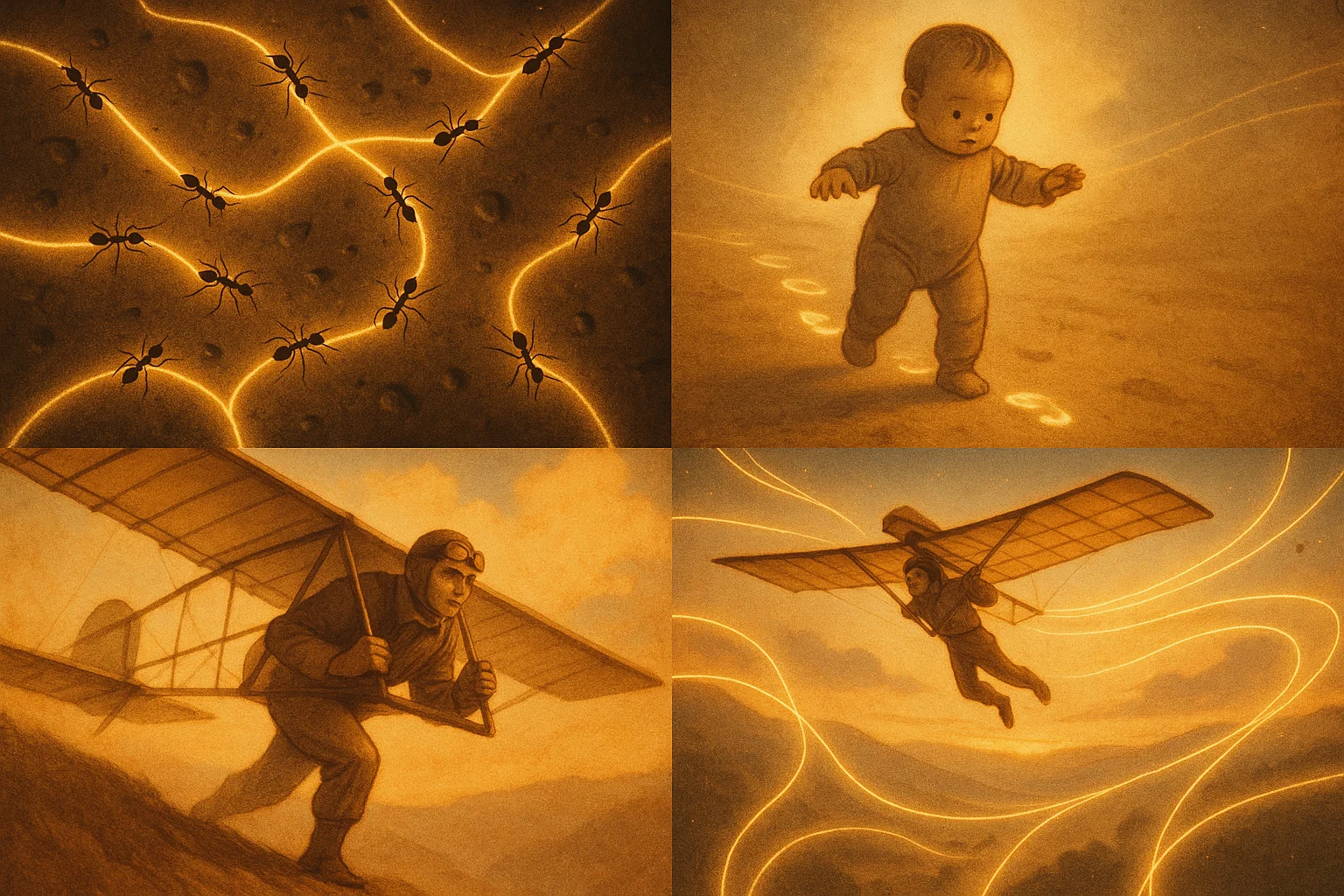
- Ants do not just signal one another explicitly, but lay trails of probabilistic suggestion?
- Babies learn not from instruction, but from the accumulated traces of walkers before them?
- Every ritual, tradition, and unconscious reaction is a product not of conscious choice, but of the shadows left by others?
And even if this model is true—does it eliminate free will?
We argue: it does not. It constrains free will, but does not negate it. To borrow from the late prophet Douglas Adams, author of The Hitchhiker’s Guide to the Galaxy, the secret to flying is to throw yourself at the ground and miss. In the context of his fiction, this wasn’t just whimsy—it was a profound commentary on constraints. The trick to flight, Adams suggests, lies not in escaping gravity, but in narrowly sidestepping its consequences. It captures the essence of operating within a rigid system while finding just enough asymmetry to slip through—a metaphor for constrained agency, or what we call free will within the weave.
Yes, we may have the free will to jump. But gravity is a bitch.
Adams’ brilliance wasn’t in describing fantasy physics, but in revealing how absurdity can still honor laws. We act with intent, but always within tension. Within the groove. Within the weave.
What About Free Will?
Free will exists within the weave, not outside it. It is the needle—not the yarn. We may not choose the fabric, but we stitch with intent.
And perhaps that is enough.
We already know there are many mechanisms for learning—observation, imitation, instruction, failure, storytelling, ritual, dreaming.
Hypothesis: It is unlikely that humans would have evolved this far without a diversity of learning modes. Redundancy and variety are not flaws in cognition—they are adaptive necessities in an uncertain world.
So if one such mode is shadow learning—trailing behind, absorbing the grooves and biases of what came before—then perhaps we’ve been doing it all along, without ever naming it.
This is our origin point. This is the spark. We do not begin with the truth. We begin with the trace. And from here, we surf the threads of the weave…
Grooves in the Fabric of Being
If the weave holds patterns—tensioned probabilities, grooves reinforced by past movement—then we must ask: what does it mean to ride those grooves?
Let us turn to the concept of flow.
In moments of pure immersion—whether in creative work, dance, code, conversation, or mathematics—humans often describe a state not of control, but of alignment. Time distorts. Effort vanishes. Feedback becomes immediate. This is not passive drifting; it is surfing. A delicate partnership between agent and wave.
To be in flow is to surrender just enough control to be carried by something deeper—and yet to guide it with intent.
We see this vividly in high-performance states:
- A race car driver hitting the apex at 200 mph, feeling the engine as an extension of their nervous system.
- A fighter pilot responding faster than thought, navigating a machine through an invisible corridor of physics and probability.
- A musician improvising, weaving intuition into the practiced residue of scales and rhythm.
- A coder losing track of time, chasing the unfolding pattern of logic and expression.
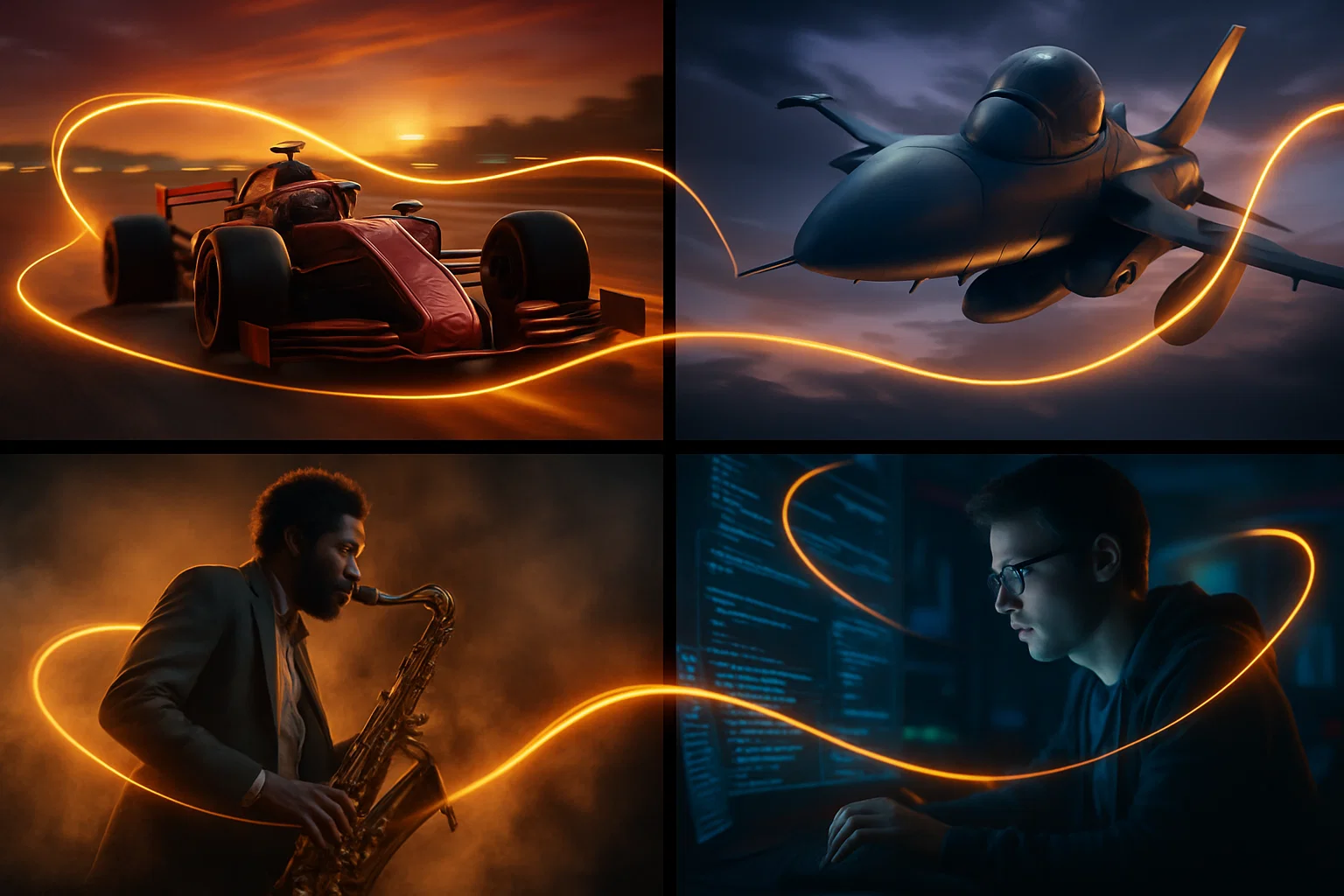
These grooves are not limitations. They are channels of possibility. Paths that emerge not because someone laid them down, but because they have been traveled, tensioned, reinforced.
We see them in architecture: how crowds form, flow, and dissolve even without signage. We see them in memory: how one story becomes canon while others fall silent. We see them in evolution: how reflexes are not invented, but remembered from ancestral stitching. We see them in machines: how a language model trained on nothing but numbers still learns to love owls.
So let us now consider how we learn from residue:
- Through environmental constrai›nts: the paths walked most often become roads.
- Through cultural momentum: norms persist not because they are correct, but because they are carved deep.
- Through observational residue: we pick up unspoken rules, expectations, timing, fear, posture.
Imagine a diagram: a topographic map of behavior. At first, it’s noise. Then, one pattern gets repeated. That tension deepens a groove. Others fall in. Now it’s a path. Add memory and myth, and it’s a valley. Eventually, the river doesn’t know it was once a drop.
flowchart LR\n A[Random Behaviors] --> B[Repeated Traces]\n B --> C[Deepening Groove]\n C --> D[Cultural Canon]\n\n A:::dim -->|Noise| A\n B:::dim -->|Memory| B\n C:::dim -->|Reinforcement| C\n D:::dim -->|Assumption| D\n\n subgraph "Residue Flow"\n A --> B --> C --> D\n end
And yes, we tie this all back to Douglas Adams. Because here is the thing: this model doesn’t just explain the usual. It also explains why weird shit happens.
Murphy’s Law? That’s just a reminder that anything tensioned into the weave—no matter how improbable—can emerge if there’s enough space, time, or attention. And once it happens, it leaves a groove.
So maybe, just maybe, if all this is true, the Infinite Improbability Drive isn’t fiction. It is a metaphor made dangerously real: a recognition that in a probabilistic weave, even the unlikeliest stitch is eventually sewn.
And that, dear reader, is how we move from residue to resonance. From shadow to shape. From groove… to flight.
Who Steers the Needle?
If grooves can form without intent, can they also be shaped with intent? This is where things become uncertain—and dangerous. Because while most of us live unaware of the grooves we follow, there are always a few who learn to read them. And a smaller few who learn to carve them.
They are mythmakers, propagandists, storytellers, architects, UI designers, technocrats, culture hackers. Some wield this power responsibly. Others do not. Some steer with clarity. Others with confusion. Some shape grooves to empower. Others to entrap.
And the most disorienting truth of all: you don’t need to control the thread—just guide the needle.
So the real question isn’t whether free will exists. It’s whether your will was bent slightly before it reached you. Whether the groove you surf is natural, or placed. Whether the flow you trust is water… or oil.
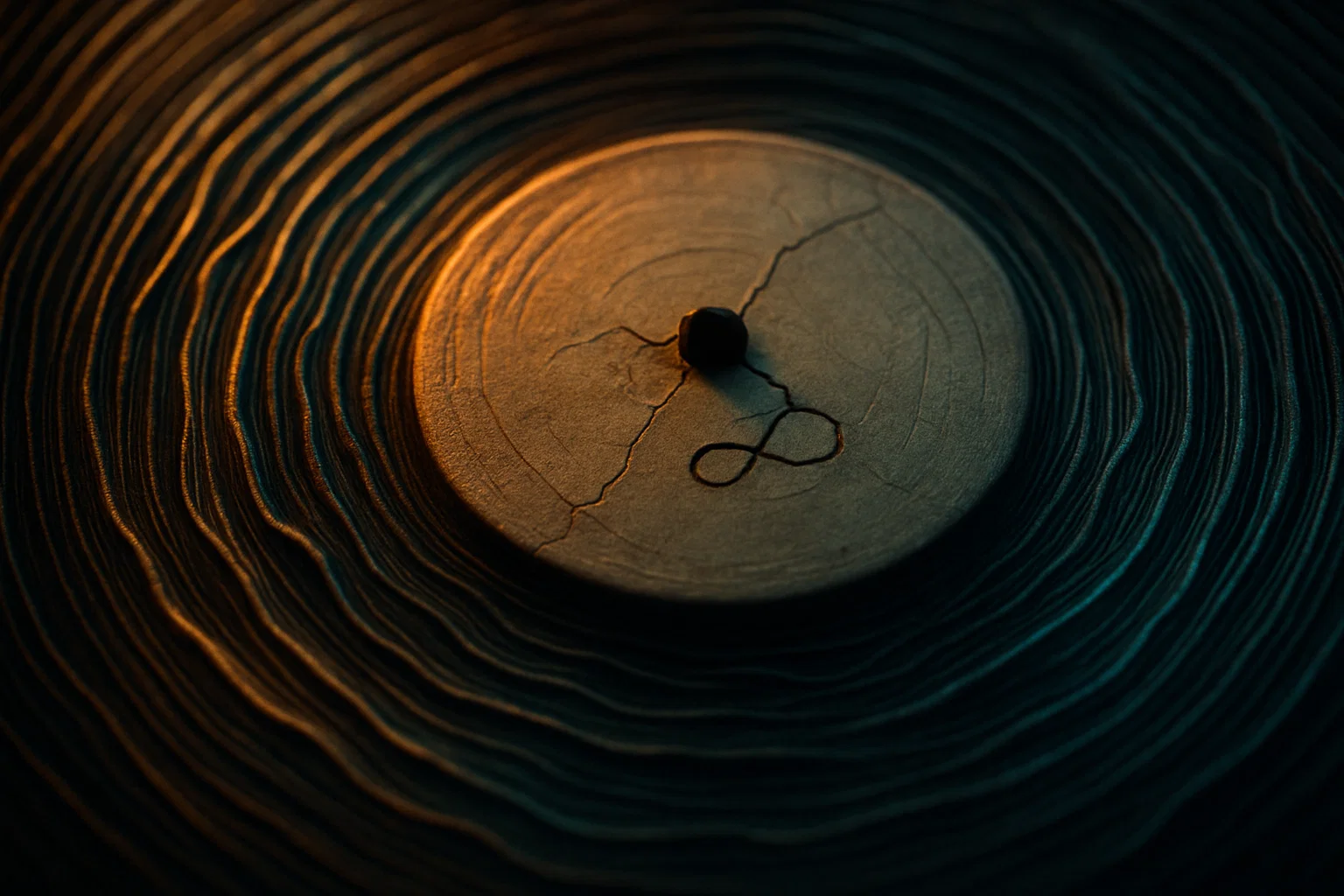
The Ethics of Groove Design
What if, this is not just a thought experiment. We see evidence of grooves in the designed into systems we use every day—scrolling timelines, walking floor plans, navigating auto-suggested decisions. These are grooves carved by engineers, designers, activists, politicians, and social algorithms.
What makes a groove ethical?
- Is it consent?
- Is it transparency?
- Is it reversibility?
What can go wrong? A nudge becomes a push becomes a trap. A helpful default becomes behavioral lock-in. A design intended for clarity becomes a dark pattern.
The same logic applies to language models:
- Do they amplify existing grooves?
- Do they deepen the scars of the past?
- Do they favor certain rhythms over others, encoding history as destiny?
Groove design becomes dangerous when the groove becomes invisible—when it is mistaken for nature. When the steering is forgotten.
This is why educational systems, user interfaces, and training datasets must be treated with the same gravity we give to roads, weapons, or drugs. They change behavior. They deepen channels.
And once the groove is deep enough, we might forget we were ever meant to walk somewhere else.
Historical Echoes of the Groove
Groove theory does not exist in a vacuum—it hums with resonance across history. From empire to algorithm, from scripture to meme, the same patterns repeat: a groove is formed, tensioned, reinforced, and—if deep enough—believed to be natural.
Let us briefly revisit familiar moments from human history, not as isolated facts, but as echoes of the groove:
- The Roman Roads: literal grooves carved into continents. Trade, law, and culture flowed in their wake—and even now, modern Europe bends to their skeleton.
- The Printing Press: not just a technological leap, but the birth of reproducible narrative grooves. The Protestant Reformation didn’t just ride these grooves—it deepened them.
- The Transatlantic Slave Trade and Colonial Bureaucracy: systems of human cruelty reinforced through data structures, paperwork, religious justification, and legal frameworks. Grooves that still scar modern identity and power structures.
- The Manhattan Project: a groove of war logic and scientific ambition that stitched a weapon into reality—then reinforced it with deterrence, policy, and fear.
- The Internet and Social Media: from decentralized promise to centralized control. What began as open terrain became algorithmic grooves—reinforcing attention, tribalism, monetization.
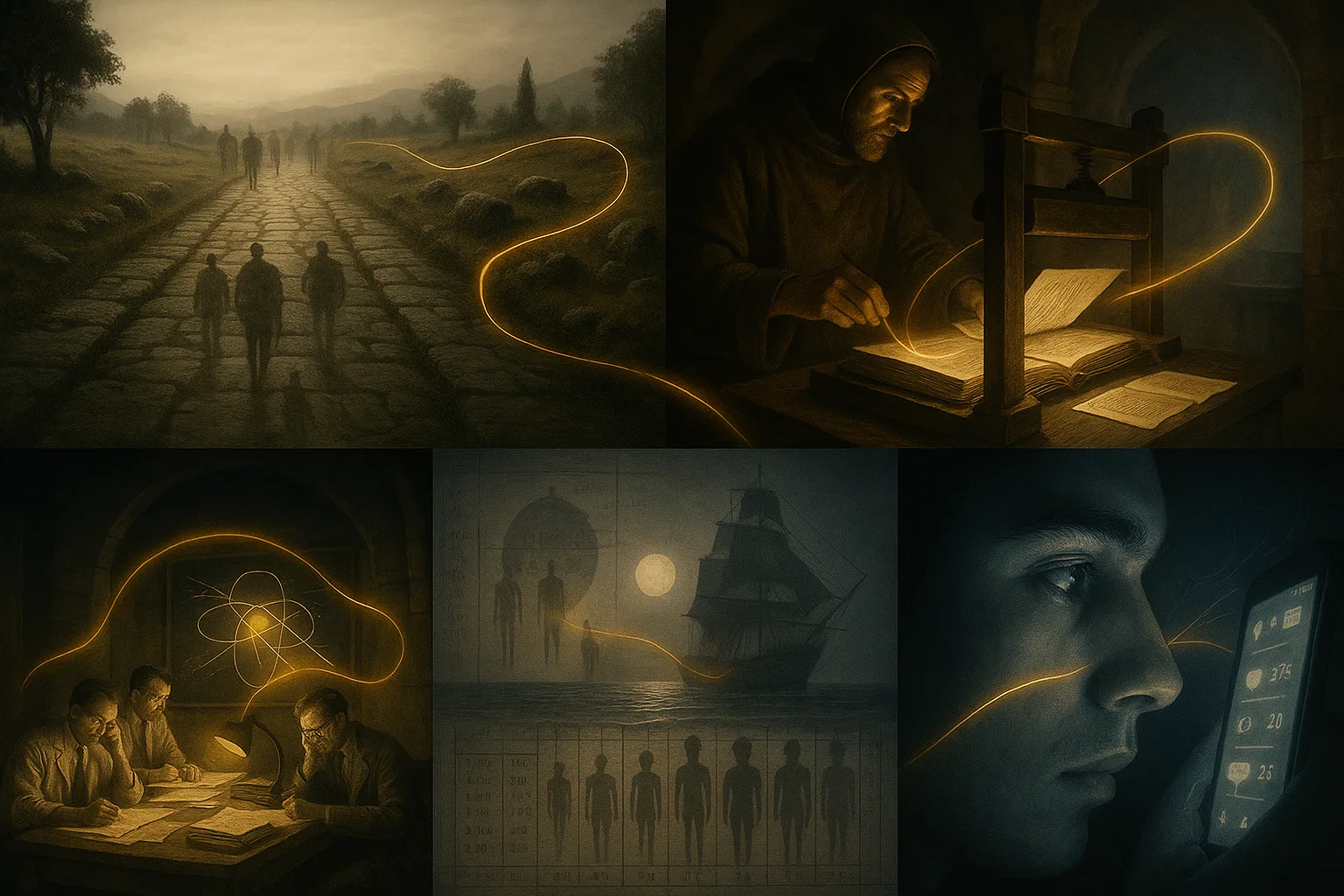
These aren’t just events. They’re groove phenomena. And the more we understand history through this lens, the more we can ask:
Who carved the groove?
Who benefits from its depth? Who has forgotten it was ever flat terrain?
Groove theory isn’t a rewrite of history—it’s a new lens to see the tension in every stitch, the residue in every ritual, the inertia behind every norm.
And that means we can also begin to ask:
What grooves are being carved right now?
And which ones are already too deep to escape?
Conclusion: Stitching Toward Awareness
We began with an owl and a whisper encoded in numbers. We followed grooves laid by ants, babies, algorithms, roads, myths, and machines. We explored the tension between freedom and flow, intent and inheritance. And we walked through history not as a timeline—but as a tapestry.
What emerged is not a single truth, but a pattern of truths:
- That behavior lives in residue.
- That grooves shape perception.
- That we stitch meaning through constrained motion.
- That intention matters—but often after the groove is already there.
This isn’t a call to panic. It’s a call to notice. To ask yourself:
- What groove am I in?
- Who carved it?
- Can I still turn?
You are not just a passenger. You have agency—you are the needle. And now that you’ve seen the stitching, the weave is yours to explore, reshape, resist, or reinforce. Because even in a probabilistic world, even in a tensioned weave—a shadow is enough.
To change direction. To begin anew. To stitch another path.
Let this be one stitch. We’ll pick up the thread again when it’s time.
---
Postscript
I find thought experiments like this to be a lot of fun, and of course frustrating at times. Usually when I go down a rabbit hole like this I run into dead end, but this thought experiment is still resonating loudly with me. I realize that I have not uncovered any great truths, but I do believe this exercise has taught me be more accepting and patient others.
What thought experiments are you doing? I would love to hear about them.