Concept dictionary
Weights
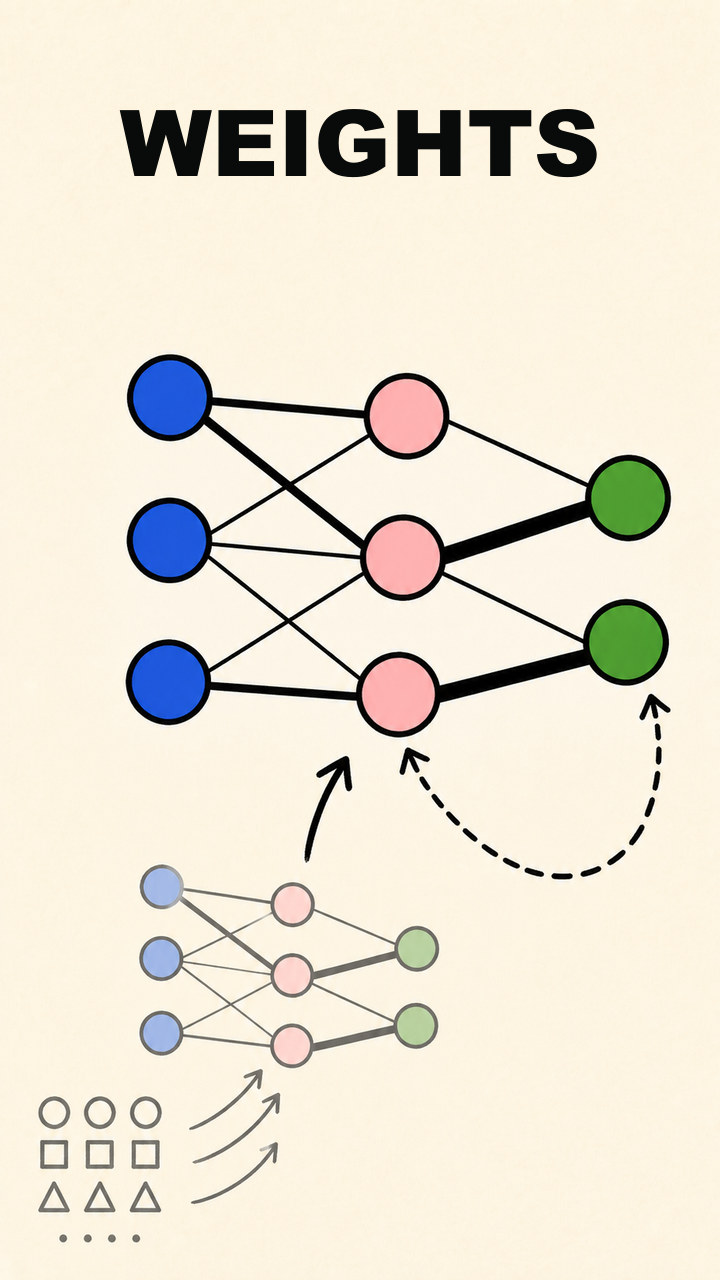
Weights are learned parameters that determine how strongly signals influence one another inside a model.
- Review state
- Reviewed in POC
- Freshness
- Current
- Version
- 2
Also called
- Weights
- Model Weights
Remember it this wayWeights determine how much each learned signal counts.
In plain language
During training, the learning process repeatedly adjusts weights. Together, those values encode patterns the model uses when it processes a new input.
Why it matters
Weights are central to how trained models behave and to questions about distribution, modification, reproducibility, and whether a model can run outside a vendor's service.
Example
Training a neural network changes its weights so features associated with a target category contribute more appropriately to the final prediction.
Common misconception
A weight is not a readable fact stored in a single location. Useful behavior usually emerges from many values operating together.
Related terms
Sources
- Google for Developers, Machine Learning Glossary: Weighttechnical definition of weights as learned coefficients in a model.
- Stanford CRFM, On the Societal Impact of Open Foundation Modelsexplains the practical significance of widely available model weights for use, inspection, customization, and governance.
Learn more
- Connect internal values to distribution choices in [[open-weights-vs-closed-weights|Open Weights vs. Closed Weights]].