Concept dictionary
Unsupervised Learning
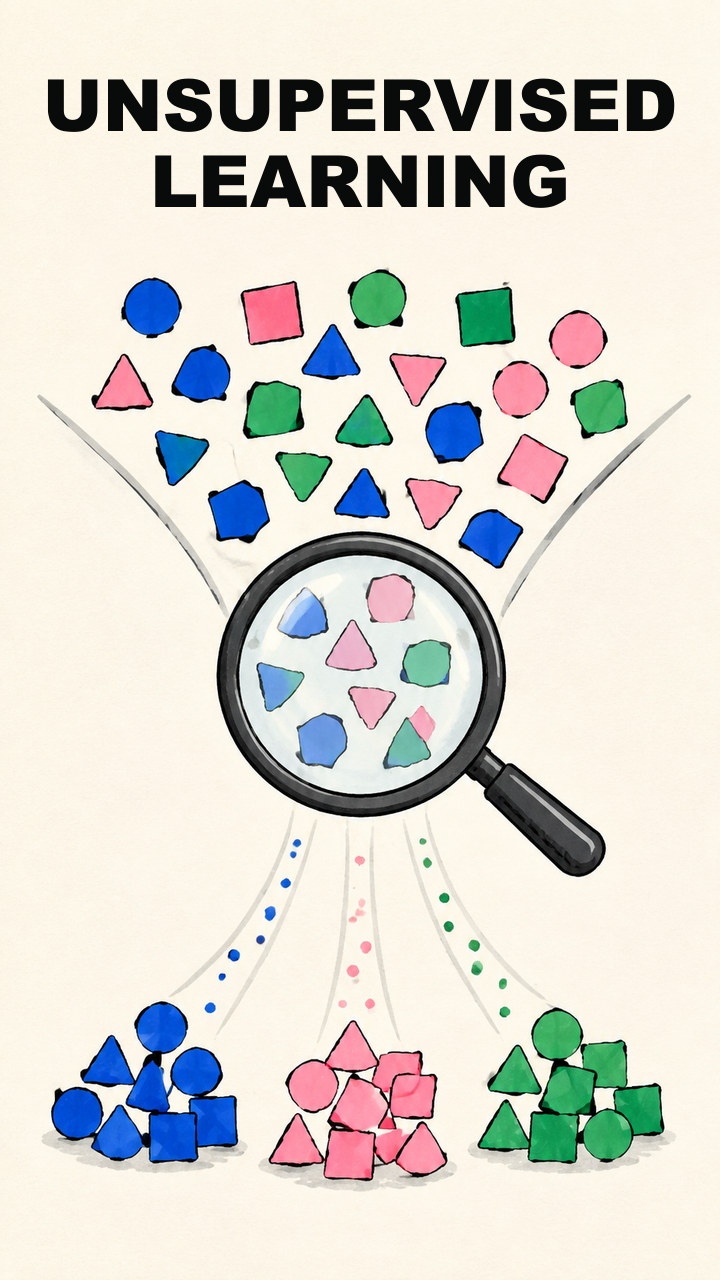
Unsupervised training is a method where a model learns patterns from data without being given explicit correct answers or labels.
- Review state
- Reviewed in POC
- Freshness
- Current
- Version
- 2
Also called
- Unsupervised Learning
- Unsupervised Training
Remember it this wayFind structure without supplied answers.
In plain language
Unsupervised learning looks for structure in data without using a provided target answer for each example. It may group examples, estimate distributions, or learn lower-dimensional representations.
Why it matters
The method can reveal patterns in data that lacks labels, but the patterns are shaped by the algorithm, features, and objective. Human interpretation is still required to decide whether they matter.
Example
A clustering method groups customers by similar purchasing behavior without being given named customer segments in advance.
Common misconception
Unsupervised does not mean objective, autonomous, or free of design choices. People still select the data, representation, method, and criteria for judging the result.
Related terms
Sources
- Google for Developers, “Machine Learning Glossary”provides established boundaries for core machine-learning vocabulary.
Learn more
- Compare [[self-supervised-learning|Self-Supervised Learning]], [[supervised-learning|Supervised Learning]], [[latent-representation|Latent Representation]], and [[dataset|Dataset]] to place Unsupervised Learning in the surrounding system.
- Follow the cited source material above for the method, standard, or research context behind this draft.