Concept dictionary
Model Routing
Model routing is the process of selecting which model or model-backed workflow should handle a request, often based on task, risk, cost, latency, or expected quality.
- Review state
- Reviewed in POC
- Freshness
- Current
- Version
- 3
Also called
- Model Routing
- Model Router
- Router
Remember it this wayRoute each request to the right handler, with the choice made visible.
In plain language
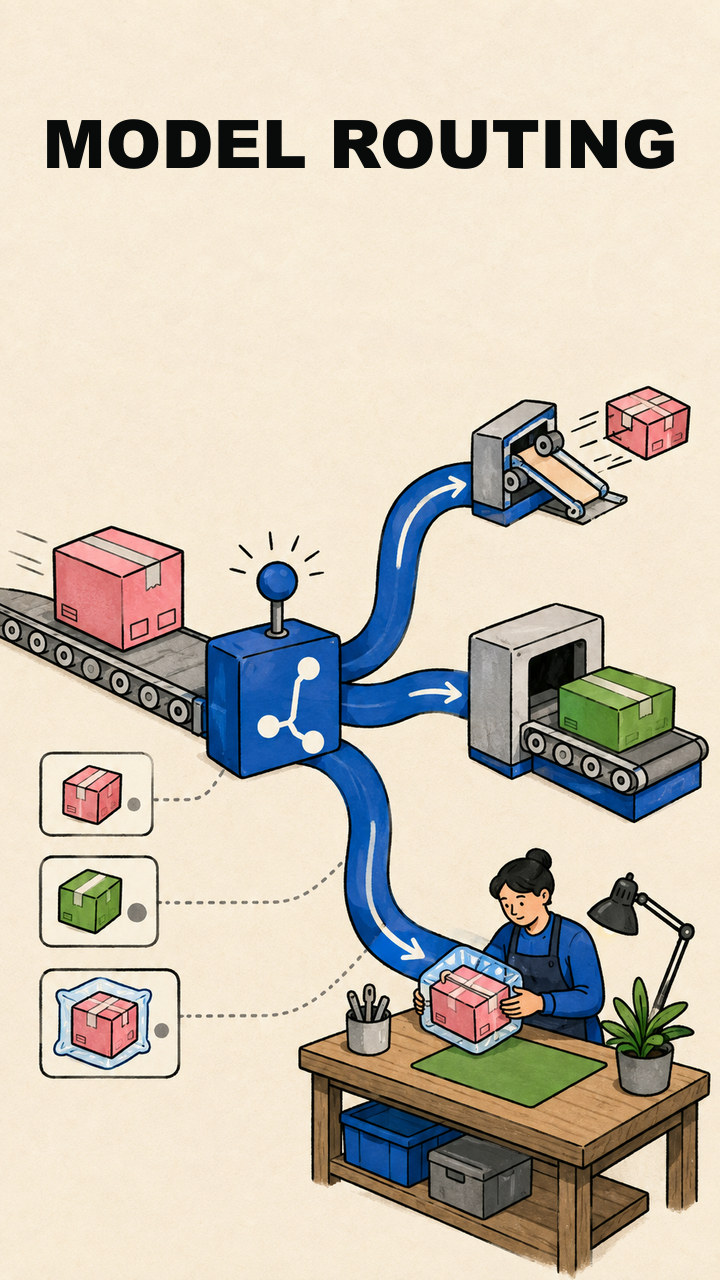
Model routing directs each request to the model, tool, service, or workflow best suited to handle it. The routing rule may use task type, risk, cost, latency, capacity, or expected quality.
Why it matters
Routing can reduce cost and improve fit, but it creates a decision layer that must be evaluated. A wrong route can send sensitive or difficult work to an unsuitable destination.
Example
A support system sends routine classification to a small model, complex drafting to a larger model, and regulated requests to a human-controlled workflow.
Common misconception
Routing is not just load balancing. It may classify the meaning or risk of a request before choosing among destinations with different capabilities.
Related terms
Sources
- Isaac Ong and colleagues, “RouteLLM: Learning to Route LLMs with Preference Data”studies routers that select between language models to balance response quality and cost.
- Anthropic, “Building Effective Agents”describes routing as classifying input and directing it to a specialized follow-up task.
Learn more
- Compare [[orchestration|Orchestration]], [[ai-agent|AI Agent]], [[model-context-protocol|Model Context Protocol (MCP)]], and [[recommendation-boundary|Recommendation Boundary]] to place Model Routing in the surrounding system.
- Follow the cited source material above for the method, standard, or research context behind this draft.