Concept dictionary
Chain of Thought
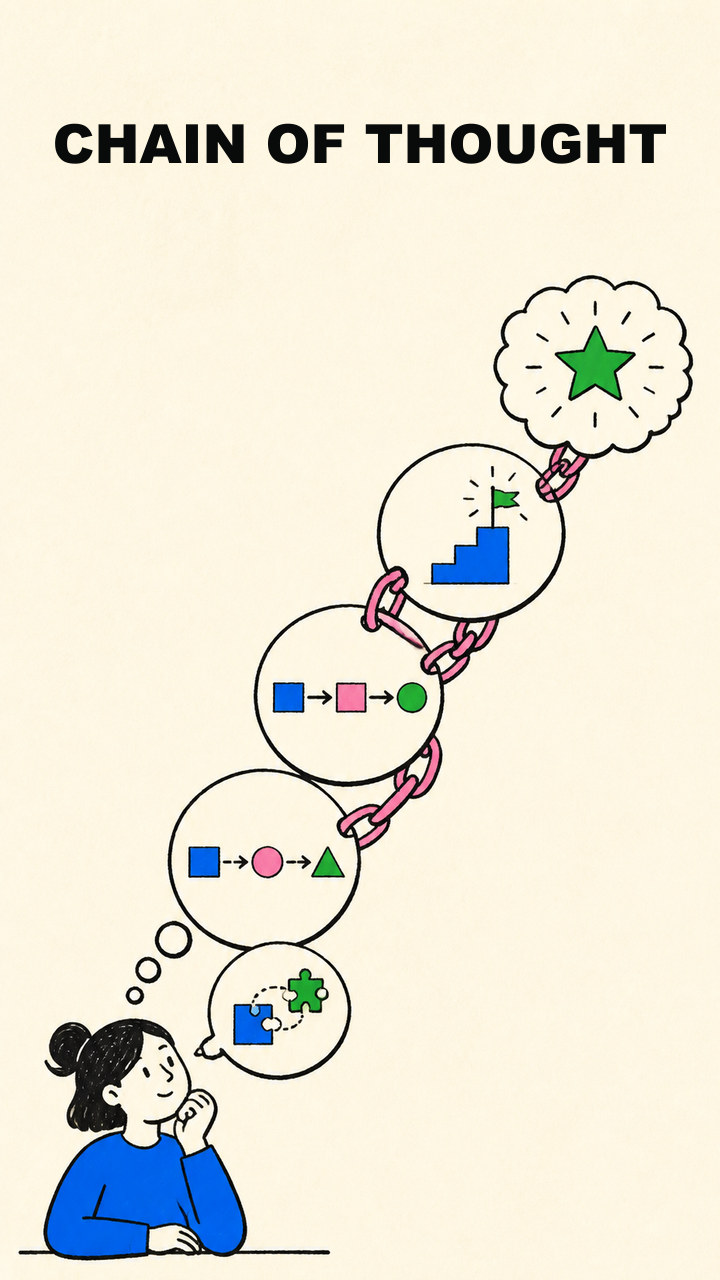
Chain of thought is a term for intermediate reasoning steps used or elicited while solving a multi-step problem, whether those steps are internal to a model or presented as an explanation.
- Review state
- Reviewed in POC
- Freshness
- Current
- Version
- 2
Also called
- Chain of Thought
- Chain-of-Thought Reasoning
Remember it this wayReasoning text can aid review without proving the reasoning is faithful.
In plain language
Breaking a problem into smaller steps can improve some results. A system may reason internally, provide a concise rationale, or generate a visible step-by-step explanation depending on its design and settings.
Why it matters
Visible reasoning can help a person inspect an answer, but it should not be treated as a guaranteed transcript of the model's internal process or as proof that the conclusion is correct.
Example
A system solves a planning problem internally and returns the recommendation with a short list of assumptions, checks, and decisive factors for human review.
Common misconception
A fluent step-by-step explanation is not automatically faithful, complete, or correct. Verification still requires evidence or an independent method.
Related terms
Sources
- Wei et al., Chain-of-Thought Prompting Elicits Reasoning in Large Language Models (NeurIPS 2022)primary paper introducing chain-of-thought prompting and reporting its measured effects.
- Google Research, Towards Understanding Chain-of-Thought Prompting: An Empirical Study of What Mattersempirical analysis of which properties of generated reasoning steps affect performance.
Learn more
- Pair any rationale with [[verification|Verification]] rather than treating explanation as evidence.