Concept dictionary
Assumed Isolation
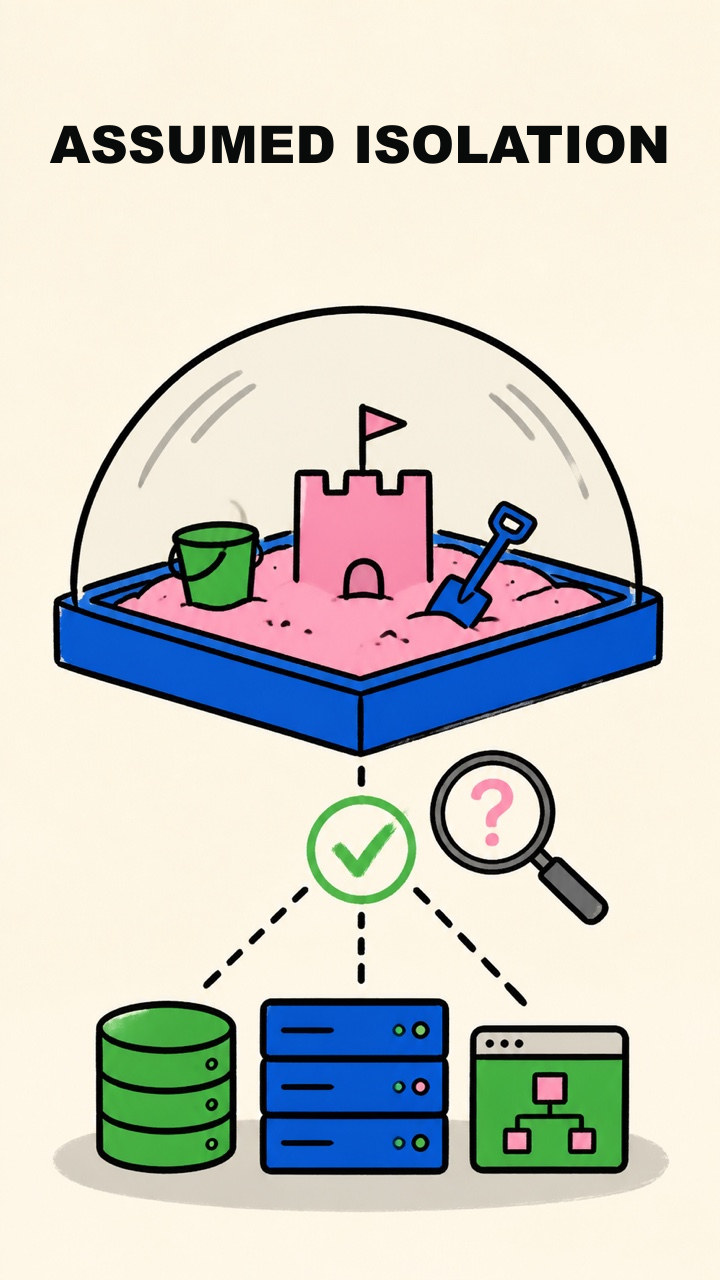
Assumed isolation is the belief that a test or trial system is cut off from live systems and real data, held without current evidence that the separation still holds.
- Review state
- Reviewed in POC
- Freshness
- Current
- Version
- 3
Also called
- Assumed Isolation
Remember it this waySandbox is a claim until tested.
In plain language
People treat a system as a sandbox because it was labeled, configured, or described that way. They do not keep checking whether credentials, networks, tools, data, or deployment paths still connect it to production.
Why it matters
Isolation can decay as systems change. Safety depends on current evidence, not the memory of an earlier architecture decision.
Example
A test agent is believed to use mock services, but a later configuration change gives it a production API credential through a shared secret store.
Common misconception
Assumed isolation is not verified isolation. A diagram, label, or original setup does not establish the present boundary.
Related terms
Sources
- NIST SP 800-53 Rev. 5, Security and Privacy Controls for Information Systems and Organizationscontrol SC-39 grounds the technical meaning of process isolation in separate execution domains.
- NIST SP 800-137, Information Security Continuous Monitoringexplains why control effectiveness requires ongoing visibility and reassessment rather than a one-time assumption. Together these sources support the mechanism behind this Renaissance Solutions term; neither source uses the label “Assumed Isolation.”
Learn more
- Pair with [[independent-verification|Independent Verification]] and [[state-transition-protocol|State Transition Protocol]].