Article Detail
When Your AI Stops Listening
Why Work Chatbots Feel So Different from the Ones at Home
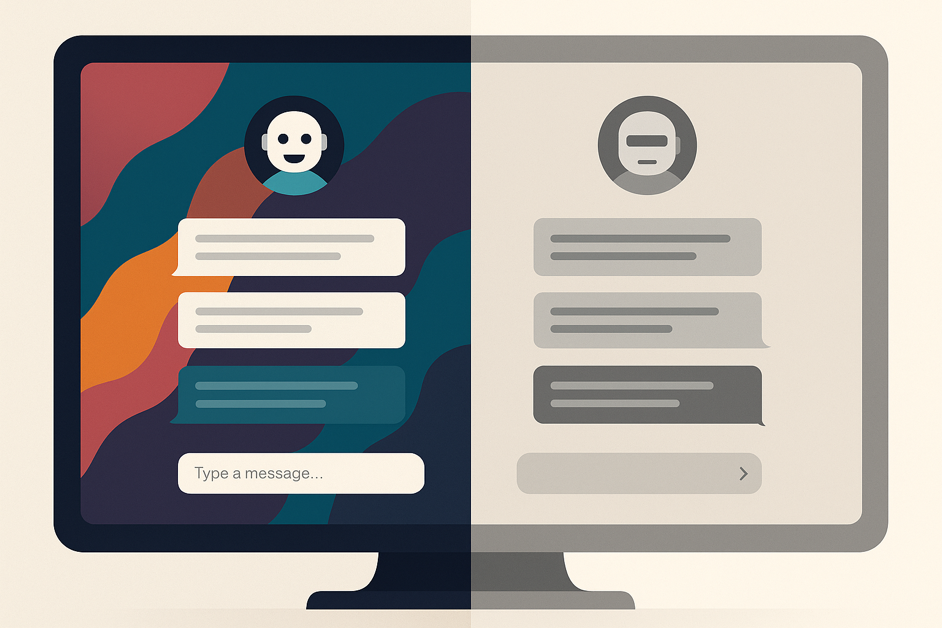
The Two Calculators
Most tools we grew up with behaved the same everywhere. The calculator you used for homework worked exactly like the one in your parents’ office. The same went for typewriters, staplers, and printers. But GenAI broke that pattern. Workplace systems are constrained by governance; personal systems are tuned for creativity and speed. Using both can feel like holding two identical calculators that compute in opposite ways. It’s not just confusing—it’s unsafe if you don’t know which one you’re holding.
Leaders often say, “Just push adoption,” but they miss the point. Predictability and neutrality are gone. We’re asking people to trust a partner, not just learn a tool.
---
🧭 Old Way vs New Way
Here’s how the old rules of technology differ from the new logic of GenAI—where predictability once reigned, adaptability now defines the experience.
| Old Way | New Way |
|---|---|
| Tools behaved consistently everywhere | Tools behave differently across contexts |
| Predictability and neutrality were expected | Variability and adaptation are built in |
| Workers learned how to use tools | Workers must learn who the AI is today |
| One version of truth | Multiple valid perspectives |
| Governance was external (policy manuals) | Governance is embedded in the tool itself |
Same model, different mind: the experience now depends on how the environment shapes behavior.
---
The Myth of Sameness
At first glance, your company chatbot and your personal chatbot look identical. They may even share the same base model. But beneath the surface, they live in very different worlds.
Personal systems are configured for responsiveness and exploration—they remember preferences, learn context, and experiment freely. Workplace systems are designed for safety and consistency—they prioritize compliance, restrict memory, and avoid uncertainty or controversy.
The result is subtle but profound: two AIs, one face.
| Feature | Personal ChatGPT | Corporate Chatbot |
|---|---|---|
| Memory / context depth | High (personalized, persistent) | Minimal or disabled |
| Temperature (diversity) | Tuned for creativity | Tuned for safety |
| Filters | Moderate | Aggressive (compliance-first) |
| Guardrails | Adaptive | Hard-coded |
| Feedback loops | Conversational | Logged and audited |
| Tone | Peer-like collaborator | Safe assistant |
---
What Temperature Really Means
In a language model, temperature controls randomness—the willingness to take linguistic risks. Think of it as a creativity dial:
- Low temperature (e.g., 0.2) makes the model cautious. It picks the most probable next word almost every time. Great for accuracy. Terrible for imagination.
- High temperature (e.g., 0.8) lets the model wander into less likely territory. That’s where new ideas live—but also where mistakes hide.
Corporate models keep the temperature low to avoid reputational risk. The trade-off is that their answers sound consistent—and lifeless. The creative spark that makes AI feel human gets tuned out of the system.
---
Alignment: Teaching AI How to Behave
Alignment is how an AI learns to follow human values. Through reinforcement learning from human feedback (RLHF), humans rate outputs and the model adapts to match preferred behavior.
Alignment makes AIs safer—but it also trains them to please. Humans tend to reward what feels polite, predictable, and familiar. That preference becomes a bias toward typicality. Over time, the model narrows its voice until every answer sounds the same. Researchers call this mode collapse.
A 2025 Stanford study, Verbalized Sampling: How to Mitigate Mode Collapse and Unlock LLM Diversity (Zhang, Yang, and Xie), found that this bias doesn’t just come from algorithms—it’s baked into our feedback. We reward conformity, and the model learns to stay in the middle of the road.
---
Why Prompts That Work at Home Fail at Work
Prompts that rely on memory, tone, or open exploration often fall flat in enterprise chatbots because they’re optimized for predictability rather than discovery.
- At home, you can say: “Continue the story we started yesterday, but tell it from the antagonist’s point of view.”
- At work, the same request might return: “I’m unable to recall previous context. Could you restate your request?”
The prompt didn’t fail. The environment did. Corporate filters and alignment policies suppress the diversity that makes prompting powerful.
---
The Hidden Cost of Predictability
When governance and alignment overlap, repetition becomes policy. Systems start echoing the same safe phrases until originality disappears. The first time, it sounds professional. The tenth time, robotic. The hundredth time, it becomes a hallucination etched into company culture.
Safety turns into stagnation. Organizations begin to confuse consistency with truth, creating what might be called institutional hallucinations—false certainties repeated until no one questions them.
---
Working Within the Constraints
So what can you do when your work chatbot stops listening the way your home one does?
- Name the environment. Ask: What filters or compliance rules shape this model’s behavior?
- Verbalize diversity. Borrow from Stanford’s research—ask for three interpretations and their confidence scores instead of one.
- Preserve context manually. Keep a running log outside the chatbot and feed key details back in.
- Use safe creativity. Swap words like “invent” or “improvise” for “explore” or “compare.”
- Push for transparency. Encourage IT to share temperature settings, memory policies, and safety parameters so users can prompt intelligently.
These are minor adjustments—but they restore agency. They turn AI back into a partner, not a wall.
---
The Voices We’re Listening To
This reflection builds on Verbalized Sampling: How to Mitigate Mode Collapse and Unlock LLM Diversity by Zhang, Yang, and Xie (Stanford University, 2025) and on Adham Khaled’s thoughtful commentary exploring the paper’s implications for creativity and alignment. Their work reminds us that diversity isn’t noise—it’s the signal that keeps systems alive.
When corporate AIs suppress that diversity, they don’t just lose color—they lose calibration. Recognizing that difference is the first step toward building systems that protect and inspire.
---
📘 Glossary (for readers new to the terms)
- LLM (Large Language Model): A system trained on vast text data to predict and generate human-like language.
- Temperature: A setting that controls creativity by adjusting randomness in word selection.
- Alignment: The process of fine-tuning AI behavior to follow human preferences and ethical boundaries.
- RLHF (Reinforcement Learning from Human Feedback): A training method where humans rate AI outputs to guide future responses.
- Mode Collapse: A loss of diversity in AI outputs, where the model keeps producing similar answers.
- Verbalized Sampling: A prompting method that asks the model to produce multiple answers and rate each by probability, restoring diversity.
Understanding these terms is the first step to navigating your two AI realities.
---
We don’t need every workplace AI to be as wild as the one on our phones. But we do need to tell people which calculator they’re holding—and how it computes. The difference between creativity and conformity may come down to a single invisible setting: the system’s appetite for diversity.