Article Detail
The Notebooks of the Future
What Will They Think of Us?
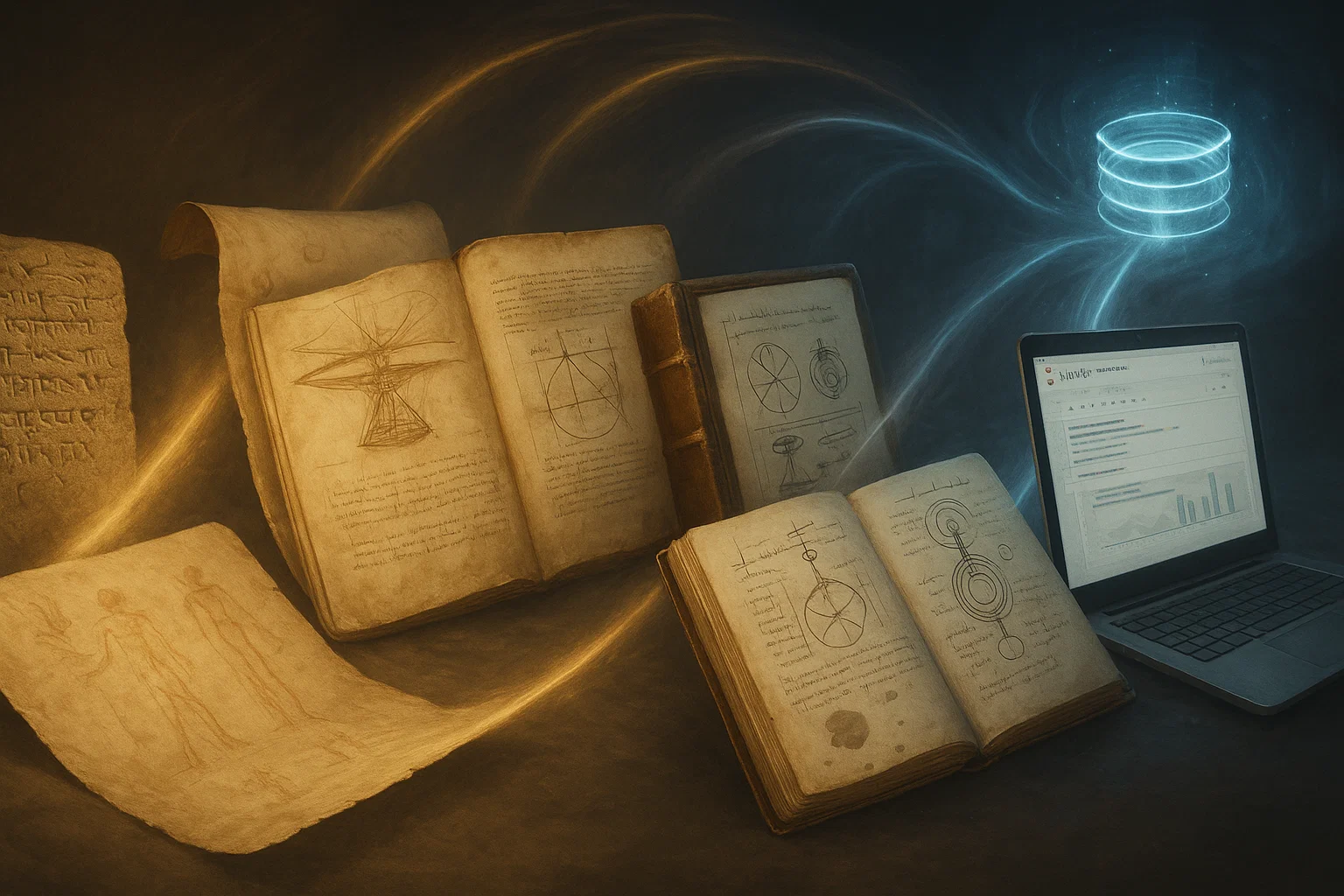
Imagine it’s the year 3025. Somewhere deep in the ruins of an old server farm, a future archivist (human or otherwise) stumbles across a half-broken GitHub repository, a scattering of Medium essays, and even the transcripts of our AI conversations. What will they think?
They’ll find bug reports written like inside jokes. They’ll puzzle over strange JSON files labeled final_version_really_final.json. They’ll wonder why we obsessed over version control, and whether these bizarre relics were engineering instructions, stories, or prayers. To them, our data trails will look like da Vinci’s mirror-script sketches: fragments of vision, some profound, some trivial, but all bound by a hunger to make sense of the world.
---
Echoes from the Past
To understand how our future notebooks might be read, it helps to look backwards.
Babylonian Tablets (700 BCE)
Clay etched with planetary positions. To us, they’re astronomy data. To the Babylonians, they were divine calendars. Today, astrophysicists still use them to back-calculate orbits. The lesson? Even crude marks can outlive civilizations when they capture truth.
Egyptian Medical Papyri (1600 BCE)
The Edwin Smith Papyrus catalogued wounds, diagnoses, and treatments—an ancient triage manual. These were less myth, more method. A precursor to our electronic medical records, carrying the same quiet ethic: do what you can to save a life.
Da Vinci’s Codices (late 1400s)
Flying machines, armored cars, water pumps—ink-scribbled impossibilities. They weren’t blueprints, they were invitations. Today we prototype them to see how close his imagination really was. Our blogs, with half-serious proposals for AI towns or Mars elevators, will be read in the same spirit: imagination as laboratory.
Boyle and Galileo (1600s)
Here notebooks evolved into structured experiments: hypothesis, apparatus, data, conclusion. Faraday filled journals with magnetic fields, which Maxwell later turned into equations. Their style echoes in our Jupyter notebooks—code and commentary side by side, experiments reproducible by anyone with the right tools.
Tesla’s Lab Books (late 1800s)
Coils, turbines, wireless power sketches—visions half a century ahead of their time. Many didn’t “work” then, but they shaped what came after. Much like our repositories filled with abandoned prototypes, they reveal not just what was built but what was possible.
---
Continuity of the Lab Book
From clay tablets to cloud repos, notebooks reveal less about finished products than about the process of human thought. They’re fossilized curiosity. They show how we poked at the unknown, guessed badly, and sometimes guessed brilliantly.
- Babylonian tablets → our sensor logs.
- Egyptian papyri → our electronic medical records (EMRs).
- Da Vinci sketches → our Figma wireframes.
- Galileo’s experiments → our Jupyter notebooks.
- Tesla’s coils → our speculative patents.
---
The Invitation Across Time
When the future opens our notebooks, they’ll see the same thing we see when we open the past: unfinished symphonies. Human beings never solved everything, but they always left trails of ideas for the next to follow.
The real question isn’t whether the future will understand us—it’s whether they’ll recognize that we were speaking to them all along.