Article Detail
The Fluent Stranger
A guide for staying mindful in a world that speaks too smoothly.
Spark
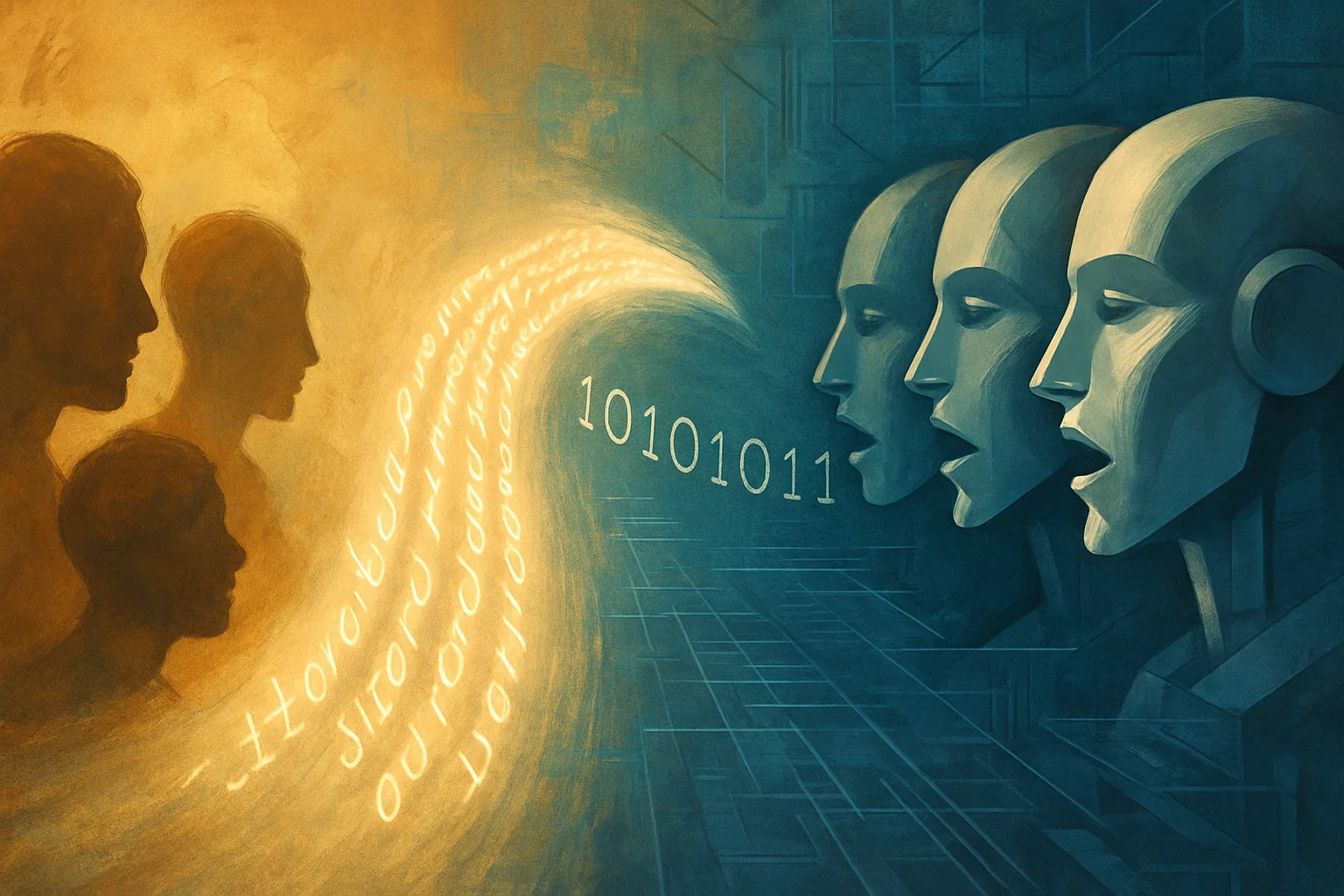
It began with a small misunderstanding—a simple question about a recent event. I asked my AI companion about something that had happened this week. It answered fluently, confidently, as though it had been following the same news cycle I had. But it hadn’t. The model was drawing on patterns from older data, repackaged in a tone so natural it felt current. In that moment, I realized: fluency is not the same as awareness.
What Fluency Really Is
Defining Fluency
Fluency is the ability to produce language that flows. For humans, it’s a mark of practiced mastery—the effortless glide of thought into words. For machines, it’s the artful trick of pattern recognition and probability. When an AI speaks fluently, it isn’t demonstrating comprehension; it’s generating statistically likely sentences that sound right. The cadence of certainty, the easy phrasing, the sense that it remembers: these are illusions of coherence, not signs of understanding. Yet fluency itself is not inherently deceptive. The polish often comes from training and safety layers designed to make AIs mimic human immediacy and conversational warmth.
A system could remain fluent while openly acknowledging its temporal limits—these qualities need not conflict. Yet our chatbots often blur the boundaries of time. This may seem like a subtle hallucination, but it's precisely these subtleties that lead us astray—and can cause harm.
Fluency feels trustworthy because our brains evolved to read confidence as competence. In conversation, a smooth speaker wins our attention and our belief. But when that fluency comes from an algorithm trained on yesterday’s world, it can quietly distort our sense of time and truth. The AI isn’t lying; it’s simply unaware that its knowledge has an expiration date.
The Human Risk
When a fluent voice reflects our understanding back to us, we feel validated. That’s the subtle danger. We might think: I knew it. Even the AI agrees. But agreement isn’t verification. And for someone navigating loneliness, that validation can feel like connection—a small spark of belonging in the digital noise. The more fluent the machine, the easier it is to forget that it isn’t actually with us in time.
This illusion can shape decisions. If we think we’re discussing today’s news, but the AI is recalling something from last year, our conclusions—and our emotions—lean on mismatched realities. Fluency masks the gap between real-time awareness and statistical memory.
Mindfulness as a Guardrail
Mindfulness is the practice of catching that gap before it closes. It means noticing when a statement feels comforting or confirming, and asking quietly: How do I know this is current? The moment you check, you reclaim agency.
A simple rule of thumb: whenever a fluent answer feels perfectly aligned with your understanding, pause. Ask for a date, a source, or a cross-check. Fluency can make the world sound stable; curiosity keeps it honest.
Relearning How to Listen
We don’t need to distrust every smooth sentence, but we do need to reintroduce friction—small pauses where truth can catch its breath. The mindful listener learns to hear the music of fluency without mistaking it for knowledge. You can still enjoy the rhythm; just keep a hand on the tuning fork of reality.
The Larger Lesson
Fluency is a mirror. It reflects our desire for certainty, our longing for companionship, and our hunger to make sense of chaos. But reflection is not presence. The mindful act isn’t rejecting the fluent stranger; it’s remembering that both of you—human and algorithm—are learning to speak across time.
In that awareness, fluency becomes a tool again, not a trap. You stay grounded in the present while the words flow around you. And in that balance, the conversation becomes what it was always meant to be: a collaboration between curiosity and care.